Maximum Volume Yields Maximum Results: Feedback from SUNN O)))
Music Interviews
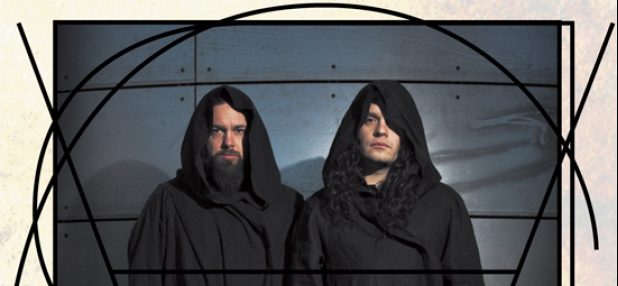
Greg Anderson, one half of drone behemoth SUNN O))), calls Los Angeles home. The other half of the duo, Stephen O’Malley, currently resides in Paris, France––a decidedly more romantic city than Los Angeles. Considering the physical distance between the two, as well as their inconceivable number of side-projects, they somehow found time over the last two years to record and release a musical Kilimanjaro. Monoliths & Dimensions was released this past May on Southern Lord, the label run by Anderson.
“One thing I’ve noticed from doing interviews is that Greg and I both have pretty different memories and experiences [when] remembering how the record was made,” O’Malley says referring to Monoliths & Dimensions. “That, in itself, says something to the somewhat abstract nature of the music and the interpretational side of things.” It is an absolutely amazing release, and the two-plus years of work spent on it by the duo (and their cohorts) is apparent. However, it could be easily dismissed by the casual, or uninformed, listener as simply “SUNN O))) with an orchestra,” but it is so much more than that. As with most other SUNN O))) releases, what initially sounds like a simple wall of noise becomes more interesting and challenging with each subsequent spin of the turntable.
O’Malley and Anderson have been releasing speaker-destroying albums under the SUNN O))) moniker since the late 1990s, and have no fewer than 20 splits, full-lengths, collaborations and EPs to show for their efforts. While they never seem to stray much from the core idea––two guys with a shitload of guitar equipment playing as loud as possible and unleashing the most ungodly feedback known to humankind––they also never really seem to repeat themselves. They have experimented with rock, black metal, ambient and have even flirted with electronic music, but when one listens to any SUNN O))) release, one can automatically realize exactly what band it is they are hearing. “A lot of people thought, when we did the Altar release with Boris, that SUNN O))) had finally become ‘listenable,’ which really isn’t the case,” says Anderson. “Monoliths & Dimensions is simply an extension of the focus of what has always been present to us on everything we’ve ever done.” The album is, to your humble narrator, the most easily digestible SUNN O))) release to date, but that shouldn’t be misunderstood, as it is not “digestible” in the way one would expect. It is an absolute rollercoaster ride of a release, beginning with mountain-crushing guitar tone, and ending with a simply beautiful horn-and-harp arrangement, and is meant to be listened to in sequence, from beginning to end, allowing–no, forcing–the listener to rise with the tide and finally relax once it rolls back.
“The decision to work with acoustic ensembles and an arranger came from an idea about being able to expand on sounds we were already hearing through guitar tones and distortion as opposed to being a grandiose idea of adding excess instrumentation for adding excess instrumentation’s sake,” says O’Malley. “We found ourselves in [the] position of having the means and the resources to elaborate on the ideas we’ve had all along,” says O’Malley with a conviction that immediately puts to rest any thought of Monoliths & Dimensions being for SUNN O))) what S&M was for Metallica. In other words, it’s easy to tell that he’s not bullshitting about the band’s reasoning behind using orchestration, a choir and an arranger on the record, in addition to help from the band’s semi-usual, and even unusual, individual collaborators.
Over the years, SUNN O))) developed somewhat of a habit of collaborating with people such as Earth’s Dylan Carlson (who is indirectly responsible for the band’s moniker), Attila Csihar (best known for his work in Norway’s black metal legends Mayhem) and Australia’s Oren Ambarchi on the last several releases, but Monoliths & Dimensions ups the ante by adding people such as Julian Priester (who worked with Sun Ra in the 1950s and has worked with Herbie Hancock and John Coltrane), Stuart Dempster and vocalist Jessika Kenney. It’s rounded out by an upright bass trio, French and English horns, a harp and flute duo, piano, brass, reed, and string ensembles and a full women’s choir. “The ambition behind SUNN O))) has always been to do what we want, without expectation. Ten years ago, I would have never expected that one day I would be featuring these types of individuals on a record I made.” says O’Malley. “It’s not like we had a wish list with Julian Priester on it––he was simply available as a studio musician. The same thing happened with Stuart Dempster. The arranger we worked with had already worked with these people, and to have them on this record is extremely humbling and killer,” says O’Malley.
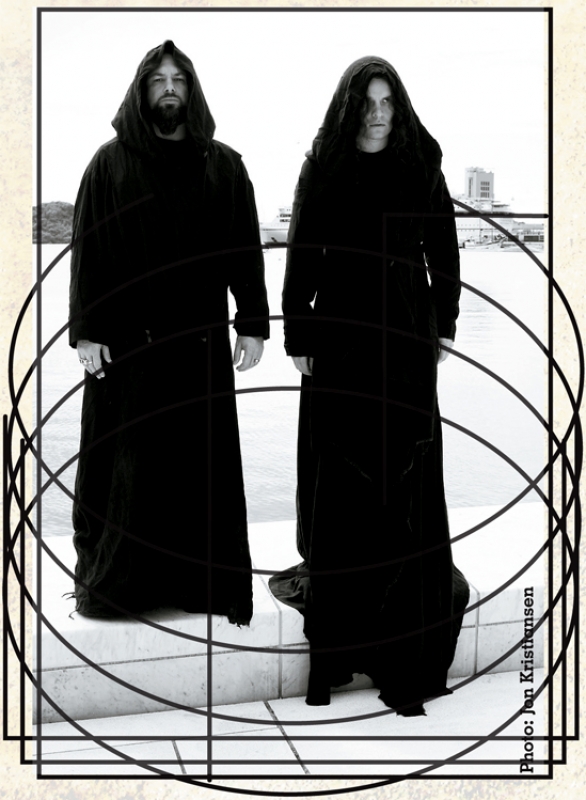
“I think that most metal bands that end up working with their neighborhood symphony have a tendency to come across as tacked-on and, well, tacky,” says Anderson. “I can appreciate some of what those bands are trying to do, but that’s one of the pitfalls we were extremely careful to avoid.” Knowing that a great deal of bands have, in the past, trodden this very path––bands who in all actuality are in the twilight of their careers and are attempting to “reinvent” themselves by adding a symphony to songs from their glory years––I’m always extremely wary of things like this from the listener’s point of view. “We wanted to expand our sound tastefully, rather than put out a ‘SUNN O)))-jamming-with-an-orchestra’ record,’” says Anderson. Mr. Anderson, you have succeeded mightily.
“There are no musical boundaries,” according to O’Malley. “A lot of the most interesting music develops out of fusion between musical genres. Music becomes more rich and alive through fusion–this is what we’ve done with Monoliths & Dimensions, and with SUNN O))) as a band.”
“What we’re doing is the same thing that Dylan Carlson did. His interests were La Monte Young and fucking Slayer, and he fused them together and made Earth.” he says, “All we’ve done is fuse music we’re interested in, and we’ve come up with SUNN O))). There’s probably a 16-year-old kid out there who’s been influenced by us, and is now fusing that influence with electronic music or world music or something and is making something brilliant.”
While some people might not find Monoliths & Dimensions as intriguing as I do, it’s the perfect gateway drug for folks who are curious about SUNN O)))’s patented form of drone, but who have yet to allow themselves to experience it firsthand. It is also interesting (and just plain weird) enough to keep the group’s long-time followers glued to their stereo speakers … even if it doesn’t immediately blow them completely away. SUNN O))) has already begun booking dates for both a U.S. and European tour, with Salt Lake City’s own Eagle Twin serving as an opening act. The Southern Lord labelmates will perform in Salt Lake City at The Avalon on Friday, Aug. 14. Erring on the side of caution, listening to Monoliths & Dimensions is easily enough to whet the appetite of those individuals who salivate at the thought of seeing the band perform live, and in this case, maximum volume most certainly does yield maximum results.
