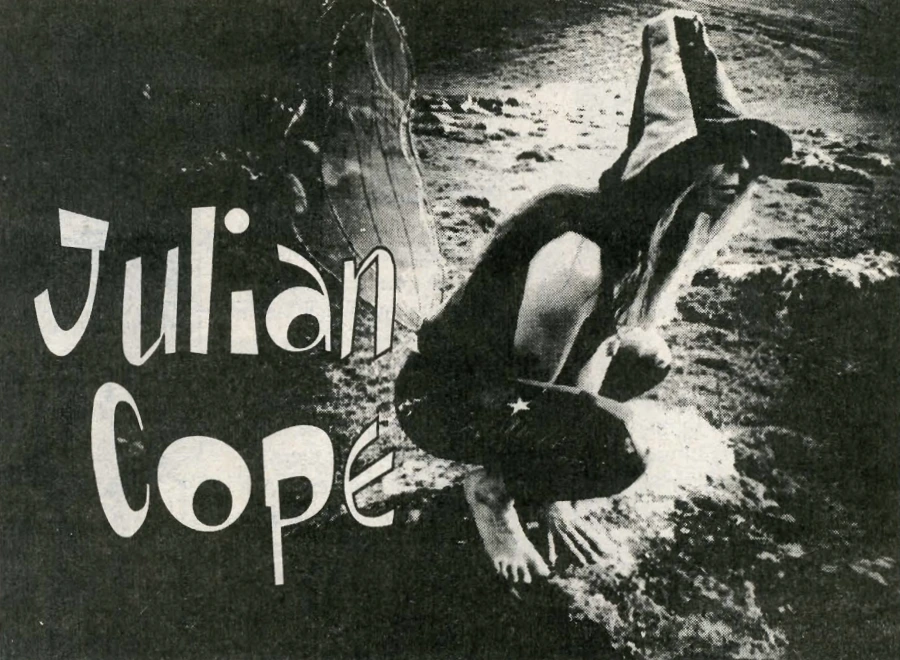
Julian Cope
Archived
Julian Cope is back again, a welcome intrusion into your mundane world. On his own Ma-Gog label he has, within the past two years, released Rite and Queen Elizabeth, two musical adventures into the cosmic beyond and has issued, through American, his latest epic, 20 Mothers. In another light, he has also written the first volume of his autobiography, Head-On and the history of German post-war music Krautrocksampler.
SLUG: Why did you write Head-On and feel it necessary for your story to be out in public circulation?
JC: Cause I realized that the people who make history are not the people who are there but the people who make it and then write about it. You can’t even leave it to other people to do it who are on your side ’cause they become fundamentalist about it and things get wrong. And I wanted to write it (Head-On) when I still had a firmly in my mind rather than write about it at 25 years. I thought that was important.
SLUG: Reading its introduction again, did you as you are now come about from the death of Pete de Freitas (Echo and the Bunnymen drummer killed June 14, 1989).
JC: Yes, I’m definitely an amalgam of myself and him but I wouldn’t say in what amounts … A huge percentage, and I know he affected other people the same sort of way but I don’t know if … other people have told me weird things happened but none, none of that has happened to me.
SLUG: When I finished reading the whole thing, I thought of the liner notes for “My Nation Underground,” your Nietzsche quote, “Battle ye not with monsters lest ye become a monster.” Did you feel that way, becoming what you most hated?
JC: Yes, I did, I took it on, I didn’t know. I was a neophyte orphan.
SLUG: Andy Eastwood once told me that Skellington or Droolian was done on a date, that you couldn’t produce an album in one day.
JC: Skellington was done in a day and a half. Droolian was done in two days but it was done in somebody’s living room, in Pam Young’s living room, just in Liverpool. She just vacated and went to London for two days and Donald (Ross Skinner) and I went and stayed in her flat and just recorded on what was there. It certainly has the ambiance of that front room, which was good. We mastered it off a C90.
SLUG: Droolian seemed to sort of exorcise you, because all the music after Droolian was markedly differently.
JC: Well, my, my kind of Pete vision, my Pete de Freitas vision happened during the recording of Droolian so I mean Droolian was only a two day session in any case. I think there was a lot of Pete’s ambiance in Pam’s living room. So I mean it kind of set the scene perfectly and it was a very de Freitas thing, but I think that’s what happened.
SLUG: What about the Queen Elizabeth and Rite albums, what made you do those sort of soundscape pieces?
JC: Because I think everybody is doing those kind of things now, because it’s right to be doing those things. I actually think I’m quite a harmonious artist in terms of what I’m doing, I would always prefer to be in harmony with what’s going on. I’m so rarely in harmony that I can’t complain when I am so, you know, in that case I would just be cantankerous for the sake of it, wouldn’t I, being out of step of the sake of being out of step.
SLUG: I heard that Rite was written as an album to have sex to?
JC: Yes, yeah, to have sex to and to actually meet the person to some on to, ’cause on a city dweller level you could really do that and get the whole dribbling out of the way in 17 minutes.
SLUG: Before we move on to the new album and book, do you think the past seventeen years have been worth it?
JC: Ohhhh yeahhhhhh, completely!
SLUG: No regrets?
JC: Shitloads! Loads and loads of errors, but they were all only tactical errors, so, it’s like Carl Jung said, “No one can drink the whole cup of life with one dignified swallow.” You’re allowed to have a couple of chokes.
SLUG: Why do you think you’re not as big as U2 by now?
JC: That’s pretty obvious I think, because what U2 does is do it the corporate way, they do what the corporation wished, wear everybody down ’till everybody knows that U2 is back. Whereas I’m just an artist, I can just slam it out, mines a holistic trip, you could put me in a coracle and send me off to some rock to make art but your could do that to any member of U2 and they wouldn’t make art, you know, they’d find a way back to the mainland. It’s the difference, it’s what Joseph Campbell said, it’s the difference between the celebrity and the hero. The celebrity does everything, will walk across tall buildings and dance on tightropes for his audience but the hero will do exactly the same things and would love to please his audience has all gone home, he’ll be doing it to please himself. T.S. Eliot said that all we can ask of our poets sit at home and muse poetically or artistically but they turn it into some kind of poetry or art that we can all enjoy and that’s what I do, and I reckon that I’m in the luckiest position of all.
SLUG: Have you always considered yourself an artist and not a musician then?
JC: Um, yeah, it has always been the bane of my existence that my passport says “musician” and not artist.
SLUG: 20 Mothers is a very parental album…
JC: Totally, it’s fuck everybody who doesn’t have a parental view, because I do.
SLUG: What do you think of the album as a whole, in comparison to your past material?
JC: I think it’s a cohesive fuck-off, a lot of songs to get into and I’d hate to have to review it. It’s unbalanced, which is what I’d aimed for (long pause). There’s not enough singles on it.
SLUG: Do you think lyrics are more important to a song, or must the music be the strong point?
JC: Oh, I think it’s the whole thing. I think you can have the greatest lyrics in the world and if it doesn’t have the best tune in the world it will suck. I mean if the music wasn’t important it would just be a poem. My lyrics, all the repetition is written in, I just, I just sing that song out, it’s the whole thing.
SLUG: What of some of the songs, The first single is “Try, Try, Try” and there’s no second? What about “Wheelbarrow Man”?
JC: Yeah! The thing is you see, with my songs, with everybody in the record companies, they always jump up and down when they first hear them, and then after a couple of days they all go back and they start conferring, and they all go, “well, you know, it’s just very melodic,” so, I figure that’s fair enough, I’m actually pleased that I’ve just got any kind of single at all.
SLUG: And how about a bit of background on “Greedhead Detector”?
JC: Um, it’s about the sublime and the ridiculous, the ridiculous being Sedgerick Brown who is kind of the king of the British Greed Heads who just makes an astronomical amount of money as the chairman of British Gas, which used to be a British company, owned by the people, and now is owned by a bunch of greed heads right at the top. And what it really says is, dancing on the flame outside the top of your head is what the mystic and what the enlightened soul aims for. What the king of the greed heads aims for his knighthood, from Queen Elizabeth, who’s a fucking inbred w****. Basically, they suck, we don’t.
So, verse one is listen to what happens if you follow the inbred w****. Verse two is “Your soul becomes degraded with control, the invade, the invader inside you, sneaks inside you, you are hypnotized to see nothing, feel nothing, know nothing that means anything at all, conditioned feed nothing, a big zero, but that circle is filled with light and love where she dances in the base of your soul,” and that means everything.
SLUG: Which goes back to “Paranormal In The West Country” on Autogeddon! Well, an interesting thing about your album as a whole is that they seem to want to play themselves.
JC: That’s cool man … well, you know, I spent a lot of time on them, you know. I don’t know if I can keep doing the huge double album thing but I’m doing to do as much as I can and I’m gonna just keep coming at different angles. The way I see it, I’m just gonna sustain and that way it will be proven that I mean it. Cause anybody can mouth off.
Read more from the SLUG archives:
Dishwalla
Film Review: The City of Lost Children
