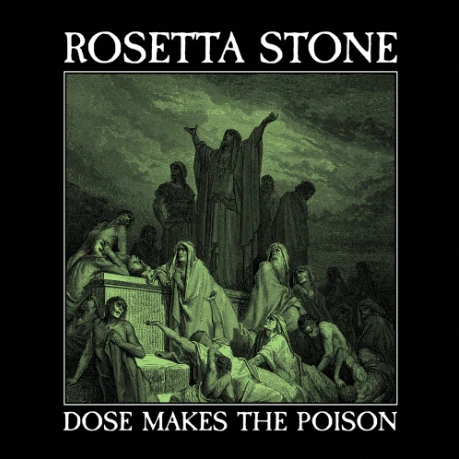
Review: Rosetta Stone — Dose Makes the Poison
Music
Rosetta Stone
Dose Makes the Poison
Cleopatra Records
Street: 08.08.2025
Rosetta Stone = Wayne Hussey – Sir. Thomas Malory + Che Guevara
Rosetta Stone, a duo consisting of bassist Karl North, guitarist/vocalist Porl King and a drum machine known as Madame Razor, rose to prominence in the early 1990s with a sound that updated the First and Last and Always era of The Sisters of Mercy with a nod to the more bombastic production values of The Sisters’ later recordings. By the mid-90s the band incorporated an industrial element into their songwriting that drew comparisons to Nine Inch Nails. In 1998, I considered them to be the most exciting band on the planet as they combined gothic, industrial and EDM to create a sound wholly their own.
In October of 1998, the band played their last show.
A handful of remixes, compilation appearances and an album of covers produced by King alone were released under the Rosetta Stone banner at the behest of their record label. North joined Dream Disciples and released two albums.
In 2005, King resurfaced as Miserylab, a new solo project that stripped away the layered production of Rosetta Stone in favor of a minimalist sound. Lyrically, King’s focus shifted to political, often class-focused topics. After a handful of self-released albums, King turned his attention in 2012 to In Death It Ends, a witch house project that brought back the electronic elements of late Rosetta Stone.
In 2019 Rosetta Stone made an unexpected return with Seems Like Forever, a selection of Miserylab songs remixed and refashioned by Jurgen Engler of Die Krupps. 2020 saw the release of Cryptology, the first batch of new Rosetta Stone material in 20 years. North was absent, and the arrangements, while not as sparse as the original Miserylab material, were still minimalistic when compared to their ‘90s material.
I imagine that there were many who found the new material to be a shocking departure. I suspect that those fans were equally perplexed by 2024’s Under the Weather. It would be like getting The Cure’s Seventeen Seconds when you were expecting to hear Pornography.
It’s like the woman I sat next to at a performance of Peter Brook’s adaption of the opera La Tragédie de Carmen. Brook believes that any open space can be a theater. His adaptation of the opera is paired back to its basics so that it could be staged anywhere, including a small village in Africa, or the rooftop of a high-rise building, at any time. Gone are the lavish costumes and ornate scenery. Brook’s aesthetic was completely at odds with the woman’s expectations. She wanted the pomp and circumstance. I loved the performance. She didn’t make it through the first act.
Dose Makes the Poison isn’t an empty stage. Far from it. “Drive Down Spiral” is dominated by a pinpricking string arrangement, complimentary guitar, and an that angry, desperate and anxious vocal that begs the listener to abandon their apathy.
“Connect the Dots” begins with throbbing bassline and an exotic guitar riff that gives way to the sort of punchy strings that accented the band’s early hits. It’s a hypnotic mix that has King’s vocal hitting directly one moment and swirling around the listener the next.
“Kick the Can” has a beautiful, ringing guitar line that Wayne Hussey would happily nick. You’d be forgiven if you expected the lyrics to be about mermaids, dragons or flowers and summer dresses, but King’s focus remains political. The words feel at odds with the music and I like the juxtaposition.
“Scars” pulls back the production to give the focus to King’s vocal. The song, a reflection on not fitting in and the lasting impact of being an outsider has had on King. It is, as far as I can recall, the first time King has directly reflected on his youth. Initially, it felt like a strange track to release as the album’s first single, particularly considering other options. It has grown on me considerably. The darkwave, gothic or whatever you choose to call the genre often comes with a sense of grandstanding that serves as a shield between the artist and their audience. There’s no barrier here.
I love the mystical sound of the phrase “Dose Makes the Poison.” How much inaction can a soul take before it becomes an infection? There’s a theatricality to this — a puzzle to solve and a foil to the vulnerability of “Scar.” This could have been released in 1985 and still sound fresh in 2025. The theme, sadly, endures. Whether Margaret Thatcher or Donald Trump, the sewage always runs downhill.
I’m tempted to call “Unfriended” a pop song. There’s a hook to the chorus that I’ve found myself involuntarily singing along with. Clearly a cautionary tale regarding social media, fame, and disappointment. It’s not exactly “Friday I’m in Love,” but a pop song, nonetheless. The deceptively simple structure frees up the guitar nicely.
The pace slows for “Ill Informed” as the subject matter returns to the realm of politics, and the focus is back on the vocal and the wordplay. It lacks the immediacy of the album’s opening tracks, but the guitar spirals upwards, inducing a hazy, dream state. By the time you realize it’s a nightmare, it’s too late.
“Another Exit Wave” is also sparse but picks up the pace ss the guitars shimmer and bounce beneath the vocal. King is doing some interesting things within the mix.
There’s a hint of chaos bubbling beneath the surface of “On Which We Die.” Whereas the song would have likely spun out of control in 1996, it remains completely contained in 2025. I miss the reckless nature of the past here for the first time.
“Dead to Me” is a haunting ballad that appears to deal with the abuse and neglect of young people. It’s the most melancholy track on the album, as it leaves me feeling off balance and unresolved. I’d argue that putting the listener in an uncomfortable, hopeless space would be a wonderful way to end the album.
King, however, closes the journey with “Source Neutral,” another atmospheric track that looks at the state of the world and begs the listener to stand up, leave the sideline and make a difference. It wraps up the album’s themes nicely. Back in the 1990s this album would have been all about the futility of our existence. In 2025, there’s almost a sense of hope.
Dose Makes the Poison is a strong release. It feels less burdened by the past and that frees King up to bring elements from the classic era and organically incorporate them into the present. The first half of the album is more active; the latter half is more hypnotic. It doesn’t scream out for the dance floor, but if you can dance to Nick Cave, You absolutely can dance to this! —Ryan Michael Painter
Read more reviews from music around the world:
Review: The Knee-Hi’s — Razzle Dazzle
Review: Tyler, The Creator — Don’t Tap The Glass
