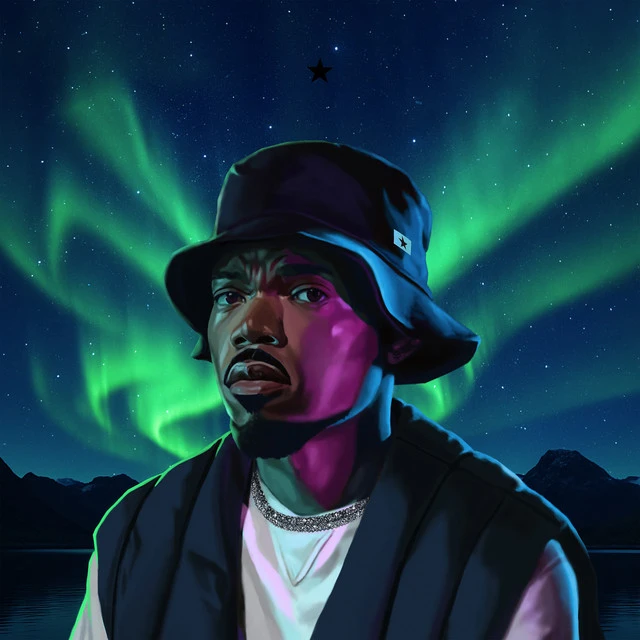
Review: Chance the Rapper — STAR LINE
Music
Chance the Rapper
STAR LINE
Self-Released
Street: 08.15.2025
Chance the Rapper = Lupe Fiasco + Eminem x smoking weed in the confessional
Chancelor Bennett, also known as Chance the Rapper, reminds avid listeners and detractors alike what he’s capable of molding the medium of rap into with STAR LINE, a comeback album that re-colors every crevice of his repertoire with a new and subtly diffused darkness. Themes of self-love, social consciousness and a back-home mentality are palpable across 17 tracks, as is the prophetic yarn-spinning that Chance has been known for since his first two mixtapes, 10 Day and Acid Rap.
Unlike 2013’s Acid Rap, a momentous achievement that demonstrated to the vampiric industry what independent artists are capable of — and encapsulated the youthfulness of the early days of SoundCloud — STAR LINE is not era-defining. It is, however, a near-total return to form for Chance, and is already being widely recognized for positing dual themes of hurt and healing.
Ever since his first official album, 2019’s The Big Day, an opus of marital bliss, Chance has largely been dismissed by gatekeepers of rap. The Big Day was an ultra-personal, overly ecstatic celebration of his marriage to then-wife Kirsten Corley Bennett, but critics, fans and salivating haters all denounced it as out of tune with the moment. It flopped critically and commercially, resulting in a cancelled tour and the widespread decrying of Chance’s ability to keep his finger on the collective pulse of hip-hop.
But movement in silence is still movement. After retreating from the limelight, Chance is reported to have taken several “transformative” voyages to Accra, Ghana. The title of the new album is inspired by the Black Star Line, a shipping and trading liner organized by Marcus Garvey in the 1920s. It traversed global waters to connect Black people everywhere and, like Chance’s new album, was a creative, cultural conversion point. Chance’s 2022 single “Child of God” features Ghanaian-American Moses Sumney and unofficially launched what fans are calling his “Star Line Gallery era”. Each of the singles released during this time, roughly 2021 to 2025, was accompanied by an original art piece commissioned by Chance, which were made and then translated into cover art. There are at least 10 singles in the series, some available only on SoundCloud or YouTube.
It’s important to view the album that was the culmination of this creatively productive period with context in mind. STAR LINE is a widely aimed announcement of Chance’s return to the rap game and a signal to his hometown that he never really left. On “Back To The Go,” featuring fellow Chicago-bred rapper Vic Mensa, one of Chance’s longest and closest collaborators, he raps, “Surprise! It’s the boy from the premature burial / Fresh off the boat with a story and a stereo.” The song also includes a redubbed version of Djo’s own ode to Chicago, “End of Beginning,” which plays slowed down and somber in the background.
The album’s production is diverse but generally purports a darker tone than The Big Day or 2016’s Coloring Book, the latter being a dedication to Chance’s firstborn daughter. Many of the tracks herald multiple creative contributors and producers and the varying sounds that result range from Chance’s Lion King-reminiscent, triumphant gospel, as on “Star Line Intro” and “Space & Time,” to the use of pulsing lasers that slide around the backdrop to “Ride.” Meanwhile, the boom-bap of “Drapetomania” is an unmistakable nod to Chicago drill.
The result is a Chance we haven’t heard from in a while, as he returns to certain quasi-political themes that were evident in his first two mixtapes. His lyrics take aim at corrupt police on “Drapetomania,” when he tauntingly raps, “Love 2Pac ’cause he shot two cops / I got a 9 millimeter called Thug Life / I got a new chain, it say: ‘FUCK ICE.’” Chance also goes for the jugular of corrupt megachurches on “Letters,” despite his all-too-advertised Christian identity. “Letters” is a mailed-in threat to the predominantly white and uber-wealthy power structures; those which pretend to represent the principles of fairness while worshipping false idols, making shady campaign donations and covering up devilish scandals to protect their coveted power. With gusto, Chance raps, “Dear mega church, I hope this letter finds you ‘fore I do.”
Growing up on the South side of Chicago, Chance is undoubtedly familiar with some of the consequences of this consolidation of power by a wealthy few. “No More Old Men” is about the rising mortality rate among young Black men, an issue that has grown exponentially worse in the last decade. On “The Negro Problem,” he says that it’s not a vacuum-sealed issue, either, singing, “My problem is your problem / Your problem is my problem.”
The album’s final few jams call to mind the type of soft cushion that Chance’s religion likely lends him. I’d be remiss if I didn’t say it made me feel jealous of him for having something like that to buoy himself with.
At the last song, Chance brings STAR LINE back to Earth, giving some of his most casually delivered but sincerest bars of the album with “Speed of Love.” It’s a reflection on life and lessons via his extended journey with the art form of hip-hop, and he raps, “The end of the day, man, the day gon’ end / But I always end up where the love don’t go / But if you look up, that star gon’ shine / I’m always in my glow.”
I think this is a version of Chance that hasn’t changed — he’s just returned. —Kyle Forbush
Read more national reviews from SLUG here:
Review: Reneé Rapp — BITE ME
Review: The Voidz — Męğż Øf Råm
