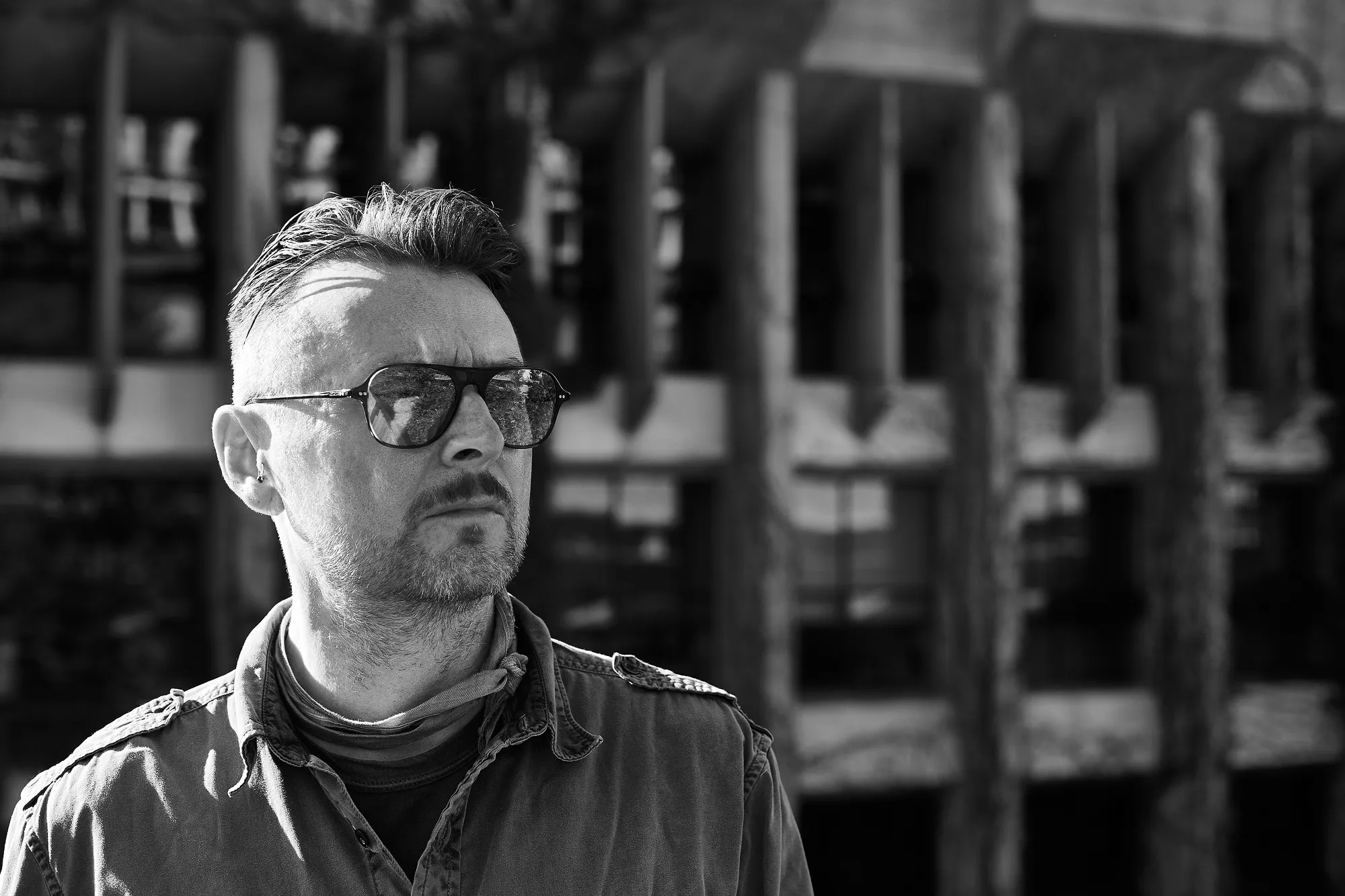
Imprint Response Machine: An Interview with Rhys Fulber
Music Interviews
With a career that stretches back nearly 40 years, Rhys Fulber is one of the most prolific and successful electronic musicians of his generation. Known primarily for his work with Bill Leeb in Front Line Assembly, Delerium and their numerous other side projects, Fulber has also worked as Conjure One and more recently under his own name.
His new release Memory Impulse Autonomy, his debut for Artoffact Records, sees Fulber looking to the future while returning to the sounds of his youth. Ahead of the album’s release, Fulber took a moment away from his busy schedule to talk with SLUG about the album’s inspirations and recording process.
SLUG: There were moments on your new album that took me back to 1990 when I was 14 and cleaned some of the classrooms of my middle school to earn money to buy music. I listened to a lot of Bauhaus Swing the Heartache, Skinny Puppy Cleanse Fold and Manipulate and songs I’d recorded from a local radio program called “Unrest on the Seventh Day” that played darker tracks that didn’t fit into the normal weekly programing. It was music that mixed well with the sound of an industrial vacuum cleaner. Were there particular artists and albums from your youth that served as inspiration for the new record?
Fulber: Well, the select top influences of my teenage years are intertwined in my current musical DNA, still so it just took a bit of a shake to bring them to the fore again. Cabaret Voltaire, Portion Control, Skinny Puppy’s Bites cassette (with the bonus tracks — my favorite material of theirs), Tangerine Dream. All of those artists helped shaped my style in electronic music.
SLUG: My introduction to your music would have come a few years later via the Third Mind record label. I loved In the Nursery and that led me to the Intermix records and Will. I knew Front Line Assembly, but they didn’t really click at the time. I think the metal aspects of Millennium didn’t work for me. You and Bill Leeb had so many projects; it was difficult to wrap my head around it all in the pre-internet days. When writing a song, is it clear in your head what project it is for?
Fulber: Yes, it’s always been a defined process. I do, however, constantly throw down quick jams into the studio computer or my laptop to revisit later and decide where they fit best, but once an album project starts, it’s a chosen path.
SLUG: With the new album, Memory Impulse Autonomy, you set out to rediscover the sounds and passion for making music that you had when you first started playing keyboards in the mid-80s. Had you lost the passion of your youth for music?
Fulber: I have never lost the passion for making music, but when you do it for a living there are many other factors that come into play and can enhance or impede the process (business elements or label politics, etc). I think I was just trying to get back to the carefree mentally of my youth when I didn’t think about any bigger picture and just had fun making music I wanted to hear.
SLUG: Did you revert to older equipment or was it more of a mindset?
Fulber: In a way, I did. I used some of the older equipment and methods, but still with modern recording techniques. A lot of younger artists want to recreate that era completely using step sequencers and tape machines, but they didn’t suffer through the hassle of that being the only option. If you start on a computer and revert to an older method, it’s exciting because it’s new for you, but it doesn’t quite work the other way. I had a conversation with Gary Numan about this once. He doesn’t want to touch a Minimoog ever again! However, it also depends on how you make music. I think a lot of my music first and loved the computer when it arrived, because I could translate thoughts into reality. When you would think [of] a part, then try tapping it in step by step on an old sequencer, you [would] end up pressing play and going, “Ummmmm… Okay, close enough!” At least that was my experience. I did use step sequencers on the record but it’s more for a specific thing. I couldn’t make a whole record with that kind of technology exclusively.
SLUG: For this album, did your years of experience help or get in the way?
Fulber: The experience absolutely, definitely helped. I am much better working with vocals now and also focusing on priorities, so the things I have learned over time enabled me to make a record I could only dream of back in those days, which was kind of the idea — to make my teenage dream album.
SLUG: Memory Impulse Autonomy is intended as both a nod to the past and a look to the future. The presence of newer artists like William Maybelline from Lebanon Hanover, Years of Denial’s Barkosina [Hanusova] and Konstantin Unwohl, keep the album from being purely nostalgic. You’ve worked with many different vocalists over the years — what was it about this trio that made you want to include them on this project?
Fulber: They were current artists that I thought were doing retro-ish music in a way I really liked. Capturing the spirit but with enough modern sensibility that it wasn’t just pastiche; they also developed their own personalities. William I came into via his Qual project (I mixed a couple of his tracks, he remixed one of mine), Barkosina I came to via Years of Denial (who remixed one of mine also and we share an agent) and Konstantin I discovered hearing a remix Ancient Methods did for him at a club, then finding out what the track I heard was. All three are very talented in their styles and it was a great compliment to the music.
SLUG: Were you tempted to reach out to vocalists who would have been active in the 1980s? Or would involving someone like Al Jourgensen or Nivek Ogre be too much of a distraction?
Fulber: It never really crossed my mind to try anything like that. I still wanted a current element to the record, and also big names like that would just eclipse everything the record was trying to achieve and possibly come off as disingenuous on my part. I saved that element for Steven R. Gilmore who provided the Nettwerk-era-like artwork.
SLUG: I’ve always marveled at your productivity. For most, the recording and touring with Front Line Assembly would be more than enough. Still, you find time to write and release solo records while also appearing with or producing other artists. Do you ever take time to step away?
Fulber: I just have a high motor when it comes to music. I am always playing around with something and [I] also need to stay sharp and always be learning. If I step away, it’s never for very long. Sometimes you hit a wall on something but after a couple days, I am usually good to go again. That being said, it takes a long time for me to hear my work objectively. I guess when you put everything into a project, it drains you, so after I finish an album, I am always one step away from trashing the whole thing. It takes about a year or two for me to say, “Okay, maybe this album doesn’t suck”.
SLUG: You’re currently on tour with FLA, do you know what comes next?
Fulber: There are tour dates like you said with FLA, a couple solo dates planned and as always production work in the pipeline. The cycle continues….
Memory Impulse Autonomy is available from Artoffact Records on Sept. 5.
Read more by Senior Staff Writer Ryan Michael Painter:
Clan of Xymox @ Metro Music Hall 08.18.2025
Review: Rosetta Stone — Dose Makes the Poison
