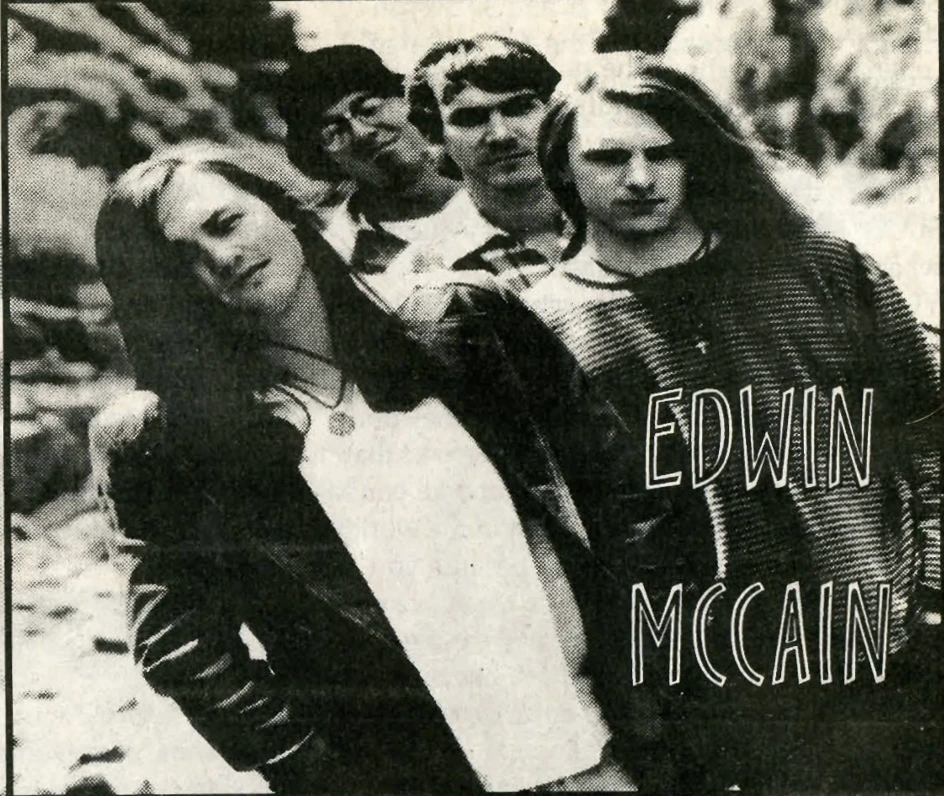
Edwin McCain
Archived
God, I’m such a whore! Here’s an interview with a guy that has Hootie & The Blowfish helping out on his CD! I don’t sit around listening to Edwin McCain or Jewel all day (I do listen to both) and I certainly don’t listen to Hootie & The Blowfish — ever. I kind of liked Edwin and his music before I talked to him. After talking to him on the phone I liked him even more. Then I met him and the guy is cool as can be. There are plenty of people who will buy his music, even if the typical SLUG reader doesn’t. So fuck you all.
SLUG: I have a few questions to ask you. I guess you’ll be here on the 19th with Jewel.
EM: Wait, let me guess the questions you’re going to ask me. Can I guess them?
SLUG: Sure.
EM: One of them, the easiest one, the most definite one I know that you are going to ask is how I know Hootie & The Blowfish?
SLUG: Nope.
EM: I didn’t guess that?
SLUG: Nope, I’m not going to ask that.
EM: Oh my god you’re the man.
SLUG: Cause I don’t care how you know them?
EM: You’re the man, you’re the man. I think we’re going to dedicate that entire show to you. I won’t guess anymore. Fire away, fire away at will.
SLUG: Okay, the first one is, is the story in your press release true, about your father’s nightmare? (Edwin’s father had a nightmare about his son becoming a rock and roll musician.) EM: Yeah, that’s the honest to God truth.
SLUG: So it seems like he was set on you going to college.
EM: Yep.
SLUG: And what were you supposed to become?
EM: Oh, I don’t think he had any set vocational options for me but I’m sure he would have liked me to be a doctor or lawyer or engineer or teacher or something. I don’t know. I have no idea. He never told me what he wanted me to be. Thank god because I would have definitely done the exact opposite. He told me what he didn’t want me to be which pretty much nailed it down.
SLUG: And that’s what you became.
EM: No, that’s what I always wanted to do.
SLUG: Here’s another one. Most of this is out of your press release. When you were working solo you say you played half covers and half originals, but the covers were songs people had never heard of?
EM: Yeah, pretty much.
SLUG: So what covers did you play?
EM: Oh, like at that time I was playing, that was before Seal was popular and I was playing his stuff, and I was playing Hendrix, like obscure Hendrix tunes, and…
SLUG: Acoustic?
EM: Yeah. If you listen to Jimi’s music, man, it translates really well to acoustic guitar. I mean I know that everybody gets lost in the fact that he was such a guitar wizard. His lyrics are incredible and his chord progressions are beautiful and they translate to the acoustic guitar really well.
SLUG: Maybe more so than someone trying to copy them electric.
EM: Oh yeah.
SLUG: Cause there’s a ton of people trying to be Hendrix on electric.
EM: That’s for sure.
SLUG: It says you were playing 11 shows a week and it says $100 per show, so you were making over $4,000 a month doing solo?
EM: I was doing pretty well. I don’t remember the exact figure. You figure some shows you make $300 a show playing 11 shows a week you can do pretty well for yourself.
SLUG: You had a nice comfortable job and now you’ve been on the road a while, do you ever think about returning to that comfortable job?
EM: No, because I think that when we stop striving to do better, to do something to challenge ourselves artistically or business wise or whatever, if I didn’t challenge myself I could still be sitting in a resort somewhere playing my gig like it was a job, but because of all the stuff we have tried to accomplish we got a whole great bunch of people together playing and having a ball and it’s wonderful.
SLUG: It’s a little bit strange to have someone, I don’t know, I guess maybe it’s just me but to have someone with an acoustic guitar leading the band and then you have those horns?
EM: Yeah, it’s great isn’t it? I love the horns.
SLUG: How did you come upon that idea?
EM: Well, Paul Fox and I got into that together.
SLUG: Was that when you started forming your band? You just started out with the horns and the keyboards, and…
EM: Well actually it started out with me and Craig Shields and a conga player so it was a like acoustic guitar, congas and saxophones.
SLUG: Really, no bass?
EM: No, and no drums.
SLUG: That was when you first started out. It sounds like an interesting band to see.
EM: It was great. It was a lot of fun.
SLUG: Now on your live show, your drummer studied African percussion and you’ve got some funk bass and you have the horns, when you play live, does the funk come out more?
EM: Definitely. It kind of runs the whole gamut. It crosses a lot of the musical lines. I mean what we’ve been writing lately varies from soft acoustic ballads to funkier rhythmic stuff.
Here’s a free plug for The Zephyr. Andrea, AJ, Sam and Charlie — you have all been more than kind to me on more than one occasion and I don’t forget. Edwin wanted to know about the venue.
SLUG: It’s a really nice club. The sound is beautiful. Great sound.
EM: Great, what’s the name of the place?
SLUG: The Zephyr, it’s called “the Zephyr Club.” Yeah, it’s a nice club. I get the impression you had a pretty normal childhood. Church choirs, you sang in music halls, graduated from high school and went to college. But then there’s a story of getting kicked out of college and then the songs on your album “Jesters, Dreamers and Thieves” and “Don’t Bring Me Down,” is there a bit of the devil in you?
EM: I think that there’s probably… I have an affinity for the fun side of… just the mischief of it all but nothing really truly to live by.
SLUG: You didn’t get in any trouble when you were growing up?
EM: Nothing really to speak of.
SLUG: Also in your press release, when you’re on tour, the last stop of the tour you get out of the van and you stay in the town?
EM: Yeah, usually, cause I don’t have a place I call home at all. I don’t have a place to live. Just kind of wherever we are, it’s where I’ll hang for a little while or go somewhere else and check it out.
SLUG: What kind of places have you stayed?
EM: Everywhere from Virginia Beach, Virginia, to Destin, Florida.
SLUG: Have you ever been out west?
EM: Yeah, I used to live in Vail, Colorado.
SLUG: You lived in Vail? For how long?
EM: For a season.
SLUG: For one season?
EM: Yeah, a whole ski season.
SLUG: So were you playing the clubs there?
EM: Yep.
SLUG: You weren’t a ski bum?
EM: Yeah, I was a ski bum.
SLUG: You were a ski bum. Let’s see, here’s the last question. It’s kind of a theme of the decline of America, a theme that runs through your songs a little. You seem to want… you see a need for change?
EM: Yeah, definitely.
SLUG: The people running the country now pretty much aren’t doing a very good job and they are the 60s people that had all that idealism when they started out. Do you think that when the young people grow up today, they can retain their idealism and actually make some changes?
EM: Well, I think idealism is just as useful as gasoline in a can. If it fuels the right machine it can be incredibly useful but it can also burn down your house. It’s part of the reason why we’re doing, next fall, we’re doing a benefit concert for a foundation that I’m setting up called the America Street Foundation and basically what we’ve done is gotten some of the Atlantic artists that we work with and we’re going to come down to Charleston and do an acoustic show and record it live and put out a CD and all the proceeds from that CD will got to help rebuild the sewer system in a section of town called, well it’s basically the section of town the street runs right through the middle and they call it America Street. The point is if you preach and never do anything about it then I think your words fall on deaf ears. But I think if you actually can put your money where your mouth is people can stand up and take note.
SLUG: You’re actually starting a foundation yourself to do that.
EM: Yeah, I’m putting together this show as we speak. I’m actually, in between your phone call and the next interview, working on that project.
SLUG: Who are some of the people you are going to have? Do you have any commitments?
EM: Yeah, Darius Rucker, Jewel, Frances Dunnery and I’m waiting to hear, I don’t know for sure if Dave Matthews is going to come or not. But I should know that pretty soon too.
SLUG: And your song “America Street,” that would be about the exact street that you’re going to repair. so you’re not all talk you’re actually doing something. That’s very cool.
That is Edwin McCain. Love his music or hate it, the guy is real. There isn’t any phony in him. I’ll take real over a whole string of cutting-edge bands preaching change while taking the money home to count in their mansion or shooting it in their arms until it’s time to make the next record and preach about change some more
Read more from the SLUG archives:
7 Year Bitch
The Afghan Whigs
