Film Review: One Battle After Another
Arts
One Battle After Another
Director: Paul Thomas Anderson
Ghoulard Film Company
In Theaters: 09.26.2025
“Comedy is easy. Tragedy… now that’s funny.” —Bender B. Rodriguez
Throughout history, periods of conflict and political upheaval have captured through art — whether in paintings, photography or music. One of the most distinctive and enduring of these art forms, in my view, is satire. Dr. Strangelove, M*A*S*H, and Three Kings portrayed war with sharp political wit and dark humor. While we may not be fighting a literal war today, the tension and division feel just as real. One Battle After Another is the film that speaks directly to this moment.
One Battle After Another introduces us to a radical leftist group known as the French 75. Two dedicated soldiers for the cause, lovers “Ghetto” Pat Calhoun (Leonardo DiCaprio, Titanic, The Revenant) and Perfidia Beverly Hills (Teyana Taylor, Coming 2 America, A Thousand To One) lead daring missions to free immigrants from detention centers and strike government targets. When the man tasked with stopping them, Colonel Steven J. Lockjaw (Sean Penn, Milk, Mystic River), becomes obsessed with Perfidia, this leads to a rather unexpected encounter between them.
Nine months later, Perfidia gives birth to a daughter, Charlene. She abandons her family to continue the fight, only to capture and coerce by Lockjaw into betraying her comrades. We flash forward sixteen years, and Pat has gone into hiding, living under the name Bob Ferguson.
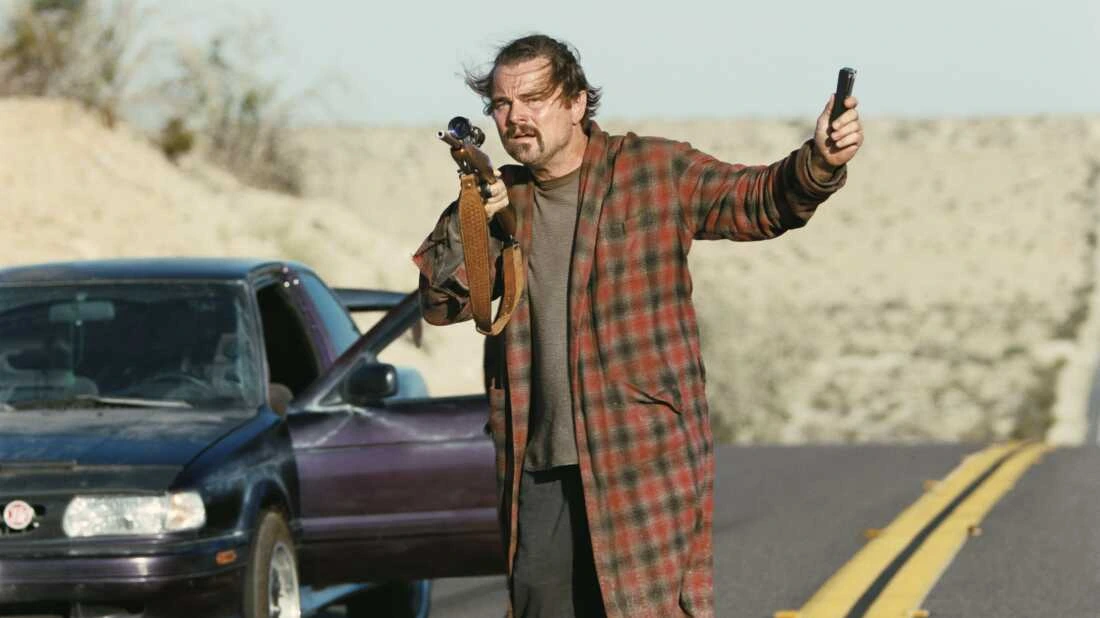
He has become a paranoid stoner and a single father, and he raises his teenage daughter, Willa (Chase Infiniti, Presumed Innocent), in the sanctuary city of Baktan Cross. Lockjaw, aligned with powerful white supremacists known as the Christmas Adventurer’s Club, sets out to find Bob and Willa. As raids and betrayals mount, Bob teams with Willa’s karate sensei, Sergio St. Carlos (Benicio Del Toro, Traffic, The Phoenician Scheme), an unofficial leader in the undocumented community, to find her and rescue her.
While it has a runtime of 2 hours and 42 minutes, One Battle After Another never drags. It remains one of the most expertly paced and involving films I’ve seen all year. Even with revered classics like Boogie Nights and There Will Be Blood to his name, it may well stand Paul Thomas Anderson’s masterpiece. Inspired by, but very loosely adapted from Thomas Pynchon’s 1990 novel Vineland, Anderson’s screenplay is a smart, edgy and often zany look at extremists clashing with extremists in a world of paranoia, confusion and violence.
One Battle After Another presents a unique portrait of individuals caught in an endless cycle of war. They find themselves long past the point of fighting for a cause and merely try to survive amid a sense of purpose and identity that has muddled to the point of being nearly gone. Through sharp dialogue and moments of absurdity, it questions whether persistence in the face of perpetual strife is a mark of strength or a symptom of despair.
At its core, the work critiques the ways institutions and societies normalize continuous struggle. Suggesting that the real cost of “one battle after another” lies in the gradual loss of humanity. It’s less of a story about winning or losing and more about the grind of just getting through another day. Anderson explores questions of the futility of war and the nature of heroism. In a cycle where resilience often feels pointless because when the same battles occur over and over again. The sharp dialogue has an absurdist quality that brings to mind the works of Joel and Ethan Coen. Seeing Bob’s descent from driven and fiery revolutionary to an even hazier version of The Dude from The Big Lebowski is as amusing as it is pathetic.
The Christmas Adventurer’s Club plays a mix of a bit of Coen Brothers, a bit of The Simpsons and a lot of the very kind of all too real people we’re seeing all over the internet evoking the name of Charlie Kirk as a call to arms. I don’t use the last comparison lightly, but when we’re living in a skewed, dystopian reality, it’s more than necessary to spot the most disturbing elements of farce that mirror reality.
There’s also some pointed and uncomfortable (but much needed) exploration of a certain kind of fetishizing of Black women by white men that is neither diversity or progress. It’s merely a niche form of racism and misogyny melded into a perfectly disgusting harmony.
Anderson’s ensemble is superb! DiCaprio’s driving the film with both the ferocious, dramatic intensity and flawless sense of comic timing that have made even his loudest detractors into admirers. Penn is riveting, disturbing and just plain weird, playing the swaggering Col. Lockjaw as something like what M*A*S*H’s Major Frank Burns would become in the talk radio and alt right podcast age.
Taylor makes a huge impression in a role that is likely to catapult to her stardom. Best of all, the aptly named Ininiti, captivates with an electric presence and raw talent point to a future career without boundaries. Del Toro isn’t given enough screen time but makes the most of every moment he’s given. He and DiCaprio make for a great understated comedy team.
One Battle After Another serves as an urgent wake up call, not so much as to where America is headed, but where many of us are just starting to realize it is right now. The movie brings to mind my favorite dialogue exchange from Raising Arizona:
“It’s a crazy, mixed up world we live in.”
“Someboy oughta sell tickets.”
“Shewt, I’d buy one.”
This is the must-see movie of the fall season right now, and quite possibly the one to beat on Oscar night. —Patrick Gibbs
Read more film reviews by Patrick Gibbs:
Film Review: Eleanor The Great
Film Review: The Baltimorons
