Film Review: Hedda
Art
Hedda
Director: Nia DaCosta
Orion Pictures, Plan B Entertainment, Amazon MGM Studios
Streaming on Amazon Prime: 10.29.2025
At the moment of writing this, there is no doubt that discourse about Guillermo Del Toro’s Frankenstein adaptation has already made the rounds online. Thoughts on changes, the spirit of the story, whether or not it is capable of standing on its own: all these questions come into play when someone takes a beloved classic and tells their own story with it. In fact, the conversation surrounding Frankenstein has been so loud that another adaptation of a definitive piece of literature seemed to slip past the vigilant eyes of movie viewers. Nia DaCosta’s Hedda is a decadent and enthralling surprise that only received a limited theatrical release before being quietly sent to streaming on Amazon Prime.
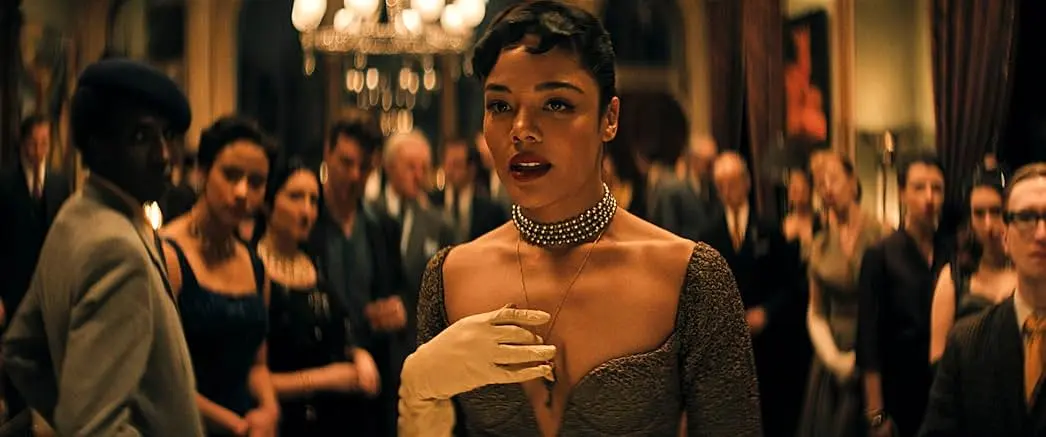
Adapted from Henrik Ibsen’s 1891 play, Hedda Gabler, the film follows the self-absorbed and manipulative titular character Hedda Tesman ńee Gabler (Tessa Thompson, Sorry to Bother You, Thor: Ragnarok) as she hosts an extravagant party for all her friends and her husband, George Tesman’s (Tom Bateman, Death on the Nile, Vanity Fair), colleagues in an attempt to secure him a professorship position and ensure their wealth. A small fray begins when one of Hedda’s old classmates, Thea Clifton (Imogen Poots, Green Room, Popstar: Never Stop Never Stopping), arrives at the party in search of Hedda’s old flame Eileen Lovborg (Nina Hoss, The White Masai, Tàr). From there, the perfectly planned night unravels into one of deceit and sabotage.
My interest in this movie piqued when I learned that DaCosta was the director. She is someone that I have kept my eye on since 2021, with her spiritual successor to the 1992 horror-classic, Candyman. A film that (for all its faults) was still a strong piece of work with a unique voice that dug into and examined the themes of the source material. And though her MCU outing was seen as a commercial failure (as it often is when they bring in dynamic independent directors and force their stories to fit into a patched-together overarching narrative), it did not diminish her prowess as a director. Here, DaCosta’s eye for visual storytelling is on full display.
Just like with Candyman, the changes DaCosta makes to the story have much more of an impact in making you understand Hedda’s plight. The decision to not only make Hedda a woman of color, but also change Eilert to Eileen adds so much more weight to the oppression Hedda faces and the self-made prison she finds herself in. There is an anger and resentment in having to deny herself the things she wants in order to enjoy a lavish lifestyle, which ends up becoming a force of destruction. It also just makes it fun to watch a character as self-serving as Hedda move the people around her like pawns because there is so much informing her identity and inner struggle.
Thompson herself is absolutely magnetic as Hedda. Her performance is the perfect cocktail of confidence, seductiveness and calculation with a hint of vulnerability and desperation to truly bring the whole thing together. The entire film hinges on Thompson’s performance and it gives new life to such an icon in the canon of egocentric, messy female main characters. In doing such a fantastic job, the entire cast is able to bring their best as they step into their roles. Hoss is excellent in delivering Lovborg’s struggle to resist as she seamlessly falls into a state of despair. You really feel the hold both Hedda and Lovborg have on each other in each scene they share.
The production design is opulent and grand, which is fitting if it’s going to be taking place in a mansion. The music is sparse and blends right into the scenes, but in the moments when tensions arise the creeping percussion is used to great effect in heightening the anxiety. The lighting was also something of interest, use of teal and gold throughout the party night juxtaposes nicely with the flat naturalistic lighting for the morning after. The warm gold could signify indulgence and celebration before the stark reality settles. I also enjoy the ways DaCosta plays with the camera, from using a fisheye lens to subtly distort the visuals to her shifts in focus. One moment that sticks out to me is the use of an amazing double dolly shot that shows us what Hedda is feeling in that moment without uttering a single word. This is what cinema is all about.
While the play unfolds over many days, the film condenses the story into a single night, elevating and hindering it in different ways. The decision allows for the tension to set in quicker, while at the same time, we end up getting introduced to various characters who we only get to scratch the surface of. It would be interesting to see how these characters deal with their day to day and know them on a deeper level. But this is Hedda’s story and clearly nothing, even attention, should be taken from her.
Hedda is an enthralling experience, especially for those who love to see captivating and self-serving female characters. It is a film that ultimately failed by a lack of marketing and being resigned to streaming prison. And isn’t that the great irony of a film about someone like Hedda Gabler, something so suited for greater heights, forced to quietly settle down in a rich yet hollow home? —Angela Garcia
Read more film reviews here:
Film Review: The Running Man
Film Review: Wicked: For Good
