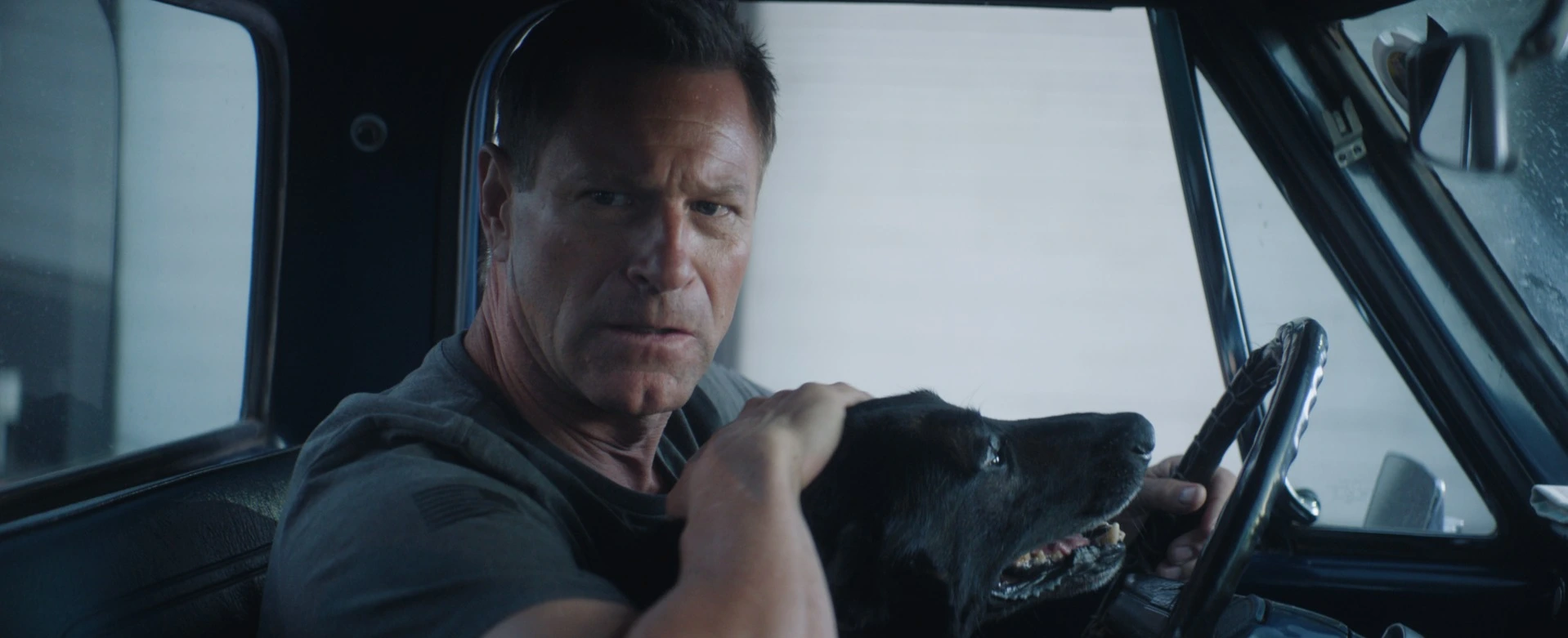
Aaron Eckhart Has Gone To The Dogs in Muzzle: City of Wolves
Arts
Aaron Eckhart Returns in Muzzle: City of Wolves
From Provo to Gotham City, the name Aaron Eckhart is one that is associated with a legacy of stellar acting and memorable storytelling. The Golden Globe-nominated actor graduated from Brigham Young University in 1994 with a BFA in film, and quickly went on to appear in the 1997 film In The Company of Men, written and directed by fellow BYU alumnus Neil LaBute. While Eckhart is perhaps best known to audiences for his stirring portrayal of Harvey Two Face in The Dark Knight, he’s given up bats for dogs. In 2023, Eckhart starred as officer Jake Rosser in Muzzle and he’s back now in the follow up, Muzzle: City of Wolves.
Aaron Eckhart on Becoming Jake Rosser Again
“Jake has all the skills, but also he has problems,” Eckhart says. In Muzzle: City of Wolves, director John Stalberg Jr. brings audiences back into the battered psyche of a combat veteran turned K-9 officer, who has tried — and ultimately failed — to outrun the ghosts of his past. Meanwhile, now living quietly with his family and his retired companion Socks, Jake hopes for a life built on routine, stability, and healing. But when a brutal gang targets them, his fragile calm shatters.
Forced back into a world he desperately wanted to leave behind, Jake partners with a new K-9, Argos, and plunges into a violent criminal network tied to corrupt officials and a dangerous drug-trafficking ring. As the danger closes in, Jake is pushed to confront not only the men hunting him, but the unresolved trauma and grief he’s spent years trying to bury. “These veterans, they have structure in their lives, and then they don’t have structure,” Eckhart says. “Jake’s trying to patch all this together. He’s trying to be a good cop, and yet he goes overboard.”
Balancing Emotional Depth and Physical Action
Eckhart explains that Jake’s struggle to reconcile the expectations of his life with the wounds he carries — both visible and invisible — give the character a depth he wanted to explore. “He’s trying to have a family, but he doesn’t know how to do it,” Eckhart says. “He never feels adequate enough; he’s getting hit on all sides. He can do nothing right. I really like that character but I think a lot of people feel that way, to try to do the right thing in life. He’s trying to have a family and have a wife and get a job and make things work. And he has a mortgage, and he has his own company, you know, but he just has a very, very hard time dealing with it. And he can’t seem to get away from his past … He has real human emotions. He’s not a superhero. He’s not an action figure.”
Even with the emotional demands, Eckhart says part of the appeal is physical. “I like doing action. I like being physical, you know, especially as I get older, staying in shape,” Eckhart says, adding that another perk of playing action-oriented roles in his late 50s is that he doesn’t have to memorize as many long monologues. “For In The Company of Men, I said too many words,” Eckhart says. “Now, I like to say less.”
Building a Real Bond with His K-9 Co-Stars
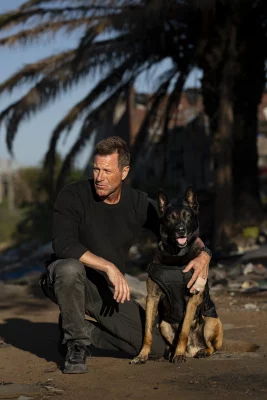
One of the defining aspects of Muzzle and its sequel is the dynamic between Jake and his dogs — first Socks, and now Argos. Building that relationship on screen required a very different approach this time.
“I went and visited the dog trainers and we laid it out on the line,” Eckhart says. “I said, ‘Listen, guys, I need you to teach me to teach the dog, but then I need you to go away. I need this dog to be mine. Nobody touches this dog. Nobody gives it a goo-goo ga-ga or gives the dogs treats –– but me, of course!’ The trainers can, because they’re with the dogs. But as soon as the dog came to set I would take them out of the cage and I would just be with them the whole day and, that way, the dog and I had a real relationship.”
That bond, Eckhart says, was essential — something he didn’t have during the first film’s shoot. “There’s two main dogs. In the first Muzzle, I didn’t have that relationship. The dog wranglers would not let me have that relationship,” Eckhart says. “In this one, it was much more rewarding. I commanded the dogs and the dogs listened to me. Just having a dog, especially a killer attack dog… These are malinois, leaned up against your leg. You’re doing the scene, and his head is just nuzzling into your leg. There’s no better feeling in the world. And I created that relationship.”
Influences from Classic Action Icons
Eckhart also acknowledges the cinematic legacy that shapes his performance, especially the influence of Clint Eastwood, who directed Eckhart starring alongside Tom Hanks in Sully in 2016. “Clint is the icon,” Eckhart says. “To this day, he owns the space. Do I consciously think of Clint? No. Am I affected by him? Absolutely… I just talked to John about this today: What do we love about Clint Eastwood? His economy with words. He’s this laconic hero who (and this is important) is playing by his own rules, and he also backs it up.”
He goes on to reflect on how action heroes have evolved and what they represent. “If you look at Dirty Harry, they’re not really action movies in the sense of what we believe an action movie is today. And you could say the same thing about Harrison Ford. There’s very little fighting in Harrison Ford movies, but yet he’s an action star. And so what is action? What constitutes action? I think it is this idea to bring overwhelming violence to an impossible problem.”
The actors he admires — Eastwood, Ford, Paul Newman, Steve McQueen — share a certain essence he hopes to channel. “They’ve never really found their next Steve McQueen,” Eckhart says. So, what is it exactly? “Again, it’s the economy of words. In other words, it’s saying everything with a look. It’s bringing overwhelming violence. It’s taking risks. I think if you can find a character that does that unapologetically, I think that you’re gonna find the essence of those characters.”
Final Thoughts on Muzzle: City of Wolves
With Muzzle: City of Wolves, Eckhart returns to a character defined by damage, duty and the instinct to protect — an echo of the stoic heroes who shaped him, yet distinctly human in his vulnerability.
Read more film interviews conducted by Patrick Gibbs:
James Badge Dale Is An Actor with Something To Say
Ross Syner and David Bradley on the Bond of Brothers
