Matthew Robinson on Writing Good Luck, Have Fun, Don’t Die
Arts
Matthew Robinson has built a career on ideas that sound deceptively simple that then spiral into something far more ambitious. From The Invention of Lying, the high-concept comedy he co-wrote and co-directed with Ricky Gervais, to the 2020 post-apocalyptic romantic comedy Love and Monsters to major studio projects that never quite materialized in the form first imagined, Robinson has consistently gravitated toward stories that use humor as a Trojan horse for big, unsettling questions. Good Luck, Have Fun, Don’t Die continues that tradition: a late-night diner, a ragtag group of strangers and a possibly unhinged man from the future warning of an artificial intelligence apocalypse that must be stopped before dawn. “It came from a few different ideas, it was a weird, labyrinthine writing process,” Robinson says. “The story very much sort of has its roots in anthology movies sort of like Creepshow or even Pulp Fiction, where there’s a bunch of different small stories that all weave together.”
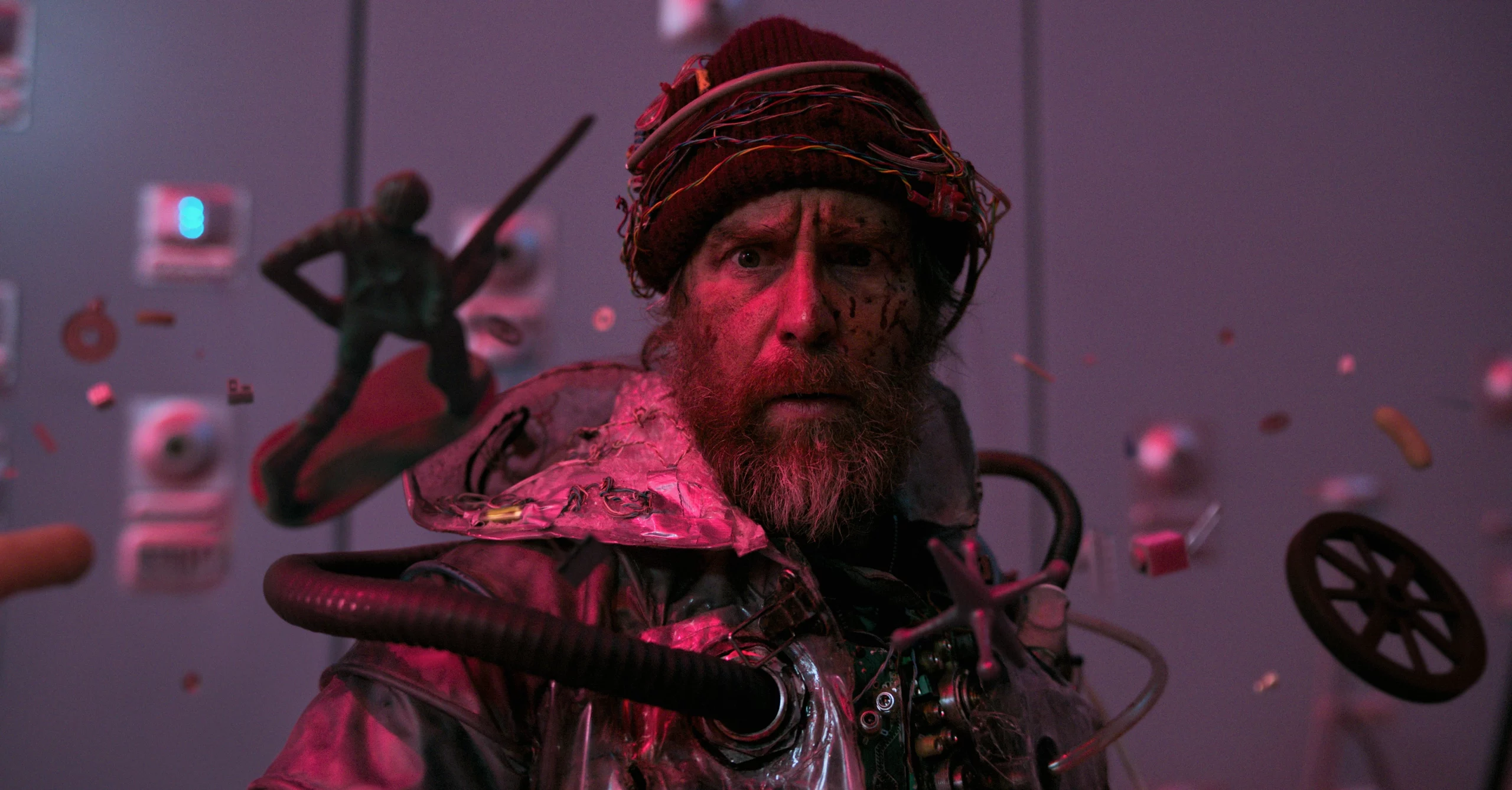
Robinson explains that the script didn’t begin as a single narrative at all, but as fragments — 20 pages of ideas he loved but couldn’t quite turn into standalone features. The breakthrough arrived not in a writers’ room, but at a Norm’s Diner, imagining what it would take for someone to burst in and jolt a roomful of strangers into paying attention. “That, to me, was a really fun, sort of jumping off point for something like Canterbury Tales,” Robinson says, describing the structure as “this one ongoing journey, where we sort of zoom in and get the origin stories of people on the journey, and then learn why they’re on the journey in the first place.” That journey begins when Sam Rockwell’s disheveled “Man From the Future” recruits an unlikely team that includes two high school teachers played by Michael Peña and Zazie Beetz, a grieving single mother portrayed by Juno Temple and a Wi-Fi-allergic princess-party entertainer played by Haley Lu Richardson. As they ricochet across Los Angeles over the course of one night, the film toggles between existential dread and screwball comedy, asking the audience to constantly reassess whether Rockwell’s character is a prophet or a crackpot.
For Robinson, threading those ideas together meant balancing dense science fiction concepts with characters sharp enough to keep the story buoyant. “I think it comes from my background in being an avid sci-fi reader and loving smart ideas told in an interesting way,” Robinson says, citing The Moon Is a Harsh Mistress and Isaac Asimov’s Foundation series. “Science fiction, to me, is full of a thousand great ideas, and all of them are told in a really interesting and fun way that all weave into the next great idea.” Robinson is drawn as much to the logic of speculative ideas as their implications, but he’s keenly aware that exposition can be deadly without the right tone. “The way to make that medicine go down and candy-coated is to do with comedy,” Robinson explains, and he loves letting his characters poke holes in each other’s theories, misunderstanding them or mocking them outright. Soon, the audience is learning while laughing. Robinson first finished the script nearly a decade ago, after reading Nick Bostrom’s 2014 nonfiction book Superintelligence: Paths, Dangers, Strategies. “It was a warning of how terrified we should be about the oncoming train of AI,” Robinson explains. “And to me, it was so terrifying that it was a comedy. There was no way that I could ingest this as reality.” At the time, AI felt like more of an abstract future problem; now it’s an everyday presence.
Robinson admits there were moments when the long road to production made him nervous. “Every year that went by the movie wasn’t getting made, I kept saying, ‘Guys, we need to do this quickly, or else this movie’s gonna feel extremely dated, like somebody screaming about a train that’s already hit them,’” Robinson says. Instead, the timing landed in a strange sweet spot, where audiences both understand and have normalized the very fears the film skewers.
The film is delightfully entertaining, and a good portion of the credit for that must go to Rockwell, an Oscar-winning actor (Three Billboards Outside Ebbing, Missouri) who is a favorite of Robinson’s. The writer freely admits that Rockwell was a key ingredient baked into the script from day one. “Since the day I wrote the script, people would ask, ‘who do you see in this role?’ And I’d say, ‘it’s a Sam Rockwell type,'” Robinson says. “He was the archetype, hands down, always.” Robinson insists he tries not to write with specific actors in mind, but this was an exception he couldn’t escape. When Rockwell finally came aboard, the experience surpassed expectations. “This was written for your speech patterns, for your rhythms,” Robinson told him. “And then just watching him do it ten times better than I could have ever imagined was a dream.”
That sense of collaboration extends behind the camera as well, particularly in Robinson’s admiration for director Gore Verbinski (Pirates of the Caribbean, Rango). “Directors are my heroes,” Robinson says without hesitation. “Some kids grow up, and they’re obsessed with basketball players or baseball players. I was a six-year-old obsessed with William Fuller and Sam Peckinpah.” For Robinson, writing is inseparable from the thrill of handing a script to a filmmaker he respects and watching it transform. “My favorite thing in the world is to write a script and get into the hands of a great director and watch the magic they do,” Robinson says, emphasizing that his joy comes as much from facilitating that process as from authorship itself.
Robinson is a writer-director who is less interested in directing himself than in making sure his films have great direction, and Good Luck, Have Fun, Don’t Die is a film less interested in providing tidy answers than in the messy, funny, human responses to looming catastrophe. It’s a movie about strangers forced into communion, about technology that promises connection while eroding it and about the thin line between genius insight and absolute madness. For Robinson, comedy isn’t an escape hatch from dark ideas — it’s a way in.
Read more film interviews by Senior Staff Writer Patrick Gibbs:
How Louis Paxton Came Into His Own with The Incomer
Why Cinematographer David McFarland Took a Shot on Bedford Park
