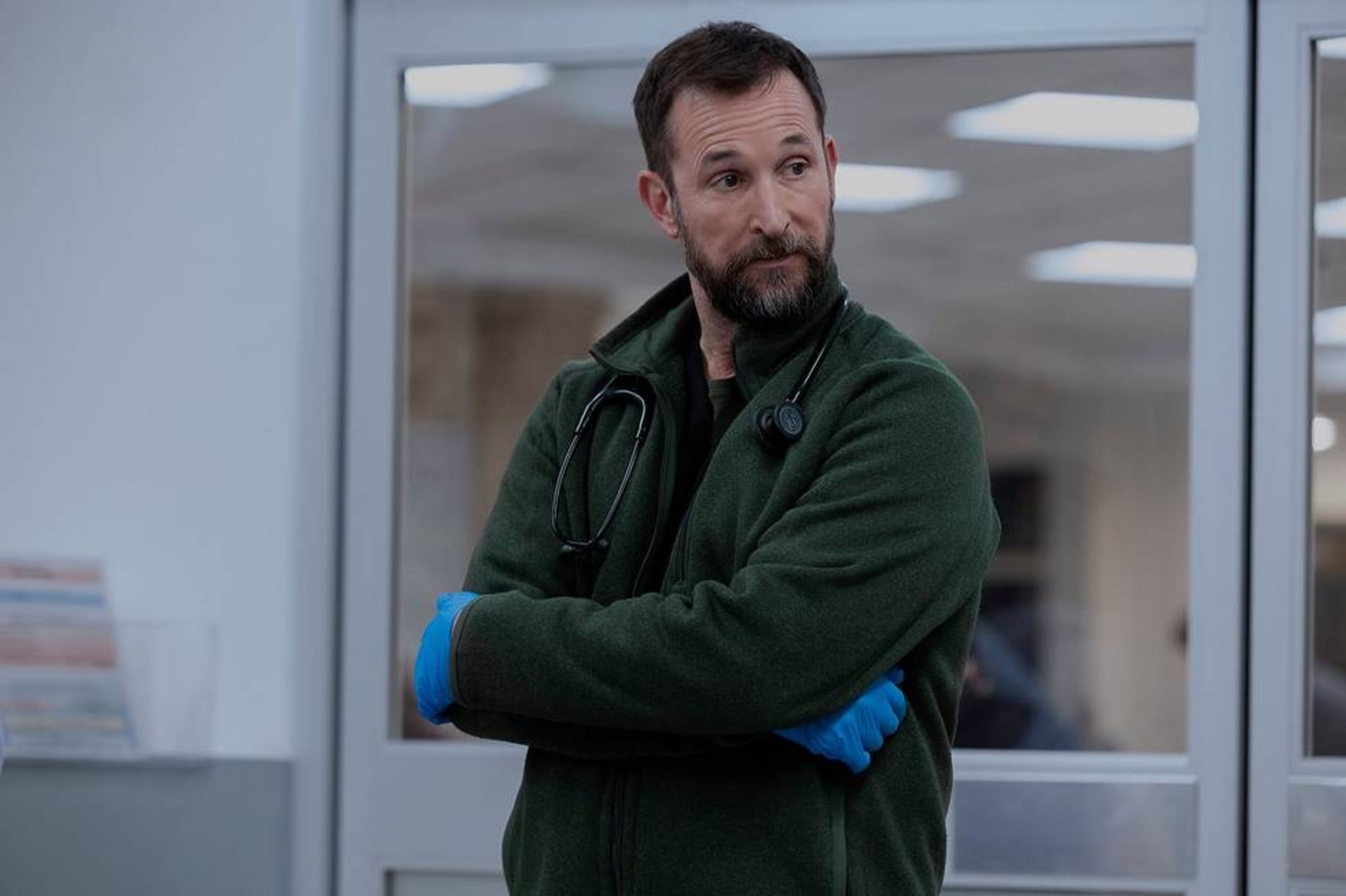
Noah Wyle’s Direct Approach to The Pitt Season Two
Arts
It’s fair to say that 2025 was at best a mixed year for many of us, though it was certainly a significant one for Noah Wyle, thanks to his HBO Max series The Pitt. The medical drama, which follows a 15-hour shift in a Pittsburgh emergency department in real time, emerged as a television phenomenon. The product of numerous healthcare professionals reaching out to the former ER star during and after the pandemic, eager to talk about the difficulties that they were facing, The Pitt season one exceeded all expectations. The show received five Emmys, two Golden Globes and three Critics Choice Awards, including a Best Lead Actor nod from each of these for Wyle, who stars as Dr. Michael “Robby” Robinavich. The second season kicked off on Jan. 8 with streaming ratings reaching over 900 million viewing minutes in a single week, and Wyle is wearing more hats than ever — he’s an actor, an executive producer, a writer and, for episode six, a director.
“For whatever reason, I’ve only ever really directed on shows that I’ve been in, so it’s something that I’ve become kind of comfortable with,” Wyle says. The former star of ER has directed episodes of Falling Skies, The Librarians and Leverage: Redemption, but this is his first time calling the shots on The Pitt. Wyle admits there are moments when the dual responsibility pulls at him in different directions. “I find that occasionally I would rather go to the director’s chair than my mark. I’d rather watch it than do it,” Wyle says. Directing, for Wyle, has become a central creative pursuit and important part of the evolution of his career. “Directing is something I’ve really fallen in love with over the last few years and in some ways seems like a natural progression to everything I’ve been doing in the last while,” Wyle says. “I love the opportunity to try to pull all those people into a singular sort of focus.” That sense of focus is especially critical on a show like The Pitt, where realism is the foundation and momentum is everything. Wyle describes directing as “the most collaborative job on set,” one that offers “the most education in all the different aspects of filming, from pre-production to casting to production to editing to scoring. “It’s a wonderful creative journey, and I love it, so I hope to do more of it,” Wyle says. “And it worked out well this year.”
Notably, Wyle chose not to direct during the first season — a decision rooted in humility rather than hesitation. “I didn’t want to do it in the first season; I didn’t want to Orson Welles my way through this and try to say this is a one-man show,” Wyle explains. “I wanted to make everything feel organic, like the storytelling, and so far, so good.” That patience paid off, allowing Wyle to focus on a career-best performance and for The Pitt to take shape. As season two starts on decidedly sure footing, Wyle venturing behind the camera feels like a natural expansion rather than a pivot. The long-haul nature of television also shapes how Wyle approaches both acting and directing. “It’s an interesting difference between making movies and doing a TV show,” Wyle explains. “The experience of doing a movie is so finite.” Television, by contrast, demands sustained precision. “It’s the aggregate of doing a TV show, of a five-day-a-week, 14-hour-a-day, nine-month-a-year commitment to basically create only 15 hours in a single day,” Wyle says. That grind is invisible when it’s done right. “You’re painting with such a fine brush, and you’re doing it over such a long period of time,” Wyle says. “The specifics of the scene work usually aren’t difficult if you’ve prepared properly. But the difficulty is in keeping your energy and focus over the long haul, so that when you watch these things, if you did watch them as a binger, you wouldn’t see that.”
In episode six, Robby and the rest of the staff are dealing with a loss, as Louie Cloverfield (Ernest Harden Jr., White Men Can’t Jump, Sweetwater), an unhoused patient who has frequented the ED for years due to severe alcohol-related issues, passes away. In the episode’s climactic sequence, Robby becomes the leader and father figure once again as he shares stories about Louie during an impromptu memorial. It’s a moment that personifies the overlap between Wyle’s off-camera role and his on-screen character. “I wear a lot of hats on the show. I am in a leadership position,” Wyle says. “So energetically, it’s not totally dissimilar to what Robby is doing in the emergency department.” That parallel helps ground his performance, and Wyle sees collaboration as the show’s greatest strength — and his own role as more facilitator than authority figure. “When you have the right people gathered together, one plus one equals three every day,” Wyle says. “Everybody’s coming in to try to bring their best game, and that inspires others to do the same and reinforces the commitment.” Wyle takes his position as an authority figure on set seriously, though he’s still reluctant to be seen as a one-man show or to place too much emphasis on his status. “I see myself more as a cheerleader than a leader,” Wyle says. “All I have to do is kind of keep the enthusiasm up and pitch out an idea, and everybody jumps on it like piranhas on a fresh piece of meat.”
The Pitt season two, episode six, premiered on Thursday, Feb. 12, on HBO Max, but there are still 14 more episodes to go! We’ll be following up with Wyle in March to discuss a crucial upcoming episode, which features perhaps the most powerful, controversial and timely storylines that the series has addressed to date.
Read more film interviews by Senior Staff Writer Patrick Gibbs:
Matthew Robinson on Writing Good Luck, Have Fun, Don’t Die
How Louis Paxton Came Into His Own with The Incomer
