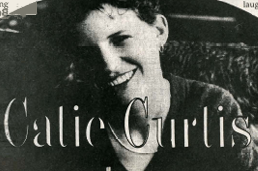
Catie Curtis
Archived
This piece on Catie Curtis is done in three parts. Some will spout off in Dear Dickheads that her music doesn’t belong in SLUG because it is “folk” music. The issue surrounding Curtis’ visit to Salt Lake City and some songs on her CD are relevant to anyone concerned about the tactics the ruling class of Utah uses to keep everyone else from having “free agency.”
First is a short phone interview I did with Curtis prior to her concert. The second portion is a review of the concert written by a friend of mine. As you will discover, my friend is a better writer than I am. Finally there are excerpts from a fax that the record label people sent two days after the concert.
Immediately on arriving in Salt Lake City, Catie Curtis recorded a song for a benefit compilation. She didn’t appear excited to talk about why she was here so instead we did the music thing.
SLUG: When you were in college, I guess you played basketball. Did you play any other sports besides basketball?
Curtis: Really just basketball. I was involved in coaching and I was a camp counselor at basketball camps. I was into sports education. I guess it got to the point where for me it was important to pursue the music instead.
SLUG: You were headed more to a career in education than playing professionally?”
Curtis: I was thinking about social work and education, but also in the back of my mind I wanted to do music. I didn’t know how I would be able to do it.
SLUG: Your first CD has a song you wrote about your experience as a social worker.
Curtis: ‘Hole In The Bucket.’ I worked for an agency that helped to keep elderly people safe at home. We kept losing our funding and sometimes what would happen as a result was that people weren’t really as able to live safely at home. They’d end up going to nursing homes. It was frustrating, because for a lot of them, they had a better quality of life at home. It was actually more cost effective to try to keep people safely at home. I guess it was like a day where I found out about more budget cuts that I came home and wrote that song. Sometimes, when things are cut out of budgets, it actually ends up costing taxpayers more money in the long run because, for full-time institutionalization, it’s really expensive for people on Medicaid.
Curtis appeared on the 12 o’clock news and Rod Decker interviewed her. He said “Radical” was a hit song and Curtis replied that it was doing pretty well. Curtis had this to say: “I thought the question of whether ‘Radical’ was doing well seemed to obscure the point of music in general and the concert itself.”
The state legislature was meeting in special session to quell the forces of the “radical” hordes. Meanwhile, Curtis was at the U Of U Fine Arts Auditorium, singing her song about lesbian love, aptly titled “Radical.” Curtis played to an auditorium filled with an audience as diverse as a rainbow flag. Her show was in support of the Lesbian-Gay Alliance at East High and the community came out in force to support the cause.
Fusing elements of folk, comedy and a little blues, Curtis delivered a light and entertaining form of pop-folk music. Her aw-shucks demeanor blended with the antics of her sidekick Jimmy Ryan, and his electric, left-handed mandolin, to produce not only great music but some good comedy as well. Her cover of Cosy Sheridan’s food and driving song had the audience rolling. She even added humor to a more serious song talking about her Dad, the pack-rat, and then launching into “Dad’s Yard,” showing her obvious love and respect for her father. (The person who wrote this was recently disowned by her family, especially her father, because she “came out” to them).
There is a serious side to Catie Curtis, which was shown through the song “The Wolf,” which talks about domestic abuse through the eyes of an eight year old. And of course “Radical,” which states that gay love isn’t a political issue, but comes from the heart: “I’m not being radical when I kiss you and I don’t love you to make a point.”
Curtis only gave the audience a single encore beginning with a new song written about Colorado. It was new enough that she didn’t have the lyrics or the key in which to play it quite down, although she did warn the audience ahead of time that she might mess the song up. She left with “Cry Fire,” a song about leaving and saying goodbye. Curtis’ performance was excellent both in the quality of her music and the entertainment factor. Her popularity is increasing and hopefully she’ll be back around soon.
Local artist Sweet Loretta opened the show with their blend of jazz, blues, rock, soul and funk all blended together harmoniously. It was clear to see why they are one of the hottest bands on the local scene. Their neurotic title song “Sweet Loretta” features a standing electric bass played with a bow, not to mention some of the most eerie and off-the-wall vocal harmonies I’ve ever heard. The song could easily have been the featured song on the 12 Monkeys soundtrack. Overall Curtis and Sweet Loretta put on a great show. If you missed this one, you fucked up because girlfriend rocked in her own folkish way. It just goes to show that if you want to hear great music, stay out of the sporting facilities and check out the small auditoriums and clubs because that’s where the true musicians play.
The event, held on the University of Utah campus, garnered nationwide attention with new updates airing on MTV News. Locally, the concert was covered by CBS, NBC and Fox television affiliates.
The faculty and students of East High have been at the center of national attention since March 19, when the local school board voted in favor of banning all non-curricular clubs from the district. The vote effectively dissolved the targeted gay student group on the East High campus, but its repercussions also took a toll on all other non-curricular clubs throughout the state. Next school year, Utah students will also lose such organizations as peer leadership groups, Kiwanis clubs, youth clubs, human-rights and environmental groups.
“I find the situation really unsettling,” says Curtis, a singer-songwriter known for exploring social issues in her music. “The fact that they would ban all these worthwhile youth clubs to get at the gay organization is so shortsighted, and not in the best interest of the students. I would have hoped, that by this point in time, people would have learned to tolerate differences in individuals.”
The fools have done it again. You cannot legislate morality. The more you try to ban free speech the more you become the laughing stock of the world. A law was passed banning gay-straight alliance clubs in Utah high schools while the concert was in progress. The law will be challenged in court and supposedly defending the law will cost taxpayers in the neighborhood of $1 million.
