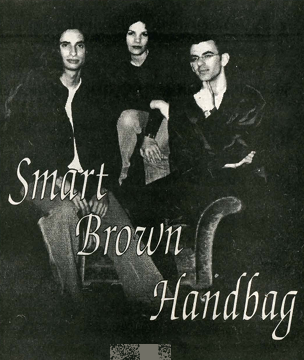
Smart Brown Handbag
Archived
Dave Steinhart has fronted this LA pop band for years, while also running the small independent label Stone Garden Records. Smart Brown Handbag is one of my favorite bands you may never have heard, and Stone Garden Records is one of my favorite labels, too. Both are original. Both are cool. You should check both out. I talked with Steinhart for about an hour, and when we weren’t way off the subject, here’s what was said:
SLUG: So what’s up with SBH?
DS: Not much. We just finished recording a record.
SLUG: What’s the new record called?
DS: We’re not exactly sure yet, ‘cause we just recorded 18 songs and we’re still in the process of figuring out who is going to release it.
SLUG: Between who, you mean?
DS: Meaning which label — we’re talking to labels.
SLUG: So it might not be with Stone Garden.
DS: It’s probably not going to be with Stone Garden.
SLUG: Why is that?
DS: Because I just think we’ve reached a point where we could probably be a little bit better exposed by somebody else helping us put up the money for the record. So it’s just time to try something different. You know Stone Garden’s my label. I’ve been doing it for a lot of years.
SLUG: You own Stone Garden?
DS: Yeah. So at this time, we haven’t released any records since 1984, and it’s getting harder and harder. The majors are buying everything, so that’s that. It’s produced by Michael Blum, who’s done everybody like Madonna, Pink Floyd, Infectious Grooves and people like. He did Red Cross. He’s working with this Permanent Green Light right now. Michael used to be in the band 3 o’clock, which reminds me of the Salvation Army many years ago. It’s an LA legend. And outside of that, we’re going to South by Southwest and playing a show there. We’ve been playing a ton; we played last night.
SLUG: So, how did Smart Brown Handbag come about?
DS: Pop Art broke up, after we released six records. I did a couple of solo albums, and then I just wanted to get into the band thing again. It initially started with my brother again and one of the girls who played keyboards in Pop Art, and we just started out.
SLUG: Are you doing most of the songwriting, though?
DS: I write all the songs. We just do that three-piece thing, which is fun.
SLUG: How did you come up with the name Smart Brown Handbag?
DS: My brother was carrying – used to carry – this bag around with him, and my girlfriend at the time used to constantly be saying, “Where’s my purse?” I made some sort of disparaging remark like, “Why do you carry that fucking purse?” and my girlfriend said, “It’s not a purse, it’s a smart brown handbag.” And I thought, ‘You know what, that would be a good name for a band.’ It’s innocuous, stupid and non-offensive, and I think those make the best bad names.
SLUG: You’re going to release this aIbum when?
DS: We’re hoping it will be released sometime like September or so, and then again, the hope would be to get on tour for a bit and see what happens.
SLUG: How is it having a label and trying to be in a band at the same time?
DS: It’s interesting. In a way, it’s a real advantage for both your band and for the label. Because on a label level, a lot of the bands know that you know where they are coming from, and they kind of trust you a little bit more from a band standpoint. You play with all your friends, and you play with all these bands that you like. So it’s a good thing. It only becomes a bad thing when you’re trying to actually fund something, and you realize you’re an independent label, which is a really sucky feeling.
SLUG: Yeah, Sony’s got all the money.
DS: Yeah, exactly. But I really think the two things mix pretty well.
SLUG: Plus, you don’t have to put up with all that big record company crap about going through people and this, that and the other.
DS: It’s really interesting for us because my whole career, I’ve never wanted a record deal. I always felt like we could find ways to get the money to get our records out, and that’s what we’ve done. The record we recorded is my 11th record. So, it’s always been the way, and we’ve finally reached a point where now we’re doing the attorney thing, and it’s very different, but I’m just doing it ‘cause it’s the only thing I haven’t done yet. And so I’m just going to try it and see what happens.
SLUG: So, when did Stone Garden become a label in reality?
DS: 1984.
SLUG: So in the early 80s, you were just releasing records?
DS: The other thing is we never really made any money on any of them. It was one of those things where if we could sell 2,000 records and break even or get some licensing deals and get some of these bands to move on — which a lot of the bands did move to bigger labels — then we just felt like we were doing our job.
SLUG: You try and stay in the pop vein pretty much?
DS: I do. We try and consider it like sloppy pop, guitar pop. We are actually the poppiest thing that we release. Yeah, definitely it’s what I like. I don’t think there are too many more indie, punk or more abrasive labels that are needed. I don’t think that anybody is doing the kind of thing we do. Very few people do guitar pop bands, and it is tough on an independent level for guitar pop bands because either you’re going to become like REM or the Gin Blossoms, or forget it, you’re not going to get a record out. So that’s where we try to fall in.
SLUG: There are obviously some pretty heavy pop influences in your songwriting. So who are they?
DS: It started out with The Beatles: Beatles, Beatles, Beatles. And you know, moved on to everything from Elvis Costello and Paul Weller and Jam, and I’m a big Lloyd Cole, big Prefab Sprout fan.
SLUG: Any Replacements stuff?
DS: I love the Replacements. I’ve always been a huge Westerberg fan. I really like all that kind of stuff, like Sebado. Melody’s important for me, and lyrics are important for me. As long as you keep the sugar value pretty low, I’m probably going to be into it.
SLUG: You can only discuss pop music for so long before somebody says, “But then there were the Beatles,” and then you lose that argument immediately. What bigger statement for pop music could there possibly be?
DS: Those are the greatest records in the world, and I think from my standpoint, I’ve never felt like I wanted to rewrite the history of pop music or never even felt that I was particularly an innovator in that way. But I always felt that a great, well-written pop song or something that’s lyrically effective is just a good thing to have. People appreciate it.
