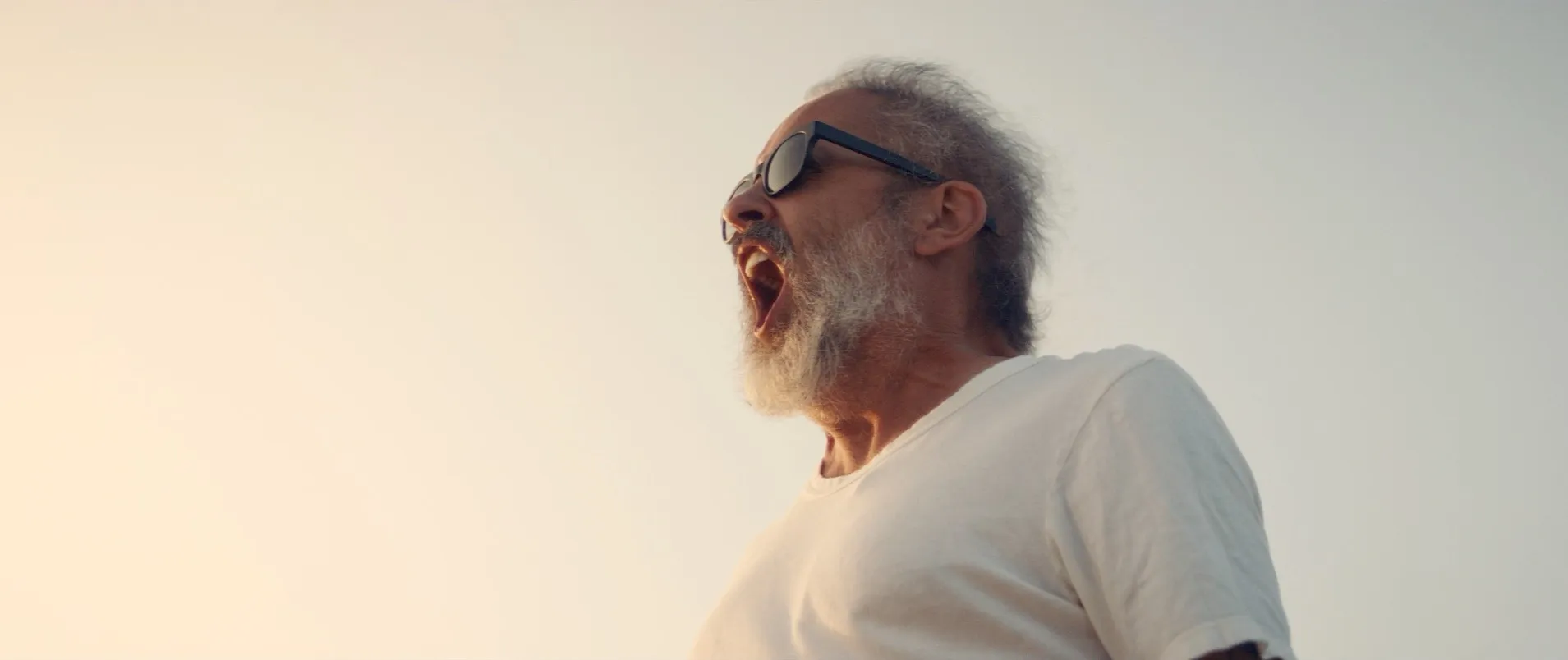
Tony Benna and Lee Einhorn on André Is an Idiot
Arts
The title André Is an Idiot sounds like it could be a lowbrow comedy starring Sacha Baron Cohen, but it’s actually a documentary that follows the final chapter in the life of advertising creative André Ricciardi, who, after skipping a colonoscopy, is diagnosed with terminal cancer — and decides to document the experience with humor and honesty. Premiering at Sundance Film Festival 2025, the film won the Audience Award for the US Documentary category and landed a limited theatrical release in the United States through A24. For director Tony Benna and executive-produced by Lee Einhorn, André Is an Idiot is a personal story about their friend’s refusal to sanitize anything.
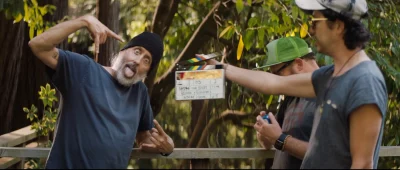
“I hadn’t talked to André in probably five years,” Benna says. As a commercial director turned indie filmmaker, Benna had worked with Einhorn and Ricciardi in the advertising industry, and was well acquainted with Ricciardi’s offbeat sense of humor, but was in no way prepared for the biggest and most macabre joke of all. “I got an email from André and Lee, and they just said, ‘We’ve got a fun project, let’s get on Zoom.’ I jumped on a Zoom, and André and Lee were sitting there, and they both looked very excited. André jumped in and said, ‘You’re gonna love this. I’ve got a stage four cancer, and we want you to make a comedy film about it.’” Benna initially thought it was a joke, but when he realized his friends were serious, he had a lot to take in, asking for a week just to properly digest the news of Ricciardi’s diagnosis before committing to making the film.
Benna quickly decided it was a movie he had to make, but describes it as a balancing act from day one. “I think I knew we knew from the beginning that that line of comedy and tragedy was gonna be a really tough tightrope to walk: knowing that cancer is not funny, but André is one of the most hilarious and brilliant people you ever meet,” Benna says. “We figured we had a great subject, and in the end, the film isn’t about cancer — it’s about André. He just sort of happened to have cancer while we were filming it.” Einhorn agrees, emphasizing that the tonal shifts audiences experience are not constructed so much as captured. “It’s very much André,” Einhorn says. “The way Tony handled that is like, André was loud and hysterical and then deeply thoughtful seconds later. And I think that rollercoaster that you see in the film very much was the plan from the beginning. It was very much just being true to who he was as a human and a writer and everything.”
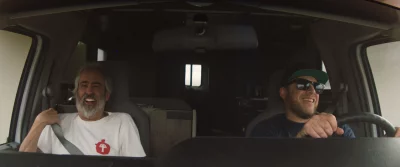
That authenticity is perhaps most evident in one small sequence, as André buys his best friend Eingorn a slice of pizza and pledges that “even in death, I will buy you pizza.” It’s a sincere moment that lands somewhere between cute absurdity and existential connection. “I’m still fucking waiting,” Einhorn laughs. “It’s really not fair. He said he was gonna figure it out, and he hasn’t figured that out yet… We’re in New York today, and I am gonna go to what I know was his favorite pizza place, which is Scarr’s Pizza on the Lower East Side. If I get there today and my pizza is paid for, then maybe, you know, maybe it finally happened.” Einhorn has a soft spot for this sequence, which is even referenced on the poster with the image of a skeletal hand holding a slice of pizza. “That scene in New York, of us kind of walking around and being there, is one of the most important to me,” Einhorn says. “That was the kind of stuff we would say to each other as friends.” It’s in that space — where jokes collide with mortality — that the film finds its identity.
Even the visual language reflects that philosophy. Benna explains how the stop-motion animation emerged as both a creative and practical solution. “Stop motion was an idea that came up probably midway through the film. We knew that we weren’t gonna be doing any sort of medical animations or anything like that, because it was too sciencey, and we weren’t really focused on that kind of thing.” Benna adds that the animation allowed the film to embrace André’s darker humor without overwhelming the audience. “A lot of the subjects that André would talk about in the interviews, they were kind of gallows humor and things that you really couldn’t show with a real human,” Benna says. “If you put a puppet through 10 ways to die or 10 ways to dispose of your body, it really becomes humorous and digestible for the audience. It was a way to get some of André’s darker jokes into the film.” That sensibility extends to one of Ricciardi’s most bizarre and oddly profound concepts: that instead of science, he wanted to donate his body to show business. Benna sees the film itself as a fulfillment of that wish. “I would say, in a way, with this film, he did donate his body to show business,” Benna says.
That idea — choice, even in the face of the inevitable — lingers long after the laughter subsides. André Is an Idiot may begin with a provocative title and a dark premise, but what Benna and Einhorn ultimately deliver is something far more human: a portrait of a man determined to be himself, even at the very end.
Read more film interviews conducted by Patrick Gibbs:
The Pitt Cast on ICE
Cinematographer James Whitaker Talks DTF St. Louis
