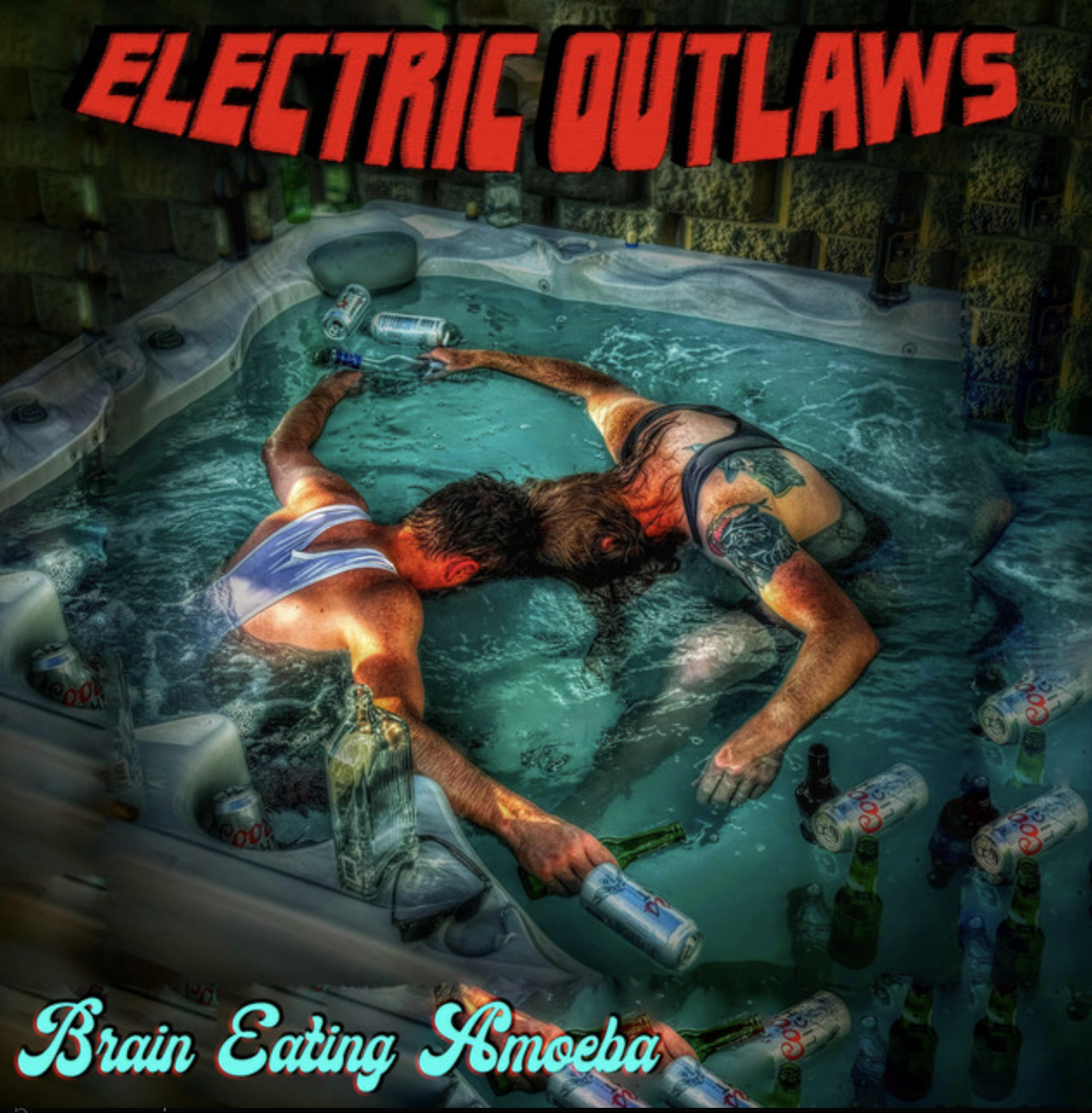
Local Review: Electric Outlaws — Brain Eating Amoeba
Local Music Reviews
Electric Outlaws
Brain Eating Amoeba
Me Likey Records
Street: 03.12.2025
Electric Outlaws = “Weird Al” Yankovic + DEVO
There’s a large sect of elitists in the electronic music community that insist on the use of “analog” synthesizers. These are synthesizers that produce waveforms and filter signals using purpose-built circuitry. “Digital” synthesizers, on the other hand, use computers and integrated circuits to create waveforms. While there is something to be said about the arguments for “analog” synthesis, and against “digital” synthesis, synthesizer technology has advanced so far in the last two decades that any difference between a modern “analog” or “digital” synthesizer signal is negligible at best. It’s that same sort of argument that has plagued audiophile circles, endlessly debating whether “My tape is objectively better sounding than your CD” as opposed to actually listening to music and enjoying it.
That being said, Electric Outlaws’ debut record Brain Eating Amoeba is “uncompromisingly” digital-sounding. Its general MIDI soundscapes sound straight out of 1998. When my editor initially assigned this record to me, he described the duo of Logan Barnes as “absurdist rock,” an assessment I have come to staunchly disagree with over the last week. Do not go into this record expecting guitars, or any relation to Albert Camus. This record is unadulterated Cocaine-Cardio Synthwave.
It has it all: the Roland TR drums, the fart-synth basslines, the cheesy ’80s FM synthesis bells, the violently MIDI brass samples, and a vocalist who sounds like a circus ringleader — the maraschino cherry on top of the ambrosia salad that is this record. All the duo needs to do now is undergo the intense and equally arduous surgical procedures necessary to graft their heads onto potatoes (See Oh No! It’s Devo). Its cold, heavily polished digital synthesizer and MIDI samples are in stark contrast to the satirical lyrics, which range from discussions of alcohol and sexual deviancy to bacteria and whatever a “Butter Boi” is.
Take for instance, the opening track “Strong 9,” a high-speed, transit-laden ode to Japanese booze. The titular beverage has actually been recently banned in Japan, if that gives you any idea as to the quality of the drink, but these guys seem to really like it, mentioning the drink 25 times in the song’s 3:15 runtime. Immediately following is “ProcrastiRAT,” a song describing procrastination as a metaphysical rat in the narrator’s brain. The duo’s cover of “Pink Elephants” from the Dumbo soundtrack is the best track here in my opinion. Their cold MIDI-synthesis sound works very well for the haunting trippy-ness of the original song. I’d argue it’s on par, if not better than the original track. I do genuinely believe that Brandon’s singing voice is great for this kind of music. Electronic music is not well known for its vocalists; artists like Kraftwerk or Aphex Twin are not exactly thought of fondly for their ability to sing, but this “works” here.
That isn’t to say the record doesn’t have issues. I recall a turn of phrase from a math professor of mine when discussing music; how techno/electronic music is driving and stimulating through drum patterns and beats, but lacks substance much further than that, and grows boring and repetitive after a while. Classical music on the other hand suffers from the opposite problem, where it’s moving and flowing and melodic, but lacks a driving force and bores concertgoers to sleep. The key to making a good song, or album, or discography even, is to find a balance — a solid mix of driving beats and melodic force. I still find myself agreeing with this approach to music and find it driving my own philosophies surrounding music, whether listening, reviewing or writing my own.
I think Brain Eating Amoeba falls victim to the pitfalls of most other techno/electronic music. Now, I don’t find it nearly as offensive as going to a rave, but the songs appear to lack substance beyond the beats and lyrics. I realize now that “Pink Elephants” is my favorite track because the melody is unique and has a presence in the song. I’ve listened to this record six times now according to Spotify and couldn’t recall a single melody from the duo’s original songs. They appear to be “driving/background songs” more than “sit down and listen” songs, which is perfectly fine. I believe that is what the duo was going for in the first place, and this record works very well in that sense.
While researching this band, I discovered a second band named Electric Outlaws, an unimpressive AI-generated country band with four monthly listeners. I think this record gives the “Electric Outlaws” name a much better look. Brain Eating Amoeba is available on all streaming platforms and CD format. —Ezra Smith
Read more music reviews by Ezra Smith:
Review: Ween — Bring Out the Foos: Live 1996
Local Review: TECOVA — Comfortable
To help SLUG continue to support local music, consider joining our community of donors!
