Film review: Michael
Arts
Michael
Director: Antoine Fuqua
Lionsgate Films, GK Films
In Theaters 04.24.2026
Even the best, most open and honest celebrity biopics must be viewed as dramatization rather than documentation, and the lesser ones are often more about commercialization than anything else. While it’s easy to point to the legal issues that caused Antoine Fuqua’s Michael to undergo major reshoots and restructuring for the fact that the movie has less substance than a Pepsi ad, it was never a possibility that the estate of Michael Jackson was going to get behind a film that gave us an insightful, hard-hitting exploration of one of pop culture’s most impactful stars, who remains one of its most controversial figures.
The film introduces us to young Michael (Juliano Krue Valdi, Arco) from his childhood in Gary, Indiana, where he performs under the strict direction of his father, Joseph Jackson (Colman Domingo, Sing Sing, Rustin) as part of The Jackson 5, a dynamite act that features Michael as the lead singer along with his four brothers. As the controlling and abusive Joseph works the boys endlessly, they rise to no small amount of success in Motown. As Michael gets older, his star presence continues to get stronger (Jaafar Jackson, the son of Michael’s brother Jermaine, assumes the role), and he wants to spread his wings and fly into a solo career. This doesn’t fit with Joseph’s master plan, and the pressures and tension begin to mount. When his first solo album becomes a breakthrough sensation, Michael sees a chance to get out from under his father’s thumb, enlisting entertainment lawyer John Branca (Miles Teller, Whiplash, Top Gun: Maverick) to be his new manager and take him to the top. As his relationship with his family is fractured, Michael’s meteoric rise to superstardom exceeds all expectations, and he finds companionship through the adoption of exotic animals, including a chimpanzee named Bubbles. It seems that nothing can stop the young artist from achieving greatness, but the desperation of Joseph and an unforeseen accident suddenly sees Michael’s life going up in flames.
Writer John Logan (Gladiator, The Last Samurai) gives us a serviceable account of the life and career of the King of Pop that offers nothing we don’t already know, while playing everything with such a tentative and careful feeling of safety that it may be the first screenplay to come with both training wheels and hand sanitizer. Even the relationship between Michael and Joseph is approached with kid gloves, as a very brief sequence of father striking son with his belt and numerous variations on the phrase “Whatcha gonna do? Whup me him?” hardly make the infamous patriarch into a likeable figure. It still feels sugar-coated and softened, and yet it’s the only element of the story that is allowed to contain dramatic conflict.
Every sequence that shows Michael talking to children is played as nothing but loving generosity, yet can’t help but be cringe-inducing. This is where my biggest gripe comes in: while the discovery that the $23 million settlement with Evan Chandler (who accused Jackson of sexually abusing his son) forbade a film to talk about the case, Chandler is hardly the only person to come forward with allegations. While the Chandler case is certainly a significant chapter, the intention was clearly to stick with a highly disputed case that was settled with a non-disclosure agreement. In other words, the version that addressed the issues of allegations of predatory behavior was always going to be as sanitized and sympathetic to Michael Jackson as possible. The version we’re getting, which ends in 1988 with a title card that reads “His story continues” as if he were James Bond or Iron Man, is slickly done with glossy cinematography, great dance sequences and stellar editing. And if this were a music video, that might be enough. But this is a movie that’s trying to pass itself off as an intimate portrait, and at best it is a staged view from the outside, looking in through a rose colored window.
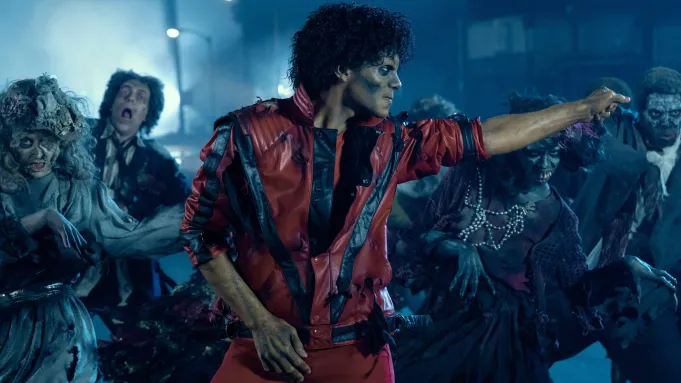
The performances have a lot of energy, and Jaafar gives a flawless impression and proves to be a phenomenal dancer, but even with Michael’s real vocals mixed with Jaafar’s, the portrayal never goes beyond one note. Domingo’s commanding presence is hard to dismiss, and had he been given meatier script, he might have made this into a career-defining role worthy of his talents. Teller seems to only be here because Branca controls the estate and clearly wanted to be played by a movie star, yet his screen time is minimal, and we never learn a thing about him. And don’t even get me started on the Mike Myers cameo that serves as a labored reference to a bad Bohemian Rhapsody in-joke.
Michael has the potential to be a big hit with audiences who didn’t watch Leaving Neverland and just want to tap their feet and enjoy the electricity of it all. I can’t deny that I enjoyed the music and dancing and appreciated the craftsmanship, but I’m very glad to have done so without putting a penny into the pockets of anyone who has silenced victims of abuse while playing the victim themselves. That’s my take on it as someone who both refuses to deny Michael Jackson’s talent and legacy and strongly believes in his guilt. But even if you’re okay with the refusal to take the gloves off (you’d think they’d only need one), the movie is simply a flat and emotionless exercise in flashiness. —Patrick Gibbs
Read more film reviews by Patrick Gibbs:
Hamlet: To See or not to See? That is the Question
Film Review: Mike & Nick & Nick & Alice
To help SLUG continue covering the latest films, consider joining our community of donors!
