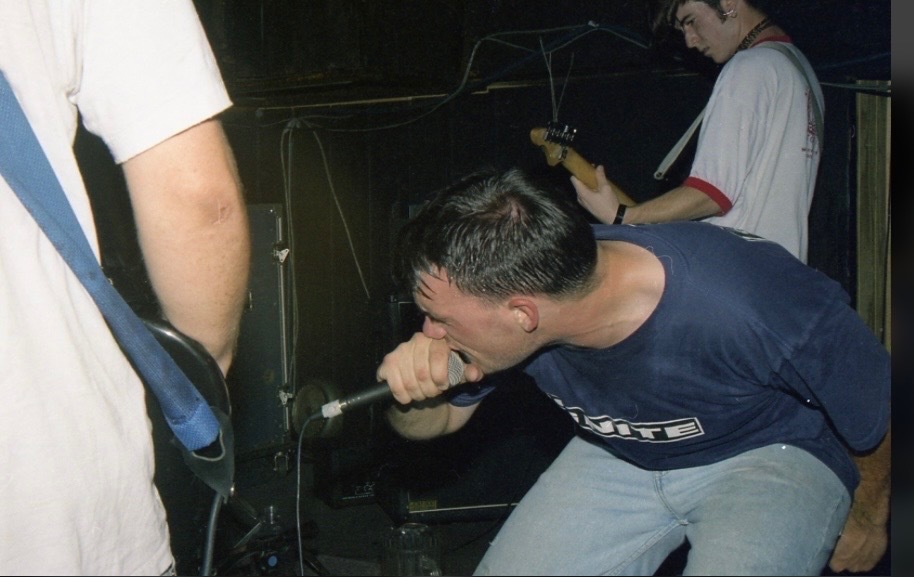
Life Sentence: Dan Gump Is Back
Interviews
The show was in a mechanic’s garage. Not a converted space, not a venue with exposed brick doing its best impression of grit, but an actual working garage with tools on the walls, equipment on the floor and a car still parked in the back bay. Someone had set up a drum kit near the entrance. The sound, predictably, was chaos. If you were near the door, chances are you got drums and whatever guitar amp was closest, with the vocals completely swallowed by the room. If you were deep enough inside, you could hear everything — and the crowd was singing along.
Dan Gump arrived a little late, ended up six feet from the kit and heard mostly drums. He didn’t mind. He bought a 12-inch and a shirt — the shirt was printed on Shaka brand, which he noted doesn’t fit him well and tends to blow out at the collar, but he bought it anyway. He hadn’t been to a show like this in years. The last time he remembered feeling it was in Chicago, back when he was young and shows happened in secret locations where everyone understood they were operating on borrowed time before someone called the police. That particular electricity — the knowledge that the thing you’re standing in the middle of is fragile and temporary and completely alive — doesn’t exist at an arena show. It existed here.
MASK and xforever warx were both on the bill that night. Gump watched, and something clicked back into place. He hadn’t planned on coming back, but Salt Lake City had other ideas.
To understand why any of this matters, you have to understand what hardcore actually is, which is harder than it sounds, because hardcore isn’t really a genre. It’s a posture toward the world. Born out of punk in the early 1980s, hardcore took everything that made punk dangerous — the speed, the fury, the refusal to make peace with a corrupt and numbing culture — and made it faster, heavier and more confrontational. Where punk made noise, hardcore meant it. Where rock ‘n’ roll celebrated excess, hardcore’s most enduring subculture, straight edge, made a defiant case for the opposite: that you couldn’t change anything with a clouded head, that sobriety was not compliance but combat.
Salt Lake City, of all places, became one of the most intense incubators of that idea in America. The scene here goes back to 1978 — a lineage documented obsessively by the now-defunct Grudge City Activities archive, forty-plus years of local bands catalogued with the devotion of people who understood they were preserving something real. By the 1990s, the metallic hardcore and straight edge scene in this city had grown so ferocious that an Earth Crisis show here ended up on America’s Most Wanted. This is not a footnote in American hardcore history. Salt Lake City is a chapter. Dan Gump knew that. It’s part of why he moved his label here.
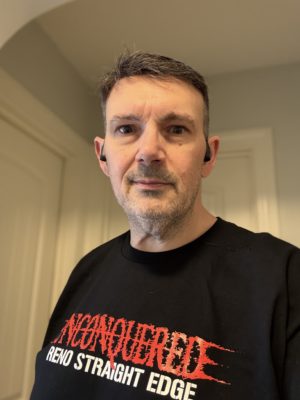
Gump is 55 years old, a former Marine, the vocalist of Excessive Force and the founder of Life Sentence Records — an independent hardcore label whose catalog is spoken about in the corners of the internet where these things are argued over passionately and at length with something close to reverence. He started it in 1994 out of a PO box in Irvine, California for the most practical reason possible: he needed to put out his own band’s record and had no other way to do it.
What he built turned out to matter more than he knew at the time. Excessive Force’s sole album, In Your Blood, released in 1995, is considered one of the defining metallic hardcore records of its era — reissued multiple times across multiple formats, most recently as a deluxe limited vinyl with die-cut gatefold and reprinted original tour flyers, the kind of treatment reserved for records that mean something. It combined the aggression of straight edge hardcore with a heaviness drawn from bands like Biohazard and created a crossover sound the scene hadn’t quite heard before. Gump has said the recording was rushed, the bass drum too clicky and some of the lyrics he’d rewrite today. It doesn’t matter. People still listen to it.
The label itself grew the same way the band did — organically, through touring and word of mouth and the mail-order economy of the pre-internet underground. Another band he met on tour asked Gump to put out their record. Then another. Life Sentence released work by Torn Apart, Eighteen Visions, Lifeless and local Utah bands including Clear. When Gump moved the label to Salt Lake City in 1996, he wasn’t relocating to the margins. He was planting a flag in a city with a hardcore history long enough and deep enough to hold it.
“Coming back, I find that Life Sentence is held by some with a degree of reverence,” he says, still sounding faintly surprised. “I’m just trying not to screw that up.”
The label went quiet in 2005. File sharing had arrived and gutted the CD market he’d built everything on — he went from selling two to three thousand CDs with minimal effort to pressing the same quantity and moving almost none of them. He lost money on a couple of expensive releases, moved out of state, focused on work and raising kids. Life Sentence became a memory. The hardcore scene kept going without him; he was no longer really part of it.
What brought him back was unglamorous and human and exactly right. Excessive Force was invited to play a festival in Florida in January 2026. Gump needed to set up an LLC just to sell merchandise and take card payments at the show. Once the business entity existed, he figured he might as well use it for something. His kids are older now — one has moved out. He has what he describes, with the bluntness of a man who doesn’t romanticize things, as “a little more expendable income I can flush down the toilet every month on the label.”
Then he came to Salt Lake for band practice, wandered into the MASK record release show and saw xforever warx play. xforever warx formed in 2024 with a stated mission to put Salt Lake City straight edge on the map in the wider hardcore world — a declaration that sounds ambitious until you hear the music. Fast, driving and brutally precise, the band draws its influences from the European metallic hardcore tradition: Sentence, Arkangel and Kickback, alongside New York heavyweights Madball and Merauder. Its EP Upon the Weak and Broken, released this past March on Life Sentence Records, was recorded by Taylor Young at The Pit in Los Angeles and mastered by Brad Boatright — the same production lineage as some of the most serious hardcore records being made today.
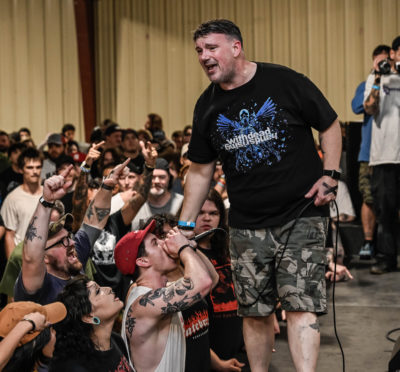
Go to one of their shows, and you will see what Gump saw that night: a room full of young people losing their minds in the best way, throwing themselves at the stage and each other with total abandon. Not performative rebellion, not irony — actual cathartic physical release in an era of increasing social isolation and algorithmic numbness. There is something almost jarring about it in 2026 — the rawness of it, the volume, the bodies in contact. Hardcore has always been the antidote to numbness. But to understand what it actually is, you have to be in the room.
Gump heard them and recognized something. “The bands are still writing the exact same lyrics they were writing 20 years ago,” he says of the current scene. “And I don’t look at that as a bad thing. It makes me feel like kids are still passionate about the same things I was passionate about when I was in my teens.”
Gump has been straight edge since 1987. The identity has changed shape over that time. In bands and on stage, he preached it. He operated Life Sentence Records in the militant straight edge world of the 90s, when the scene was confrontational by design. The label’s merchandise slogan was “Go Ahead, Keep Smoking. I Want You To Die.” He doesn’t disown that era, but he’s honest about its texture.
Now, he says straight edge is simply who he is. He doesn’t announce it in work situations. When he declines a drink at a work dinner and people ask, he just says he doesn’t drink. They assume he’s in recovery. He lets them assume.
“The whole culture is just sort of around this escapism,” he says. “People have this need to escape from their mundane existence. And they just use alcohol to do that. Straight edge becomes an act of defiance. It’s not easy. When you get into your 20s and all of your peers are drinking, it’s not easy.” He pauses. “Straight edge is just integrated into my DNA now. It’s one of those things I’ll never change. But I don’t feel the need to push it on people anymore. It’s just me. It’s just who I am.”
Life Sentence is back. Gump is pressing vinyl and CDs and navigating a music industry he barely recognizes, figuring out what collectors want now and what formats make sense and how to build a small coalition of bands worth caring about. He’s talking to the guys from Triphammer about finally putting their stuff out on vinyl. He reached out to Clear about a reissue. He’s learning about cassettes, which the kids are apparently into again. He is, by his own description, trying to figure it out.“I’m trying to build a family of bands that are interesting, that sound good,” he says. “And just try not to screw it up.”
He came back to Salt Lake City to practice with one band and discovered another one that made him feel like the scene he’d spent his best years building had survived him. Maybe more than survived. xforever warx is young and hungry and explicit about what it wants — to make this city mean something in hardcore, to carry the tradition forward, to make people pay attention to Salt Lake. It’s the same thing Gump was after in 1996 when he moved a cardboard box full of seven-inch records to a city in the desert that was already building something. He just didn’t know then that it would still be going thirty years later, or that it would be the thing that pulled him back.
xforever warx’s EP Upon the Weak and Broken is available now through Life Sentence Records at xlifesentencerecordsx.com. Excessive Force’s In Your Blood is available on Bandcamp.
Read more interviews from SLUG:
Interview: Good Kid
HEALTH is a Band Reborn
To help SLUG keep covering the music and history of the underground, consider becoming one of our donors!
