Film Review: Pressure
Film Reviews
Pressure
Director: Anthony Maras
Working Title Films
In Theaters: 05.29.2026
Some subjects and events have been so exhaustively explored on film that, no matter how interesting they may be, it’s hard to get too excited about another trip to the well. D-Day, the Allied invasion that turned the tide and ultimately won World War II in the European theater, is just such a subject. If you’re having trouble working up an interest in Pressure, you can hardly be blamed for that fact.
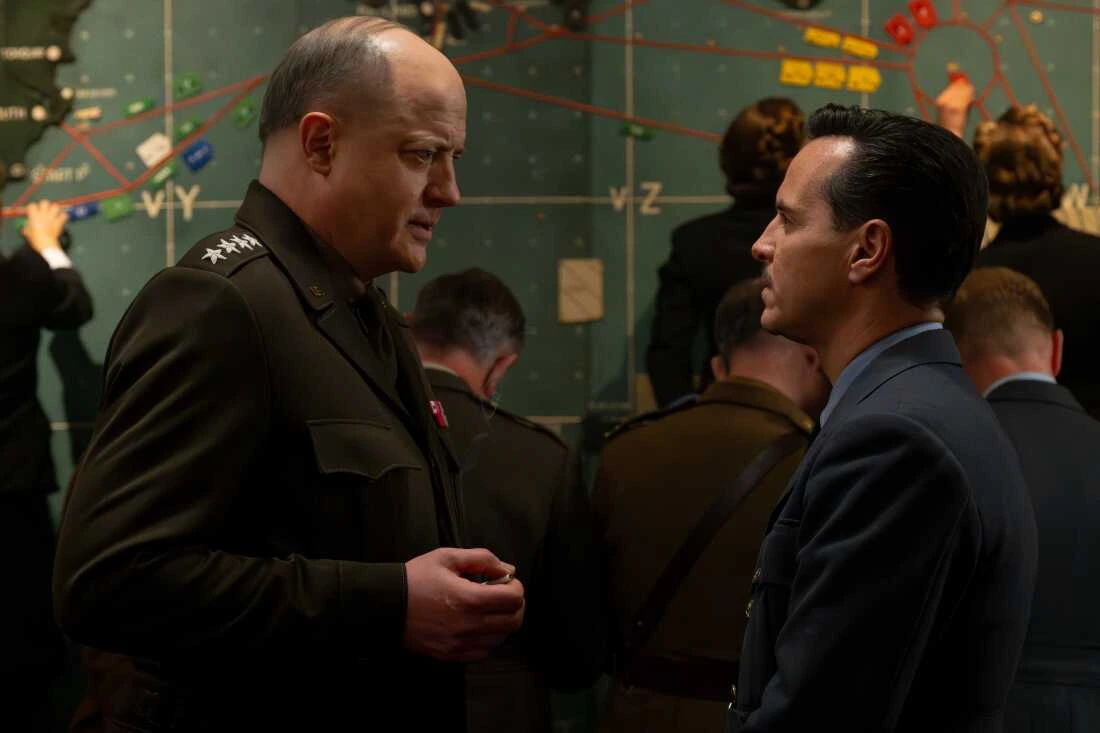
In the final days before the Allied invasion of Normandy, Scottish meteorologist James Stagg (Andrew Scott, All Of Us Strangers, Ripley) is tasked with advising General Dwight D. “Ike” Eisenhower (Brendan Fraser, The Mummy, The Whale) on weather conditions for Operation Overlord. As massive storms form over the English Channel and military leaders are divided over the forecasts, Stagg is tasked with determining whether or not the invasion should proceed, and the answer that everyone wants him to give is a resounding yes. That’s the answer that Ike’s trusted American meteorologist, Irving P. Krick (Chris Messina, Call Jane, Air), is giving, as he’s confident the storms will dissipate in time, though Stagg isn’t convinced. As thousands of lives and the future of the war hang in the balance, the clouds that hang over Stagg and over the Allied High Command are dark indeed, and the fate of the free world hinges on the right forecast.
Director Anthony Maras (Hotel Mumbai) delivers an involving adaptation of the play by David Haig, keeping it grounded in the dialogue-heavy style of the stage while opening it up for the screen. The main storyline stays within the confines of Allied headquarters, and the film is at its best when focusing on the human interaction. Some of the larger-scale sequences work better than others, with a mix of digitally enhanced stock footage and new sequences that look like they could’ve been lifted directly from Saving Private Ryan, but there is something about seeing the tumultuous waves and rain that the invasion force was facing that hits it home.
Pressure builds its drama around the agonizing uncertainty beforehand, turning forecasts, disagreements and fragments of incomplete information into matters of life and death. The storytelling soars when it’s not worrying about bringing the kind of spectacle that audiences normally associate with WWII cinema and focuses instead on the terrifying responsibility of men forced to make irreversible decisions without certainty that they are right. The film’s structure steadily tightens like a vice with every new weather report altering the emotional temperature of the room, pushing the characters further into exhaustion, doubt and quiet desperation. What emerges is less a war film about combat than a suspense drama about the unbearable weight of leadership and the terrifying realization that history can hinge on something as uncontrollable as the wind and rain. For me, the timeliness of the film’s central thesis, namely, that data is everything and no Army’s might means a thing unless we’re trusting in the scientific minds who know what they are studying, is the reason that Pressure more than secures its place as an essential historical film.
Scott is one of the most valuable “assistant storytellers” (the term that Harrison Ford coined to describe an actor’s job) working in film today, because he’s so grounded and committed to the realism of each individual performance to focus on creating a larger-than-life screen persona. In other words, he’s far too busy acting to worry about being a movie star, and the result is that people may not be clamoring to see the new Andrew Scott flick, but if you put him in a pivotal role, he’s going to make that movie work 10 out of 10 times. In contrast, Fraser is a beloved star who has many performances that just don’t buy as one that clicks, but thankfully, Ike fits him like a glove, and he brings an almost startlingly human quality to one of history’s most larger-than-life figures. Messina excels at playing the kind of guy who is so charming that he truly has no idea what a self-involved fool he can be, and in less capable hands, Krick is a character who could have come across as cursory, rather than essential. While I would have liked to see more of Kerry Condon, she’s superb as Kay Summersby, personal secretary to Eisenhower, and her chemistry with Fraser adds immeasurably to the believability of his performance.
Pressure is essential viewing for history buffs, and an involving film that should connect strongly with older audiences. By grounding its tension in character, intellect and moral responsibility rather than spectacle, the film delivers a thoughtful and steadily gripping portrait of the immense pressure behind one of history’s defining moments. —Patrick Gibbs
Read more from Patrick Gibbs:
Film Review: The Mandalorian and Grogu
Film Review: The Wizard of the Kremlin
If you enjoy SLUG’s film coverage, consider joining our community of donors.
