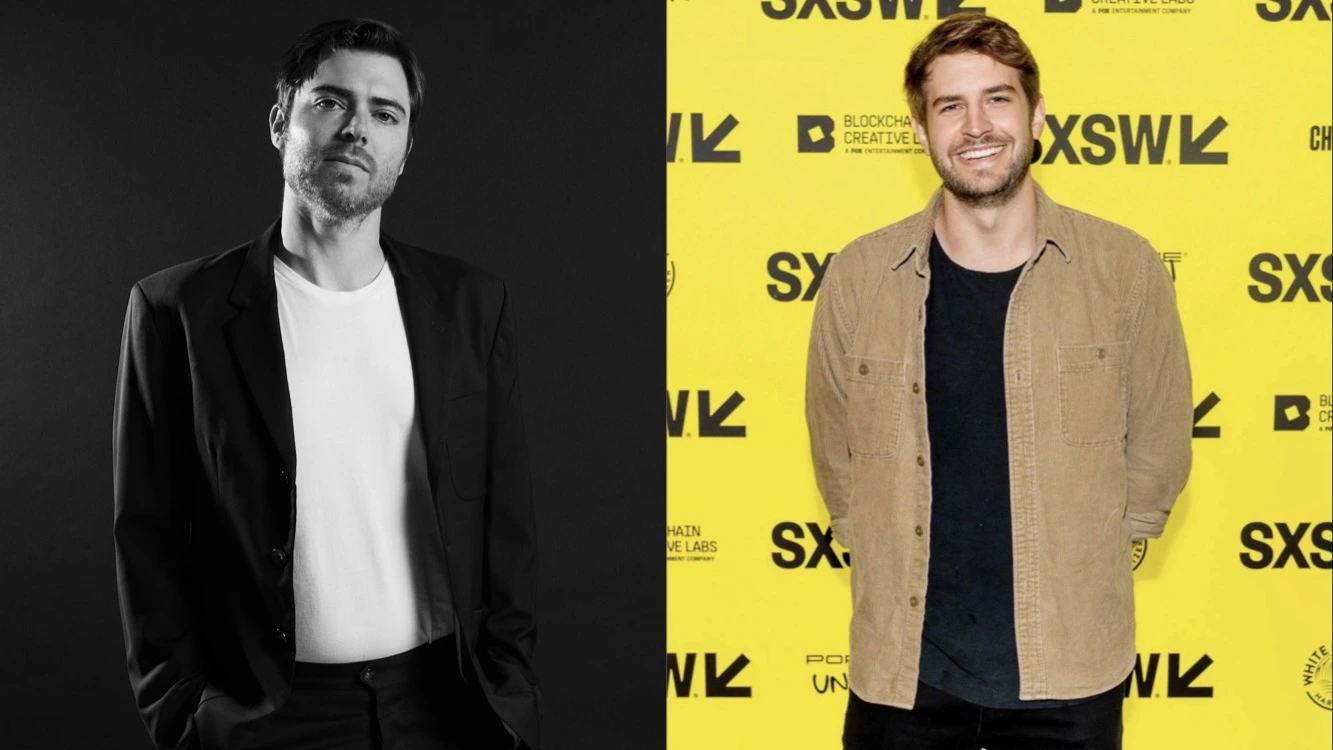
Andrew Orkin and Joseph Shirley Bring Musical Artistry to The Gallerist
Arts
When composer Andrew Orkin talks about The Gallerist, he keeps coming back to one idea: the music is a character. It’s wall-to-wall, propulsive, intimate, abrasive, elegant and ridiculous by turns, mirroring the film’s wicked satire of the contemporary art world. Directed by Cathy Yan and premiering Jan. 24 at Sundance Film Festival 2026, The Gallerist stars Oscar winner Natalie Portman as Polina Polinski, a desperate Miami gallerist who conspires to sell a dead body at Art Basel. Orkin co-scored the film with Joseph Shirley, and their collaboration — rooted in shared instincts but very different paths into film music — became central to shaping the movie’s tone.
Orkin’s road to composing began far from Sundance and Hollywood. “Music was a bit of a roundabout road,” Orkin says, tracing his beginnings as a guitar player in bands in South Africa. In his early 20s, friends began asking him to score their films, and Orkin found his groove. He moved to the U.S. on a full-ride scholarship to NYU in 2012, which marked the start of his American career. Not long after, around 2015, he met Cathy Yan. Their first collaboration was a short film that became the proof of concept for Dead Pigs, Yan’s Sundance debut in 2018. Since then, the two have remained creatively intertwined, staying in frequent contact; Orkin did uncredited work on Yan’s 2018 foray into blockbusters, Birds of Prey (And The Fantabulous Emancipation of One Harley Quinn), and came on as composer for The Gallerist. That history meant Orkin was involved early on, reading drafts of the script and discussing the role music would play before the film was even fully formed.
“The music is wall to wall, and it’s a big character in the film.”
“The music is wall to wall, and it’s a big character in the film,” Orkin explains. “It’s really a sort of narrative guide that flows throughout the whole picture.” From the beginning, he started working directly from the script, building a sonic palette around a central metaphor Yan had articulated: the characters are stretched thin, hiding behind fragile façades, like a canvas pulled too tight. That idea manifested in scratchy, intimate string textures, close-mic’d and tense, alongside quirky Miami-flavored Latin percussion and hints of techno. As the project grew and the score expanded, Orkin brought Joseph Shirley on board to add new layers that elevated the music into something grander and more ironic. “Joe came onboard and really helped take it over the finish line,” Orkin says, describing how Shirley introduced high-society classical elements that reflected Polina’s inflated self-image even as her life collapsed.
For Shirley, The Gallerist arrived at a moment when he was fully charting his own course after years of collaboration. He grew up playing piano, studied composition in New Orleans and fell in love with film scoring during college. After moving to Los Angeles, he attended USC’s film scoring program and soon began working closely with Oscar-, BAFTA-, Emmy- and Golden Globe-winning composer Ludwig Göransson (Black Panther, Tenet, The Mandalorian), a relationship that shaped his early career. “It’s nice to have people that believe in you and support you,” Shirley says, noting that working with Orkin felt natural because they shared a common musical language rooted in band culture and a love of bold, character-driven film music. That shared language made the collaboration seamless. The two composers passed cues back and forth, bending, warping and reshaping each other’s ideas until the puzzle clicked into place. Shirley describes his role as supporting and expanding Orkin’s intimate string concept while also pushing the score into new tonal territory. Piano, fuller string arrangements and a heavily produced, contemporary feel began to emerge, alongside pulsing sub-bass and four-on-the-floor rhythms that give the film its sense of momentum.
“There’s quite a lot of different colors and shapes and sounds in this score.”
“There’s quite a lot of different colors and shapes and sounds in this score,” Shirley says. Moments of small triumph are immediately undercut by narrative left turns, with the music pivoting just as quickly to accommodate new characters and escalating chaos. A prominent vocal line recorded by Ari Mason runs throughout the film, acting as another throughline that connects scenes and emotional shifts. Much of the score’s personality comes from the musicians themselves. Orkin describes recording sessions that were intentionally open-ended, encouraging instrumentalists to interpret scenes emotionally rather than simply play notes. String players Jake Falby and Jordi Nus were given melodies and ideas, but also permission to “throw paint against the wall.” Percussionist Spencer Cohen took simple written parts and expanded them into layered Latin sections, while vocal elements moved freely throughout the film as the score evolved, reappearing in unexpected places and gaining new meaning.
This sense of experimentation was made possible by Yan’s process. Orkin notes that she rarely uses temp tracks, preferring to build something bespoke for each project. For The Gallerist, she created playlists for each character — songs, not scores — before casting was even finalized. The playlists offered insight into the characters’ inner lives, their moods and the music they might listen to while driving, shaping the composers’ understanding long before images were locked.
“If the shape of the movie has a lot of twists and turns in it, then the score will also need to follow suit.”
At the heart of Shirley and Orkin’s approach was contrast. “If the shape of the movie has a lot of twists and turns in it, then the score will also need to follow suit,” Shirley says. Gentle, earnest moments sit beside bombastic, chaotic ones, making the shifts funnier, sharper and sometimes more unsettling. That contrast mirrors Yan’s film itself — a satire that skewers the art world while finding strange beauty within it.
By the time The Gallerist premieres at Sundance, the score will have traveled a long road, from script pages to stretched canvases, scratchy strings, pounding bass and voices drifting across scenes. For Orkin and Shirley, the music doesn’t just underscore the film’s madness — it sells it, frame by frame, note by note, just like the art at its center.
Read more of SLUG’s coverage of the 2026 Sundance Film Festival.
