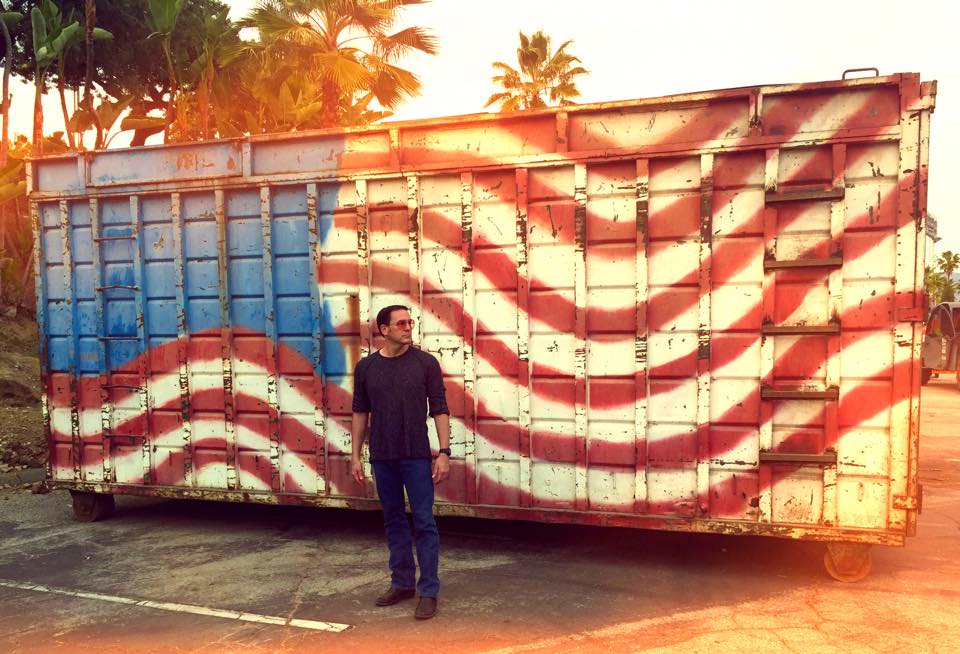
Casey G. Williams Can’t Be Contained
Arts
It begins with a deceptively small idea: a steel container, eight-feet wide and eight-feet tall, lifted whole from truck to ship. Just a big box, but what’s inside? In the 2021 documentary America Boxed In, Student Academy Award–winning filmmaker Casey G. Williams uses that unassuming container as a lens to examine globalization, power and insecurity in the modern world. The film, which just won top honors at the Vatican City Global Film Awards, is a sweeping account of how the global economy was rewired — and how its consequences now shape daily life, geopolitics, national identity and an increasingly divided society.
“It sounds like an industrial film and not a real documentary, but I smelled the gold statue in this.”
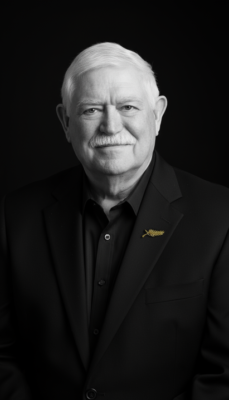
“I got a phone call from a guy from Montana,” Williams says. Lance Hoovestal, who holds a PhD in International Relations, was completing doctoral research in Australia and became convinced that he had an important story to tell. The only problem was that he wasn’t a filmmaker. That’swhere Williams came in: as a seasoned professional whose career spans animation, cinematography, editing and producing, Williams has also taught film theory at The University of Utah, Weber State University, Brigham Young University and Columbia University Poitiers Film School in France. When Hoovestal contacted him after struggling to find anyone in Australia who was interested in the project, Williams understood the hesitation. “I got why a lot of people didn’t want to touch this,” Williams explains. “It sounds like an industrial film and not a real documentary, but I smelled the gold statue in this.” A film that Williams initially thought would be a six-month commitment stretched into seven years, and Williams brought his son, Ian S. Williams, also an accomplished filmmaker, onboard as a co-writer and editor. “I realized I had something to work with there,” Williams says. “This story is interesting, and scary enough, but when you get into the politics of how the world has changed because of trade and needing our borders to be porous — yet we demand our sovereignty — that’s really something else.” In Williams’ telling, the container embodies a contradiction modern societies refuse to confront: We demand speed, convenience and low prices while insisting on strong borders and national independence.
That contradiction, Williams argues, has fueled not just economic upheaval, but a profound cultural and political fracture. The film traces this tension back to 1937, when truck driver Malcolm McLean watched dockworkers unload cargo crate by crate and recognized the system’s inefficiency. His idea — lifting entire trailers onto ships — culminated on April 26, 1956, when the SS Ideal X sailed from Newark to Houston with 58 containers, cutting loading costs by 97 percent. Williams frames this not as a technical breakthrough, but as the birth of globalization itself. The container fused economies, eroded state sovereignty, enabled criminal networks and created new security threats. It became the fulcrum between open-market “freedom” and sovereign “security.”
“How is it in the 21st century that we have become so tribal?”
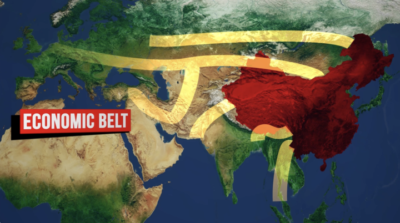
America Boxed In expands that contradiction onto the world stage, showing how containerization dispersed power away from governments and toward non-state actors and transnational supply chains. “We’ve created a very porous system,” Williams says, noting that only about five percent of containers are ever inspected. Yet this largely invisible system underpins the global economy, making its vulnerabilities — and its social consequences — impossible to ignore. For Williams, those consequences extend directly into the realm of ideology and identity. The shrinking of the world has not brought people closer together, he argues, but pushed them into hardened camps. “How did this happen in the 21st century, where we can see each other?” Williams asks. “How is it in the 21st century that we have become so tribal? If you don’t feel and think the same way I do politically or religiously or economically, then you deserve to die.” The film suggests that economic systems designed for efficiency have also accelerated polarization, turning difference into threat.
“We’ve created a very porous system.”
One of the film’s central themes is how containerization accelerated China’s rise, shifting economic power from West to East and intensifying political and ideological divisions worldwide. Recent port explosions and attacks on shipping routes have only heightened the film’s relevance, underscoring how fragile — and volatile — the global system has become. That resonance is reflected in the film’s extraordinary reception. America Boxed In has won over 100 awards worldwide, including Best Feature Documentary at the 1st Monthly Film Festival, a Globe Award at the WSXA Amsterdam / International Awards, Best Documentary Film at Berlin Cine Week, Brooklyn International Cinefest, and the Brandenburg International Film Festival, and Outstanding Achievement – Documentary Films at Black Swan International Film Festival and Cult Critic Movie Awards. The film also earned Best Cinematography at the Boston International Film Festival and Chicago Cinema Awards. It was deemed eligible for consideration in the Feature Documentary category by the Academy of Motion Pictures and Sciences.
Ultimately, America Boxed In, which can currently be seen on Tubi, is less about shipping than the world the container created — a system built for speed and efficiency, riddled with contradictions and consequences. It suggests we are all living inside that box now, shaped by it, divided by it and increasingly aware of its cost.
Read more film reviews:
Ira Sachs on Art and Risk in Peter Hujar’s Day
Aaron Eckhart Has Gone To The Dogs in Muzzle: City of Wolves
