Director Geeta Gandbhir on The Perfect Neighbor
Arts
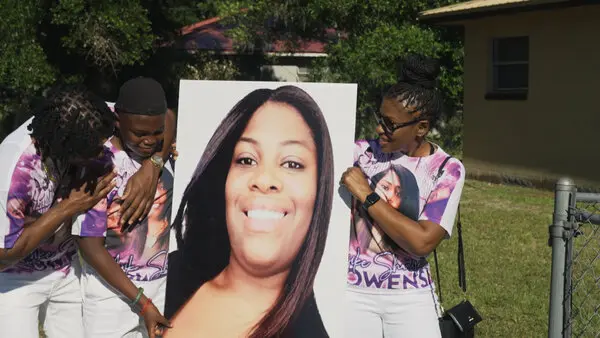
As the saying goes, the camera doesn’t lie, and in the acclaimed documentary The Perfect Neighbor, truth is everything. The 2025 film chronicles the fatal shooting of a Black woman, Ajike Owens in Ocala, Florida, by her white neighbor Susan Lorincz, on June 2, 2023. The film premiered at the Sundance Film Festival, where it won the Director Award for Geeta Gandbhir and is now nominated for an Academy Award for Best Documentary Feature. For its director, it’s been more than a film; it’s been a fight for accountability and a vessel for healing.
“This film came to me through my family. Ajike Owens was my sister-in-law’s best friend,” Gandbhir explains. “They were very close. And so when Ajike was murdered, we were immediately involved.” The film tells this disturbing story by chronologically piecing together police bodycam, dashcam, Ring camera and interrogation footage, following the escalation of neighborhood disputes, the killing itself and Lorincz’s eventual conviction for manslaughter. In doing so, it interrogates the systemic bias embedded in the application of Florida’s stand-your-ground laws.
When Gandhir and her husband, the film’s producer, Nikon Kwantu, got a call from her sister-in-law asking for help, they took action. “We were immediately on the ground trying to support the family and really trying to keep this story in the news,” Gandbhir says. Gandbhir knew that bringing media attention to the case was not peripheral — it was urgent. “Gun violence is so common that it’s almost a fight to get these stories the attention they deserve,” Gandbhir says. “And without that media pressure, we knew law enforcement might not take action the way that they should.” The filmmakers formally embarked on the documentary two months later, after receiving body camera footage from the family’s lawyers. “This was a very hard film to make,” Gandbhir says. “My family was devastated, and I was sad. And I didn’t know how to channel the grief that we were all feeling. I think, for me, it was also partly grief work… unfortunately, gun violence is so common, and violence against Black and Brown people is even more common. So we live in a collective state of mourning, unfortunately, and it’s gotten worse, obviously, since the beginning of 2025.”
The project became a small but determined mission, and Owens’ mother, Pamela Dias, pushed that mission further. Gandbhir recalls: “She was like, ‘Justice doesn’t end in the courtroom. There has to be more for this. There has to be more, my daughter’s life has to have meant something.’” There was also a practical consideration: four children had been left without a mother and were now being raised by a relatively young grandmother who was not in a financial position to take on this responsibility. “My dream, it was sort of a pipe dream. If we sold the film, that meant we could give the majority of the money to the family,” Gandbhir says. That dream materialized when the film sold to Netflix after Sundance, and for Gandbhir, that has been the greatest reward for her efforts. “There has been grief in this process, but there’s also been pain to purpose,” Gandbhir says.
The footage was obtained not by the filmmakers but by Benjamin Crump and Anthony Thomas, the lawyers representing Owens’ family, using the Freedom of Information Act. “In Florida is there are what are called the Sunshine laws,” Gandbhir explains. “The material becomes public record. So, honestly, the material, once it’s released, belongs to the people, so anyone can access those files.” The attorneys sent the video files to Gandbhir and Kwantu in hopes that they could be used to keep media attention focused on the case. Drawing on her background as an editor, Gandbhir began organizing the footage. “It was about 30 hours, put in chronological order, which took me a couple of weeks,” Ganbhir says, and what emerged from those two weeks of intense work surprised her. “It told the story of this beautiful, multiracial community, as they were before,” Gandbhir says. “And you never see that after gun violence occurs… Although body camera footage can be a tool of surveillance, obviously, for vulnerable communities, we realized we could use it to humanize the community… Oftentimes, particularly with people of color, after we are the victims of a crime, we are criminalized. Our children are adultified. And the body camera footage was undeniable.”
Still, restraint guided the edit, and Gandhir wanted to be sensitive and respectful to both the family and their community. “We wanted to be very careful, we didn’t wanna show too much of the shooting or Ajike afterwards,” Gandbhir says. The more difficult choice involved whether to include the moment Owens’ children learn their mother will not return. “We chose to leave in what is ostensibly the worst day of these children’s lives,” Gandbhir says, and in making that decision, she deferred to Dias. “I was like, ‘This is up to you. We can throw this film in the garbage.’” Dias’ answer was resolute. “She was like, ‘No, this goes forward. The world needs to know, and let them see the grief… This is the true impact of gun violence,’” Gandbhir says.
In The Perfect Neighbor, the unvarnished record of a neighborhood dispute that turned into an unimaginable tragedy becomes both evidence and elegy — an archive of a community before and after rupture and a testament to transforming grief into purpose.
Read more film interviews by Patrick Gibbs:
How Hannah Ostler Went Through Hollywood and Back with Buster Brooks
Teresa Sanderson and the Spell Cast by Becky Nurse of Salem
