Cinematographer James Whitaker Talks DTF St. Louis
Film
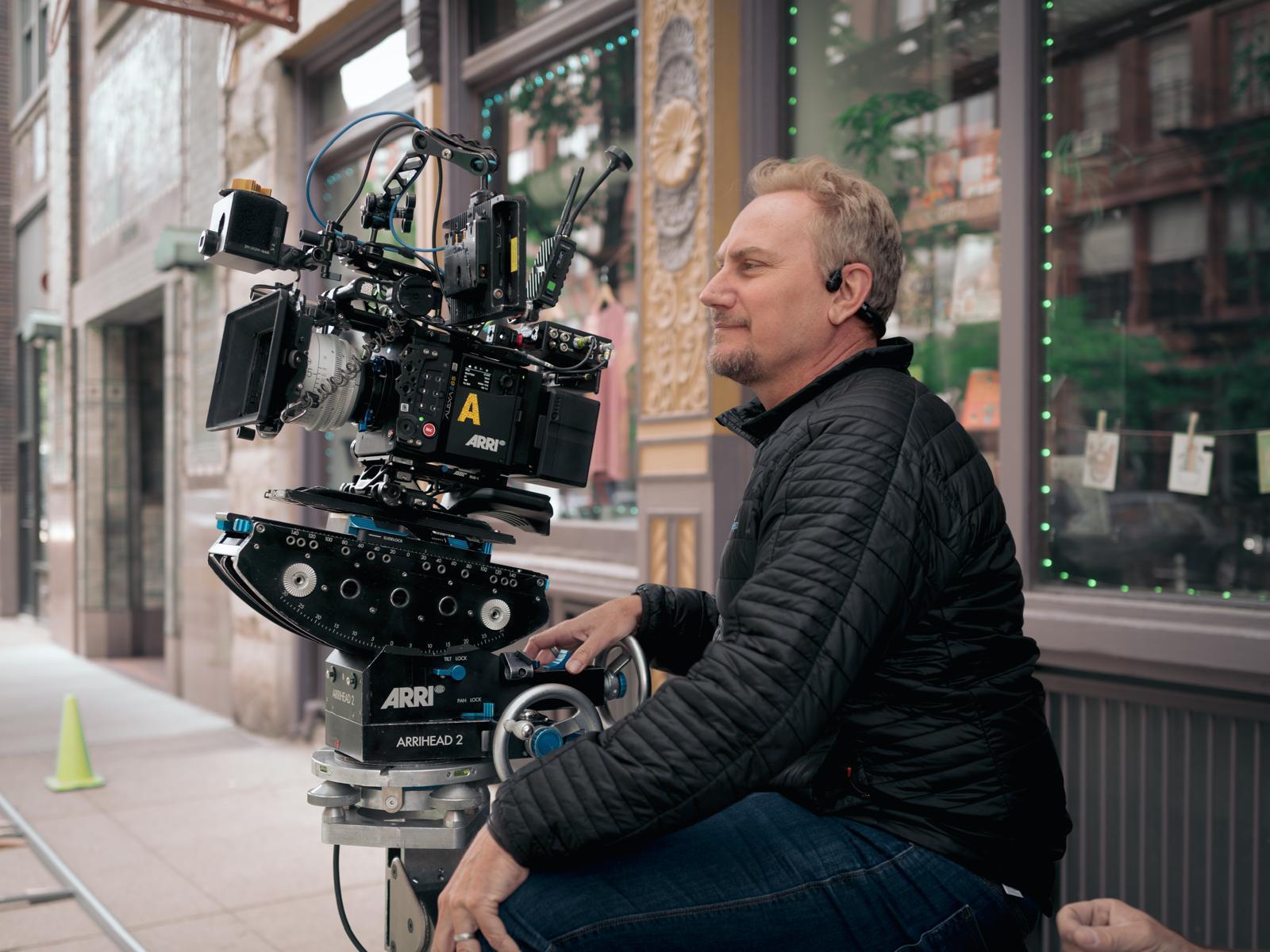
Cinematographer James Whitaker has built a career grounding big ideas in images that favor atmosphere over flash and character over spectacle. That sensibility serves him well on the darkly comic HBO series DTF St. Louis, a seven-part mystery about loneliness, desire and murder in the American suburbs, which reunites Whitaker with frequent collaborator Steven Conrad.
“Steve called me for his TV show called Patriot,” Whitaker says, which the two connected after Conrad saw Whitaker’s work on Thank You for Smoking. Whitaker had done films and television pilots but was wary of committing to a full series. “The first thing that gets thrown out the window in television is the cinematography, because all they care about is making a schedule, putting as many cameras as you can on the shot at one time,” Whitaker says. That maximum-coverage approach was exactly what he wanted to avoid, so Whitaker proposed breaking a few rules. “Let’s try to make it a one-camera shoot where we can really pay close attention to all the lighting and all the compositions and make them as close to perfect as we possibly can,” Whitaker says. That philosophy helped define a decade-long collaboration between Whitaker and Conrad with Patriot, Perpetual Grace, LTD and now DTF St. Louis. The HBO series centers on a love triangle between a group of restless middle-aged adults: TV weatherman Clark Forrest (Jason Bateman), his coworker Floyd Smernitch (David Harbour) and Floyd’s wife Carol (Linda Cardellini). When Floyd turns up dead, two detectives uncover a trail leading to a scandalous dating app that allows couples to secretly pursue affairs.
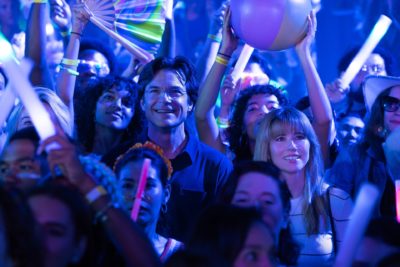
Whitaker says the Conrad partnership works best when both artists maintain creative continuity from beginning to end. “That’s definitely our preferred methodology: for him to direct all of them and me to shoot all of them,” Whitaker says. “It’s literally about continuity. It’s about having those two brains working on every single frame and blocking every single piece of action that happens with the actors to get the story tight and hopefully put across on screen what we’re going for.” If the collaboration provides consistency behind the camera, the visual challenge of DTF St. Louis was something else entirely. The story unfolds largely in ordinary suburban spaces — environments Whitaker initially worried might feel visually flat. “First and foremost, I really wanted it to feel heavy and dark,” he explains. “I was very worried about being able to do a suburban, ordinary life drama… where the photography wasn’t gonna be uplifted by something that existed in society itself.” Previous projects had built-in visual drama: Patriot utilized the architecture of Paris, while Perpetual Grace, LTD leaned into Western landscapes.
The solution, Whitaker says, was to embrace observation rather than spectacle. “I wanted us to feel like we’re capturing these hidden gems in time in the suburbs,” Whitaker says. Lighting played a major role in establishing the series’ mood. Whitaker leaned into deep shadows and controlled contrast to create emotional weight. “I really wanted black to be a major character,” he says. “We wanted a lot of shape on people’s faces… a dark shadow side. We used a ton of negative fill and really nicely cosmetic key sides for people’s faces.”
The visual strategy also shifts across the timeline of the story. Scenes set before Floyd’s death feel looser and more alive. “Everything pre-David Harbour dying was handheld and slightly warmer in the look,” Whitaker explains. “They’re on swing sets in the backyard… they’re playing cornhole together… building this friendship.” Once the investigation begins, the camera becomes more rigid, with more static framing and locked-down shots. Whitaker notes that the production also made unusual technical choices with its cameras. “We actually are the first show that shoots start to finish on the Alexa 65, a 65-millimeter-size sensor,” Whitaker explains. The system combines a compact camera body with an enormous imaging surface. Whitaker describes it as “a small camera with this gigantic sensor in it,” adding that he felt fortunate to use it because it was a format he had long wanted to explore.
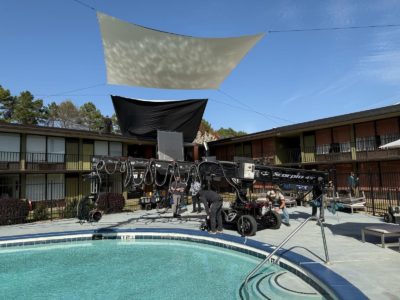
One of the show’s most eye-popping moments arrives early in episode two, during a sequence when Harbour’s character darts into traffic to save a boy crossing the street. “It’s basically from the idea of Stonehenge,” Whitaker says. The team used the phenomenon sometimes called “Manhattanhenge,” when sunlight aligns perfectly with city streets. “At a certain time of year, the sun just blasts through it.” To recreate the effect, the crew built the scene on a soundstage and simulated the sun with a massive lighting rig. “I ended up putting a single 20K on a lift, and that was our sun in the shot,” Whitaker says. The boy dodged invisible objects that would later become digital cars, while Harbour rushed in for the rescue. “That was a Steve Conrad-beautiful-piece-of-writing moment. That was fun to pull off visually.”
Across DTF St. Louis, Whitaker’s work reinforces the show’s themes of longing, secrecy and moral ambiguity, transforming everyday suburban spaces into something quietly ominous — places where small choices cast long shadows.
Read more film interviews:
Hugo De Sousa and Sarah Whelden Are Best Friends With the Devil
Óliver Laxe and the Journey of Sirāt
