Film Review: Avatar: Fire and Ash
Art
Avatar: Fire and Ash
Director: James Cameron
Lightstorm Entertainment
In Theaters: 12.19.2025
Every major franchise has its fans and detractors, but James Cameron’s Avatar films are almost unique: each one becomes the highest-grossing movie ever, yet there’s so much mainstream backlash aimed at it that many who enjoy them feel compelled to hide it because it isn’t “critically correct.” Whether Avatar: Fire and Ash will match the box-office dominance of its predecessors is anyone’s guess, and it will have its share of detractors, but I’m not among them. Because like a scientist linking to an avatar, these movies have a way of making me come alive.
Avatar: Fire and Ash – A Thrilling Return to Pandora
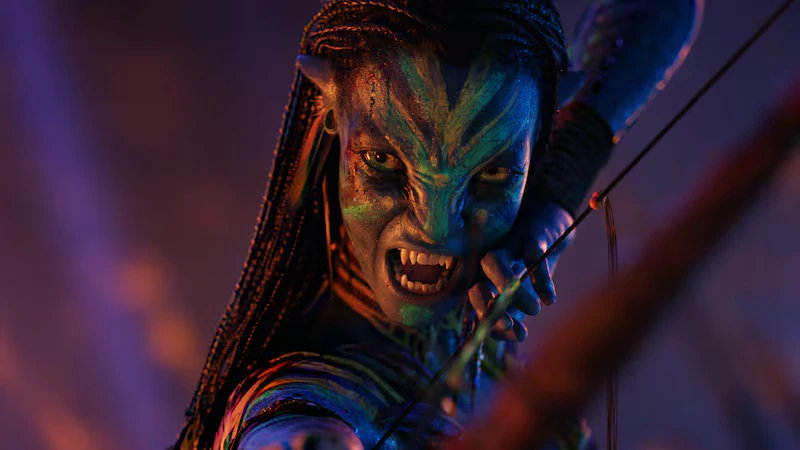
Set a year after the events of Avatar: The Way of Water, when Jake Sully (Sam Worthington, Clash of the Titans) and Neytiri (Zoë Saldaña, Guardians of the Galaxy, Emilia Pérez) are still taking refuge with the ocean-dwelling Metkayina clan, trying to keep their family safe while struggling to come to terms with the loss of their eldest son, Neteyam. Their grief is sharpened by Neytiri’s growing bitterness, which distances her from Jake and from their human-born adoptee, Spider (Jack Champion, Freaky Tales).
When a feared new faction emerges — the Mangkwan, or Ash People — Pandora’s fragile peace fractures further. Their leader, Varang (Oona Chaplin, Game of Thrones), shaped by years of hardship in the volcanic lands, forges an alliance with the resurrected Colonel Quaritch (Stephen Lang, Don’t Breathe), rekindling his vendetta against Jake’s family. As tensions mount, Jake must confront not only Quaritch’s escalating war but the possibility that Neytiri’s pain may cost them everything they’ve tried to protect.
The Complex World of Pandora and Its Characters
As a film critic, I feel like I’m always having to apologize to colleagues for my love of these films, and I’m so over it. If you’re in the anti-Avatar camp, Fire and Ash isn’t the movie that’s going to win you over. I don’t lump everyone who finds these films lacking into the same ‘hater’ category, because people can make legitimate criticisms.
Avatar is full of derivative effects-driven spectacles with plenty of corny, stilted dialogue and characterization that runs the gamut from hammy to lifeless. And yet, there’s not a single word that I just said that doesn’t apply just as strongly to the original Star Wars. The reason we loved Star Wars was because it transported us to an extraordinary place grander than our own world and swept us up in a grand adventure in the tradition of Flash Gordon, and it sold on that world just enough to fire up our imaginations and make us care about it.
Critique, Spectacle, and Cinematic Experience
The Avatar sequels may be more easily comparable to George Lucas’ prequel trilogy than his classic originals, and to say that the plot can get muddled is an understatement. We’re primarily there for adventure and thrills, however, and say what you will about Cameron — he knows how to create a feast for the eyes and senses as well as any filmmaker living or dead.
I understand the dismissal of Avatar as popular eye candy over story filmmaking. Still, if you’re going to seriously try to claim with straight face that it’s in a category of soulless, crass commercialism apart from the utter mess that is Avengers: Infinity War, or even the rousing but shallow, manufactured fun of Top Gun: Maverick, I respectfully submit that you’re actively choosing to delude yourself, and you’ve very likely got an ax to grind.
Standout Performances and Musical Highlights
Fire and Ash reaches new heights on that level, and it’s absolutely mesmerizing and often quite intoxicating. There’s also some interesting character development between Jake and Neytiri, though the arc for their son Lo’ak (Britain Dalton, Ready Player One) doesn’t quite get the screen time that it needs in order to have the intended impact. Composer Simon Franglen, who took over for the late great James Horner in the last film, really comes into his own this time around and creates some truly epic themes. Although the story overloads and loses focus at times, the movie engrossed and dazzled me so much that I never felt impatient during the 197-minute runtime.
The standout performance, as always, comes from Saldaña, who gets more to do than she did in the second film, both in terms of action and drama. The scenery chewing Lang really hits his stride with the N’aavi version of Quarritch in this film-he’s over the top, but mostly in a fun way. Chaplin, who is the granddaughter of cinematic icon Charlie Chaplin, is captivating and creepy as Varang, and Sigourney Weaver is utterly enchanting as Jake and Neytiri’s adopted daughter, Kiri. Giovanni Ribisi (Saving Private Ryan) is still just annoying as businessman Parker Selfridge, but this film makes much better use of Jemaine Clement (Flight of the Conchords) as scientist Dr. Ian Garvin than the last one.
Why Avatar: Fire and Ash Captivates Fans
I won’t claim that Avatar: Fire and Ash is anything more than it is, and I’ve watched many movies this year that offered deeper, smarter, more important, and more innovative experiences. However, I’ve watched all of them with the detachment of a film critic doing his job. Avatar: Fire and Ash made me feel like a 10-year-old at the movies again: it didn’t just entertain me; it immersed me so completely that I shut out everything else.
No other active franchise, even at its best, really does that for me. Avatar: Fire and Ash lifted my spirits and made me feel carefree for a while, in the grand tradition of the movies that first hooked me. In terms of a moviegoing event that reminds me why a darkened theater is such a sacred place to me: Yes, I suppose I could ask for a bit more. But I don’t really need more out of Avatar. It sees me. —Patrick Gibbs
Read more sci-fi film reviews written by Patrick Gibbs:
Film Review: The Running Man
Film Review: Predator: Badlands
