Film Review: Blue Moon
Arts
Blue Moon
Director: Richard Linklater
Detour Filmproduction, Renovo Media Group, Wild Atlantic Pictures, Cinetic Media, Not to Be Seen Productions, Under the Influence Productions, Concord Originals, Sony Pictures Classics
In Theaters: 10.24.2025
This awards season, there’s a fair amount of buzz about Richard Linklater’s first French film, Nouvelle Vague, which chronicles the beginning of French Wave cinema. As a Linklater fan, I’m excited for this, but it’s a shame to see his other film, Blue Moon, a masterful ode to one of the giants of the American stage, be overlooked as little more than a side note.
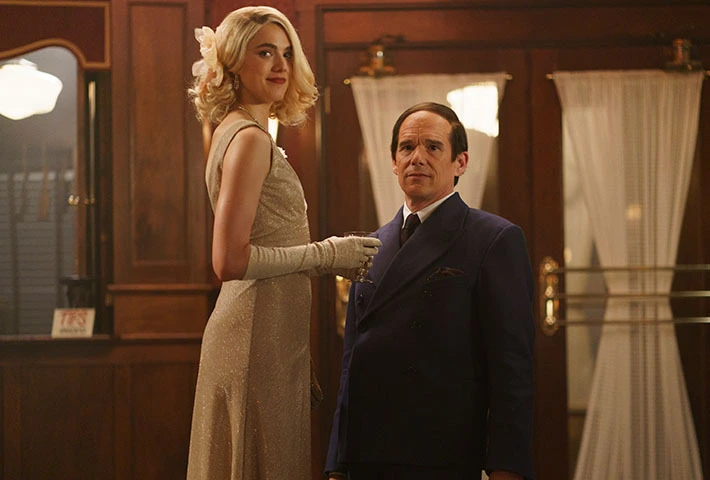
Set on March 31, 1943 — the opening night of Oklahoma! — Blue Moon unfolds over one night in the life of lyricist Lorenz Hart (Ethan Hawke, Before Sunset, Training Day), once half of the legendary Broadway team Rodgers and Hart. As his former partner Richard Rodgers (Andrew Scott, Ripley, All of Us Strangers) celebrates a new triumph with Oscar Hammerstein (Simon Delaney, The Good Wife, The Conjuring 2), Hart slips away to Sardi’s to drown his bitterness and self-doubt. There, he confides in Eddie (Bobby Cannavale, Boardwalk Empire, Ant-Man), the sympathetic bartender, and reflects on a career fading into the past, his struggles with alcoholism and his complicated attraction to a much younger set designer, Elizabeth Weiland (Margaret Qualley, The Substance, Honey Don’t!), despite his preference for men. Mixing sharp humor with defeated melancholy, Hart rails against the optimism of Oklahoma! while he’s forced to confront the end of a prolific artistic partnership, the disappointing truth about a great romantic hope and the curtain closing on his relevance as a renowned artist and important voice.
Blue Moon is a small film that is at once a remarkably intimate portrait and a sadly detached tragedy, following a man whose gifts brought great accomplishments and influence, but whose addictions, depression and personal demons made him an enigmatic lost soul. The stage play feel of the material is entirely intentional, and the elegant screenplay by Robert Kaplow, who previously partnered with Linklater on Me and Orson Welles in 2008, drips with deliciously quotable dialogue without relying on the spoken word to do all of the talking. There’s as much or more power in the things that are left unsaid — the awkward pauses and the lingering glances — as in the carefully crafted eloquence of the wordplay, which is more than fitting for a film that’s ultimately about regret and longing.
Hawke is utterly mesmerizing as Hart, combining irresistible showmanship and subtle nuance in what may stand as the defining performance of a great yet underrated career. Where actor and subject inexorably connect is in their mutual passion for art, storytelling and beauty. They also share their insistence on doing it their way or not at all — even if it keeps them from ascending to the top of the heap. Whether it’s Hart eschewing the cornpone and cornball pandering of Oklahoma! while envying the attention that it brings to Rodgers and Hammerstein, or Hawke emphatically passing on surefire hits like Independence Day and Batman Forever because he thought they weren’t cool enough to be worth his time and energy, the line between uncompromising artistic integrity and arrogant self-importance is thin in both figures.
It’s what makes them endlessly admirable and more than a little insufferable, and it’s why an actor as physically wrong for this part as Hawke — who stands a full foot taller than the legendary lyricist and has boasted luxurious locks as part of his persona for decades, in contrast to Hart’s clumsy combover — is able to embody the soul of the man in a way no one else could hope to replicate. The depth of fiery intellect, passionate desire and infinite despair that Hawke conveys in his penetrating eyes is alternately intoxicating and heartbreaking — whether it’s in his desperate pleas with Scott Rodgers to work his way, throwing aside resounding success in order to indulge a pure yet controlling creative vision, or his somewhat uncomfortable interludes with Qualley’s Elizabeth. One moment we’re seeing a leering Lothario pining for a captivating and whip-smart beauty half his age and judging his intentions, and the next we’re feeling the pain of the emptiness he’s trying to fill. Qualley is perfectly cast because she sparkles with a youthful exuberance of someone far younger than her own 36 years and the wit and maturity of someone far older. The role required someone with a unique presence, and she delivers on that effortlessly.
Blue Moon is a film for people who love words and the way they roll off the tongue to form a music of their own. It’s also for anyone who has gotten old enough to be as uncompromisingly sure of themselves as they are hobbled by self-doubt, as jaded and cynical as they are irrepressibly romantic. Maybe it was just made for me; it often felt like it as I got utterly lost in every masterful moment. Yet I suspect that there are far more people out there who, if they don’t see themselves in Hart or Hawke, will at least see enough truth to find the film to be the kind of engrossing, insightful and thoroughly unforgettable one that truly comes along only once in a blue moon. —Patrick Gibbs
Read more film reviews from Patrick Gibbs:
Film Review: Frankenstein
Film Review: It Was Just An Accident
