Film Review: Eleanor The Great
Film
Eleanor The Great
Director: Scarlett Johansson
Pinky Promise, Maven Screen Media
In Theaters: 09.19.2025
The specter of age looms over us all, but if you’re an actress in Hollywood, it’s just plain mean. This is evermore apparent, whether it’s Scarlett Johansson, defying the odds by remaining a name-above-the-title, top-billed star of major franchise films at 40, or June Squibb, the 94-year-old star of Johansson’s directorial debut, Eleanor The Great. These are two of Hollywood’s best and brightest stars, neither one showing any signs of being past their prime, and among the few who can instantly draw me to any film. As such, seeing them teaming up was an exciting prospect.
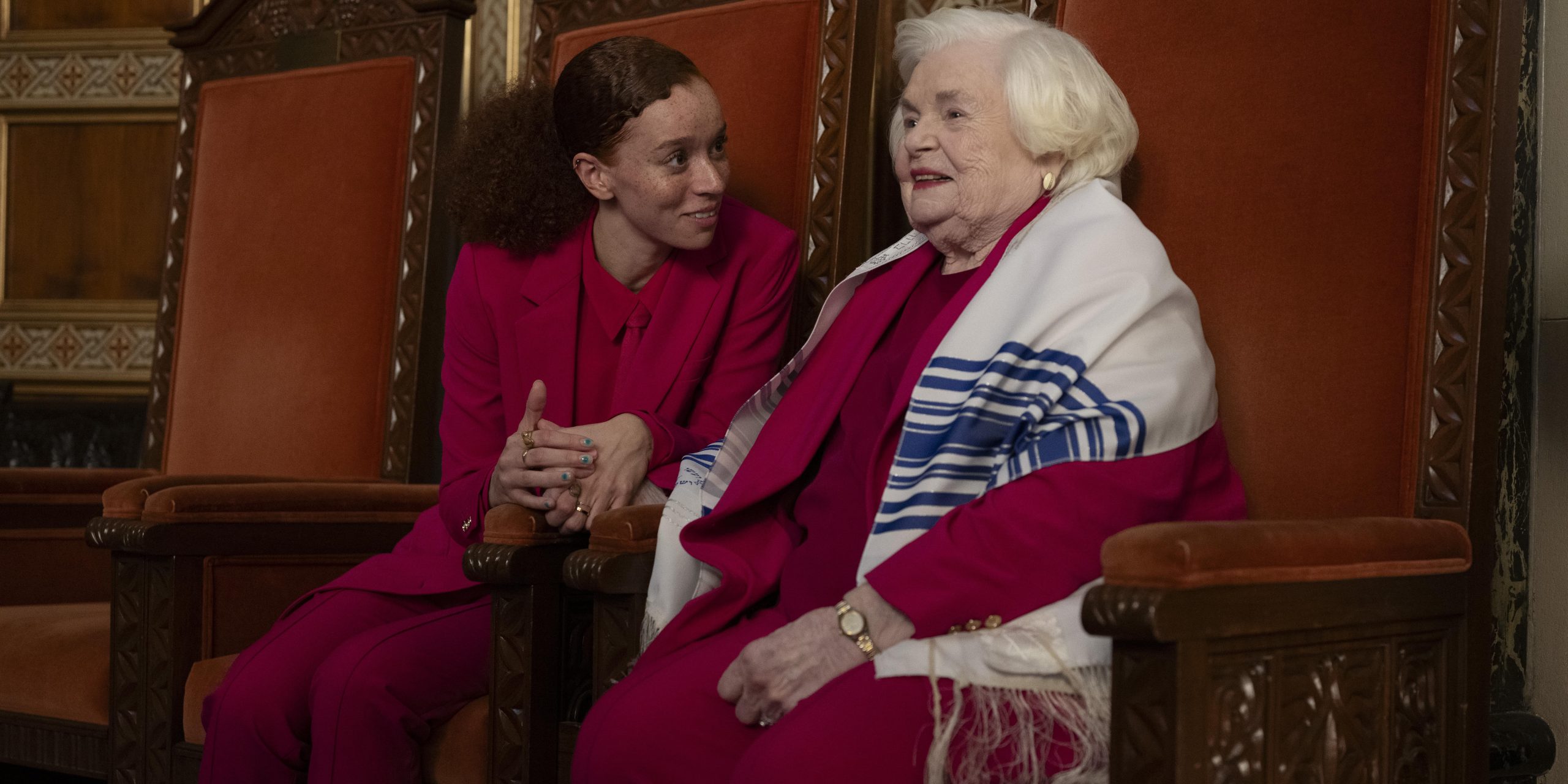
Eleanor Morgenstein (Squibb, Thelma) is a 94-year-old widow in Florida who shares her days with her inseparable best friend, Bessie (Rita Zohar, Amadeus). When Bessie suddenly dies, Eleanor moves to New York to live with her daughter Lisa (Jessica Hecht, Breaking Bad) and grandson Max (Will Price, A Complete Unknown), though neither has much time for her. Searching for connection, she wanders into a group at a Jewish community center, only to realize too late it’s for Holocaust survivors. Long steeped in Bessie’s past, Eleanor recounts her friend’s story as her own. The deception draws the attention of Nina (Erin Kellyman, Solo: A Star Wars Story, 28 Years Later), a young journalism student mourning her mother and struggling with her distant father, Roger (Chiwetel Ejiofor, 12 Years A Slave), a television news personality. As Eleanor embraces the comfort of belonging, her borrowed story begins to spiral beyond her control.
Eleanor The Great is at its best in the scenes focusing on the relationship between Eleanor and Bessie, whose decades-long friendship creates an instantly endearing dynamic. There was a better film to be made that simply followed these two women in their daily lives. Instead, we get a target conventional film with a labored premise that still had the potential to be quite interesting, if only it had the courage to lead up to a more ambiguous conclusion. The lie that Eleanor tells is a serious and potentially very hurtful one, but the circumstances that lead to it leaves plenty of room for ethical questions, and it would be a mistake to judge the character too harshly. It’s an equally serious mistake, however, to completely absolve her of any wrongdoing for the sake of a schmaltzy ending, which is exactly what Johansson and first-time screenwriter Tory Kamen do. Worse, they put a neat little button on it by attributing her actions to a single pitiable factor that’s as much about another character’s self-projections as it is about Eleanor’s motivations. None of this is to say that Eleanor The Great is a terrible movie (it’s a solidly engaging one), but it’s a squandered opportunity. A dating premise that had the potential to be unique and thought-provoking is so heavily diluted that it doesn’t pack any kind of memorable punch.
Squibb is wonderful as the titular Eleanor, and her charisma easily carries the film through its weakest moments. The script lets her down as an actress, and it’s hard not to wonder how truly unforgettable she could have been if the filmmakers had been audacious enough to allow for more ambiguity, and even genuine human flaws. Kellyman is incredibly charming and sympathetic, and the chemistry the two women share drives the film. Eijofor spends most of his career these days by being wasted in underwritten roles, and this is no exception.
Eleanor The Great succeeds as a star vehicle for its leading lady and an opportunity for Johansson to cut her teeth behind the camera, but only marginally so as a movie. It’s worth seeing as an all too rare film focused on a protagonist in their twilight years, but one hopes that Hollywood knows that Squibb still has a better one left in her, and makes it soon. —Patrick Gibbs
Read more film reviews from Patrick Gibbs:
Film Review: The Baltimorons
Film Review: Spinal Tap II: The End Continues
