
Film Review: Mouse
Arts
Mouse
Director: Kenny Riches
Dualist and WZRD Media
In Theaters: 08.21.2026
I’m a sucker for any story that puts two characters on a collision course. In Kenny Riches’ (A Name Without a Place, The Strongest Man) fourth feature, Mouse, an award-winning indie film that brings a warm palette to early 2000s Salt Lake City, this comes in the form of two pen pals: a petty thief and a small-time scam artist.
The thief, Denny (played by Kenny Riches), is a lonely, soft-spoken man on the cusp of middle age whose greatest weakness lies in his conflation of human connection with transaction, materialism and status. This fatal flaw comes to light when he finds an ad for a pen pal service promising love and decides to give it a chance.
As a first-generation Japanese-American immigrant, Denny cares for his aging mother Nobuko (played by Hiroko Oiwa Riches), whose only connections to this country seem to be her childless, unmarried son and the landline she uses to call home. This mother-son dynamic is one of many reasons why Mouse takes the cake as my favorite indie feature of the summer. It’s an authentic and touching portrayal of what it means to be a branch on a family tree with frayed roots and wilting leaves.
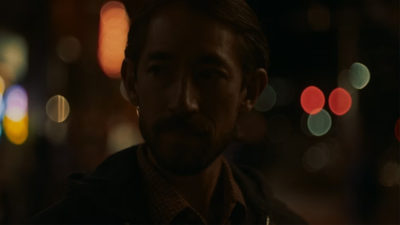
While it’s damn near impossible to overcome Denny’s transgressions (bike thieves deserve a special seat in Hell), it’s even harder to stop falling in love with him as he prepares his mother’s nightly dessert, slicing up her Snickers bar as though it’s a precious roll of sushi. And look, given the film’s tagline, “Eat the rich. Leave no crumbs,” I was initially put off by the protagonists’ many exploits of working-class people. While both Denny and Tess (played by Sarah Coffey, Godhead, Queens of the Dead) offer spitfire justifications for their actions and detailed manifestos on why crimes against the owning class are just too risky, it doesn’t do much to alleviate the cognitive dissonance.
What does get me over this hurdle, however, is recognizing that Mouse has no interest in forcing its viewers to sympathize with either Denny or Tess. Instead, it simply tells us the story of two complicated people destined to collide with one another in a maze of double-crossings — and it does so masterfully. Along the way, it shows us the good and the bad. Tess’ meet-cute, for instance, with her boyfriend Maury (played by Kimball Farley, The Righteous Gemstones, Recluse) takes the shape of a mugging-gone-wrong, in which Tess maces Maury then subsequently takes pity on him. Beyond capturing Tess and Maury’s moral complexity, this scene showcases a tone that elevates Mouse into something truly novel.
The film’s stakes continue to ratchet up after Denny steals the wallet of Charles Chandler (Eric McGraw), a mysterious man living in a mansion above the city. Initially, Denny sticks to his mantra of “small crimes only,” using Chandler’s credit card to pay for Tess and Maury’s pen pal scam. But as the film unfolds, Denny crawls deeper into a maze of his own making and it becomes clear that he’ll resort to anything before accepting his place in an unjust world. As tensions reach a critical mass, the film’s greatest strength reveals itself in the stark contrast between Denny’s false identity — as detailed in his letters to Tess — and that of his true self.
In watching Denny’s life of petty crime devolve into something much more foreboding, I can’t help but compare Mouse to Bong Joon Ho’s dark comedy masterpiece Parasite (2019). And while Riches may be several feature films away from joining the ranks of Bong, I’m certain his talent for filmmaking will be the last thing holding him back. —Keyon Hejazi-Far
Read more film reviews below:
Film Review: Insidious: Out of the Further
Malynda Hale on Bringing Humanity To The Screen in Bull Street
To help SLUG continue covering upcoming films, consider joining our community of donors!
