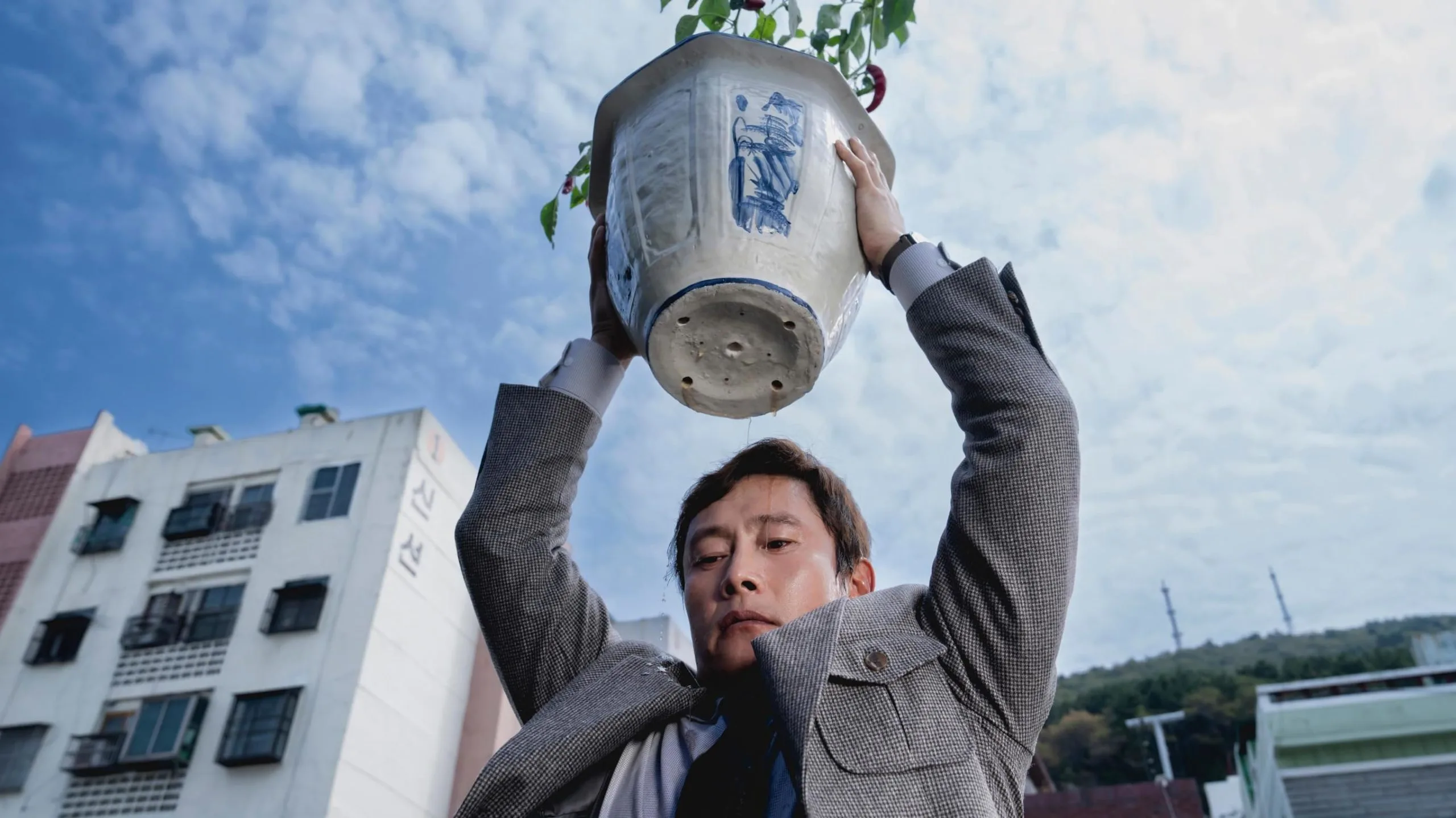
Film Review: No Other Choice
Arts
No Other Choice
Director: Park Chan-Wook
CJ Entertainment, Moho Film, KG Productions
In Theaters: 12.25.2025
Ever since Parasite rocked the Academy Awards back in 2019, Korean cinema (and by extent, Korean media) has been getting a lot more attention in America, which is a great thing. However, the repercussions of Parasite and Squid Game’s popularity is that a lot of films coming out of Korea with similar themes and ideas will immediately be compared to those stories. Yes, No Other Choice has a lot in common with them — dark humor, slapstick action, elements of horror, Lee Byung-hun — but to be honest, this film is far more creative and smart.
No Other Choice follows paperman Man-su (Lee, Squid Game, I Saw the Devil), who is fired from the company that has fed him and his family for 25 years. Though he’s assured by a group therapist (through repetitive taps and mantras) that he will find a job before his three months of severance runs out, he fails to get hired after over a year of odd jobs and awkward interviews at paper companies. Tired of the search, Man-su contemplates killing a manager at Moon Paper and filling his position, but rightly deduces the identities of two other papermen that Moon Paper would rather fill the position with and plans their murders.
No Other Choice is the most modern film I’ve seen in years — the product of millennial writers with iPhones and children is bad dialogue. It’s a real “how do you do, fellow kids” situation, where they attempt to appeal to a generation of people they cannot even begin to fathom. Rather than succumbing to that, characters in No Other Choice have a realistic relationship with technology. Several huge, character-developing moments happen when “Mrs. Wife” facetimes Man-su, who stalks his victims through the internet. The job interviews are wildly uncomfortable, and it’s impossible to get anybody to notice Man-su’s accomplishments. Characters discuss their own obsolescence and inability to change in favor of retro methods of living.
No Other Choice is an eat-the-rich film — a genre over-saturated by talentless, rich filmmakers — but what makes it distinct is where it places the blame. Yes, it blames the corporations for cutting beautiful, handmade production lines in favor of a “lights-out system” (AI doesn’t need lights), but it also rightly blames these high-earning workers for their absurd loyalty. The analog-heavy characters are stubborn and unbelievably loyal to a system that does not value them. Man-su rightly tells one of his victims that he’s stupid for ignoring wife’s reasonable offer to run a café in favor of pursuing the industry that fed him for 25 years. In a time when experts can be replaced and when employees can be cut for newer, uglier and lower quality technologies, we shouldn’t let our loyalty be abused. Just like the bosses that fire us, we convince ourselves that we have no other choice.
This is only the second Park Chan-wook film I’ve seen (the first being Oldboy), and I was not familiar with his game. He is reinventing the way films can be shot, with fantastic yet awkward zooms, overlays that heighten visual metaphors and transitions that don’t distract from the plot (fuck you, Baz Luhrmann). Park’s style is so distinct and beautiful that I didn’t even know you could make films that look like this.
There’s a slapstick quality to this film that you’ll probably recognize from Parasite, but done here to Charlie Chaplin levels. There’s a fantastic action sequence where Man-su unfolds several layers of kitchen mitts to reveal a gun, and even when it’s revealed, he has to unwrap it from thick layers of plastic wrap. Characters flail on the ground as they struggle for survival and for their humanity.
There’s no reason Lee shouldn’t win an award for his performance. A blank face expresses so much. A stupid mustache symbolizes excess and comfort. An unnerving uncaniness makes what he does that much more gruesome. He nails the humor while maintaining the tension. Son Ye-Jin (A Moment to Remember, The Last Princess) plays Man-su’s wife, Miri. Smart and loyal, there isn’t a second that she gives Man-su a rest.
Foreign films are hitting America hard. It’s the easiest way for anybody to consume art, and therefore the easiest way to “consume” other cultures. Korean films are great and you should see as many as you can, but remember that there are tons of other terrific films coming out of other countries that are just as much worth your time. Korean films are successful in part because their culture is more attractive to us than others. Go out of your way to see films from cultures far removed from your own. You may not be able to afford world travel, but you can afford a movie theater ticket. —B. Allan Johnson
Read other reviews by Contributing Writer B. Allan Johnson:
Film Review: The Smashing Machine
Film Review: Sentimental Value
