Film Review: Nuremberg
Film
Nuremberg
Director: James Vanderbilt
Bluestone Entertainment, Walden MediaMythology Entertainment, Titan Media
In Theaters: 11.07.2025
“We are able to do away with domestic tyranny and violence and aggression by those in power against the rights of their own people only when we make all men answerable to the law.” —Justice Robert H. Jackson
If this quote doesn’t immediately strike you as being alarmingly topical, you’re likely to miss a good deal of the point in retelling the story of the Nuremberg trials. The mere fact that yet another film on the subject is urgently necessary speaks volumes about the difference between a basic knowledge of history and learning from it.
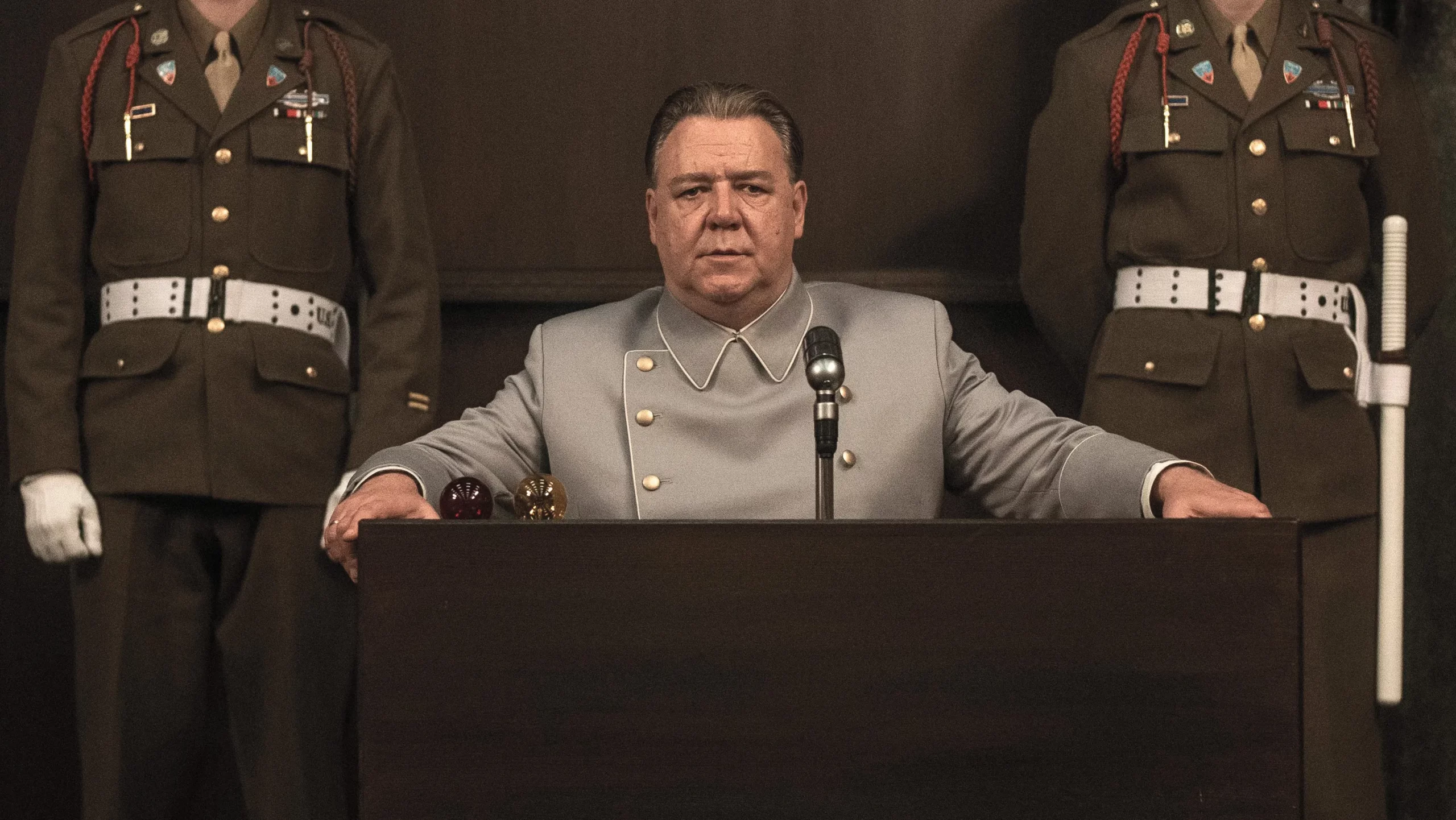
Nuremberg begins in 1945, as Reichsmarshall Hermann Göring (Academy Award winner Russell Crowe, Gladiator), second in command to Adolf Hitler, surrenders himself to the American forces in Germany. As Justice Jackson (Michael Shannon, Revolutionary Road, The Shape of Water) is recruited to put Göring and the rest of the Nazi High Command on trial for crimes against humanity, Lt. Col. Douglas Kelley (Academy Award winner Rami Malek, Bohemian Rhapsody) a U.S. Army psychiatrist, is assigned to evaluate the mental state of those awaiting trial. Kelley eagerly throws himself into the task, believing that if he can crack the code and determine what made the Germans uniquely susceptible to such madness, he can write a book and make a fortune. Instead, Kelly is quickly ensnared in a battle of intellect and ideology, as Göring manipulates every encounter. As the trials approach, Kelley’s objectivity erodes, forcing him to confront not only the evil he studies, but the unsettling truth: This could have happened anywhere, and it will very probably happen again.
The combination of trying to keep the film at a reasonable runtime and being a Hollywood dramatization results in liberal consolidation of characters and events, and a number of well-known aspects of the story don’t make it into this telling. While it can’t help but touch on some of the larger scope, the film isn’t meant to be comprehensive chronicle of the trails. In fact, it’s an adaptation of The Nazi and the Psychiatrist by Jack El-Hai, a book about the psychological impact that the relationship between Göring and Kelly had on both men. It’s also about Kelly’s conclusions that while the atrocities committed by the Nazis were monstrous, they were not committed by monsters, but rather by ordinary people no more predisposed to such atrocities than any of us.
It’s a take that is becoming increasingly unpopular once again, as any comparison between the modern right and its fascist forebears is shot down as hyperbolic or even calculatingly dismissed as inflammatory. “He made us feel German again,” Göring says when Kelly asks about the draw that Hitler had for him and others. “Even with his antisemitism, it served its purpose. It brought to us men who needed something else to focus their emotions. Something else to blame.” That callous observation about the usefulness of hate as a recruitment tool couldn’t be more disturbingly relevant today, nor could the justification that “We were elected by the people and given a mandate,” or perhaps the most frighteningly timely line of all: “We found it necessary to no longer permit opposition.”
The scenes between the Nazi and the psychiatrist have moments of genuinely pleasant human connection, including Kelley teaching Göring a magic trick. The comfort level and civility between doctor and patient is finally destroyed when film footage of the camps is shown in the courtroom, using real archival reels that are quite graphic and upsetting. This may not be something you want to see, but it feels all the more important to be reminded of it as Göring hides behind the assertion that to his knowledge, the solution to “the Jewish problem” was concentrated on emigration and deportation, and indeed, it did start out that way. If you can watch this footage in that light — and also see things such as the viral video of a violent ICE arrest taken this past week at the Salt Lake City Airport by my longtime friend, local author Shannon Hale — and not feel sick, Kelley’s assertions may apply to you as well.
The cast is superb, with Crowe in top form, rebounding from a period of seeming irrelevance and reminding us that his commanding screen presence. His insistence on bringing complex characters vividly to life without judging them, still make him one of the greats. In what is surely an unprecedented level of preparation and method acting, Crowe spent 20-plus years gaining the weight necessary to convincingly play the Reichsmarshall. The acting is so strong that even the rabid fan I am of all things related to Superman except for Dean Cain, I managed not to be distracted while watching Shannon’s Justice Jackon grilling Göring on the stand, quickly dismissing the fact that I was watching Man of Steel’s General Zod and Jor-El. Malek gives easily his most charismatic performance since winning his Oscar, and perhaps best of all are Richard E. Grant (Can You Ever Forgive Me?) as British prosecutor David Maxwell Fyfe, and especially Leo Woodall (Bridget Jones: Mad About The Boy) as St. Howie Triest, an American soldier who served as a translator for the Nazi while dealing with very personal trauma.
Whether or not Nuremberg is truly one of the year’s best films, it’s a remarkably good one, and the importance of its message at this point in time simply cannot be overstated. Fascism, evil and even genocide have happened and can happen again, absolutely anywhere, especially if nationalism masquerading as patriosm and a belief that empathy is a made up concept continue to flourish. —Patrick Gibbs
Read more film reviews by Patrick Gibbs:
Film Review: Bugonia
Film Review: Stitch Head
