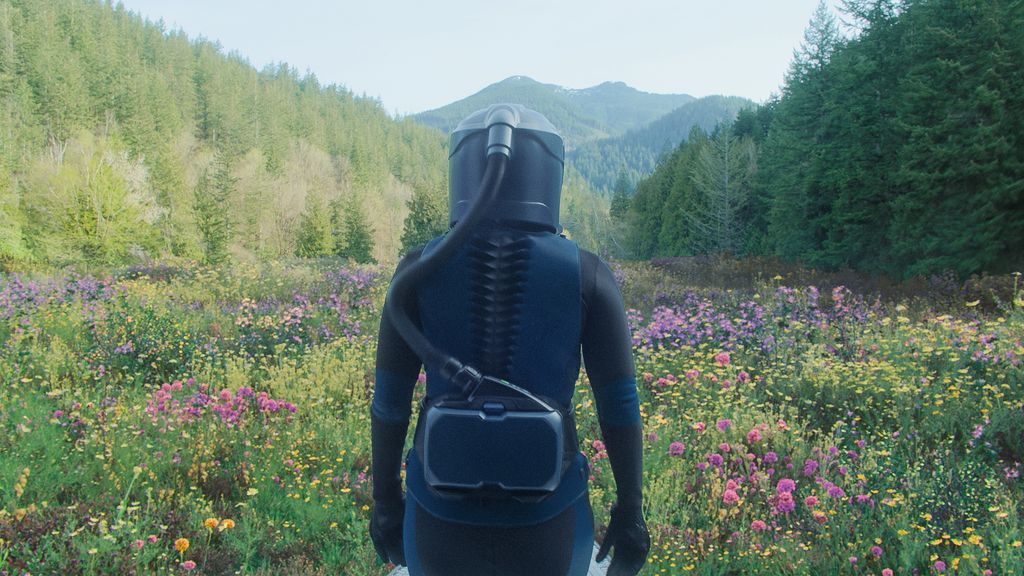
In the Blink of an Eye Promises Hope but Delivers Hollowness
Arts
Sundance Film Review: In the Blink of an Eye
Director: Andrew Stanton
Searchlight Pictures, Mighty Engine
Premiere: 01.26.2026
Andrew Stanton is a legendary Pixar powerhouse — his directing and writing credits include Finding Nemo, WALL-E, A Bug’s Life and Toy Story — which makes it all the more tragic that his second live-action attempt fails so spectacularly. He succeeds in breaking out of the standard three-act structure trap, but the result is a sweeping mess whose message about life, death and humanity’s fleeting presence on Earth is a lot more hokey than hopeful.
In the Blink of an Eye tells three stories: A neanderthal family in 45,000 BCE, a grad student couple in 2025 and a space traveler in 2417. Don’t get me wrong; I’m usually a sucker for interconnected storylines, but Colby Day’s screenplay is so broad and all-encompassing that the emotional stakes end up feeling disappointingly low. Comparisons to Cloud Atlas are obvious, but I’ll throw in a few more references from my past Sundance viewings: It’s Sasquatch Sunset (complimentary) mixed with Love Me (derogatory), plus a generic Netflix romance tossed in the middle for good measure.
The strongest of the three tales is the one told with no words at all. Jorge Vargas is warm and protective as Thorn, a prehistoric father living with the pregnant Hera (Tanaya Beatty) and their curious young daughter Lark (Skywalker Hughes). Together, they hunt, gather, grieve losses and grow old, until everything changes when they encounter a band of homo sapiens. The film’s most genuine and tender moments arise when Thorn teaches Lark how to build a fire or make a pictograph. It’s beautifully shot in British Columbia, accompanied by Thomas Newman’s grand, elegant score.
A grunting caveman sex scene cuts to an awkward one-night stand in the present day, the first in a series of cheeky but contrived parallel shots that serve as transitions between the numerous time jumps. The friends-with-benefits situation between ambitious anthropology student Claire (Rashida Jones, Parks and Recreation) and her kind, goofy classmate Greg (Daveed Diggs, Hamilton) evolves into something more when she flies home to care for her dying mother. Their long-distance relationship falls flat, however, with more focus on hitting thematic points — ie, love in the face of human frailty — than building a real romance.
Meanwhile, in 2417, the “longevity-enhanced” scientist Coakley (Kate McKinnon, Saturday Night Live) and her robot copilot Rosco (voiced by Rhona Rees) are traveling to distant planet Kepler 18b with hundreds of embryos for a new human settlement. It’s obvious the script was written over 10 years ago because Rosco is a shockingly benevolent AI who, in an unconvincing twist, ultimately sacrifices itself for a human. McKinnon gives it her all in her first fully dramatic role, though her sincere performance is restrained by the story that prioritizes exposition over emotion.
In the Blink of an Eye won the festival’s annual Alfred P. Sloan Prize for the best depiction of STEM in film, and to its credit, this comes through in the detailed neanderthal language as well as the genuine portrayal of loneliness in a futuristic, technology-dominated world. Mollie Goldstein’s editing is technically impressive too, but the excessive time jumps make it impossible to care about any one character.
In the end, the three timelines are reconciled with a bland inspirational message. Stanton and Day fail to realize that the beauty of humanity is in the uniqueness and specificity of each individual experience, not in some universal story that encompasses everyone and everything. In the Blink of an Eye opens with a cellular depiction of the beginning of life, underscored with Sylvia Plath quote, and ends with a zoom out to the galaxy, paired with an oversentimental monologue that spells it all out: “The human lifespan has been nothing more than the blink of an eye.” The film’s straight-to-Hulu release next month will surely be here and gone just as quick. —Asha Pruitt
Read more of SLUG’s coverage of the 2026 Sundance Film Festival.
