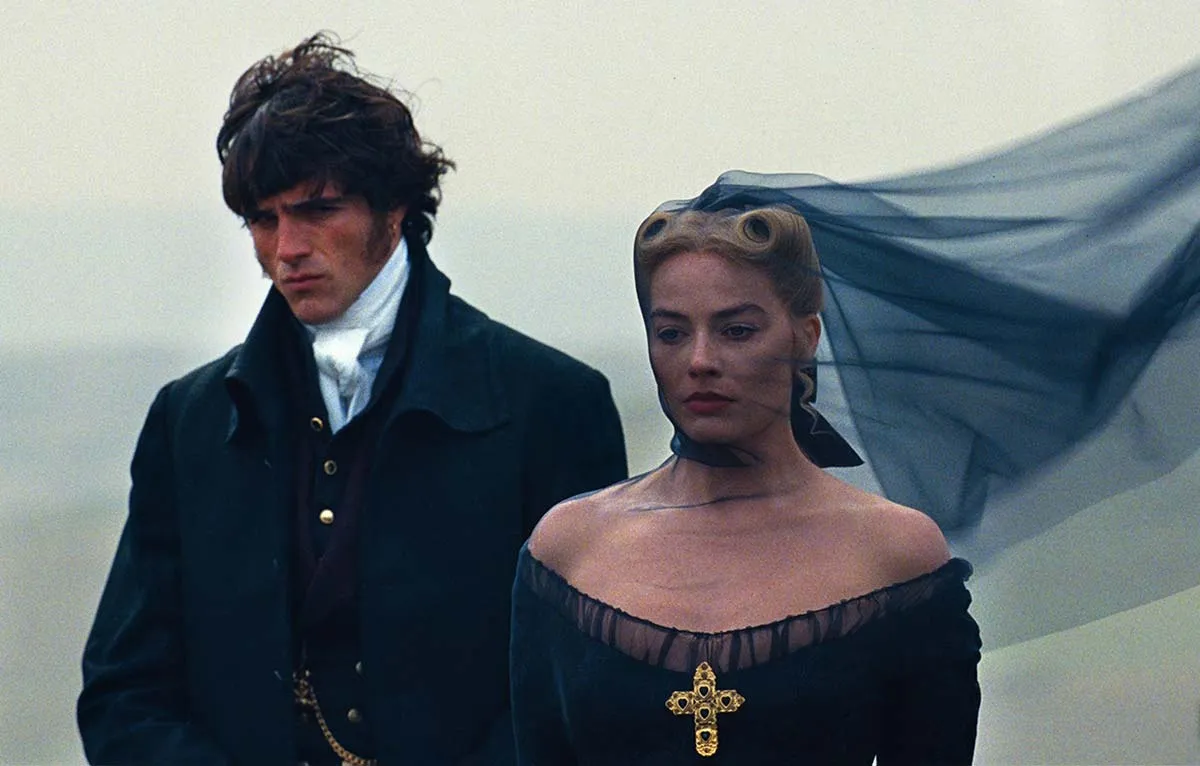
Moor is Less in Emerald Fennell’s “Wuthering Heights”
Arts
“Wuthering Heights”
Director: Emerald Fennell
MRC, Lie Still, LuckyChap Entertainment
In Theaters: 02.13.2026
Before examining writer-director Emerald Fennell’s glossy take on “Wuthering Heights,” two clarifications are necessary: I’m not a purist — by definition, I expect adaptations to reinterpret their sources — and Fennell’s quotation marks are intentional, signaling both a personal vision and a preemptive shield against the inevitable backlash from hardliners.
Young Catherine Earnshaw (newcomer Charlotte Mellington) lives in the estate of Wuthering Heights on the Yorkshire moors, when one day her father, Mr. Earnshaw (Martin Clunes, Shakespeare in Love, Men Behaving Badly) brings up a young orphan boy (Owen Cooper, Adolescence) whom he has rescued from being beaten and neglected. Catherine takes to the boy at once, naming him “Heathcliff” after her favorite orange, street-smart cartoon cat (or maybe it was her late brother, I forget).He becomes her playmate and, as her father puts it, “her pet.” Catherine controls Heathcliff, but she also protects him from her alcoholic father’s rages, and the two form an intense bond. As they grow older, Catherine (Margot Robbie, Barbie) longs for an escape from Wuthering Heights (and possibly for the invention of the vibrator). Meanwhile, the single-minded Heathcliff longs only for lasagna — no wait, sorry, that’s Garfield. Heathcliff (Jacob Elordi, Frankenstein) longs for Catherine. When Catherine sees an opportunity for security and respectability by marrying Edgar Linton (Shazad Latif, Star Trek: Discovery, What’s Love Got To Do With It?), a decision that devastates Heathcliff and fuels his sense of betrayal. After disappearing for years, Heathcliff returns hardened and determined, still consumed by Catherine and the life he believes was stolen from him. Their reunion reignites old passions but only deepens the emotional damage, as resentment, jealousy and obsession spiral out of control.
There’s been a lot of pre-judgment on this film based on the ad campaign, and I’ve been determined to enter it with an open mind, and I kept it open as long as possible. There’s no denying that Fennell’s visual skill as a filmmaker, combined with the singular talents of master cinematographer Linus Sandgren (American Hustle, La La Land), make for a gorgeous film that is a technical marvel, but behind that lush facade is a clumsy, horny, frustratingly hollow and utterly dumbed-down mess. “Wuthering Heights” manages to go on far too long while barely scratching the surface of the story. Emily Brontë‘s book is an exploration of obsessive love, classism, abuse, resentment and emotional isolation. Fennell’s film is an emotionally flat and clumsily paced bodice ripper that’s so blemished by out of control hormones that I kept finding myself wanting to reach out to the screen and pop it to see if I could get the pus to drain out. The movie is so focused on lust and desire that it never manages to create a heartfelt emotional connection between Heathcliff and Catherine, and changes in the story and character set up hopelessly dilute the true dynamic (one significant example being the omission of Catherine’s brother, Hindley). I really don’t mind a version of Wuthering Heights that emphasizes sexual tension, but Fennell goes beyond that to make it a lurid tale of an illicit affair, and the heart of Brontë’s work is lost in favor of focusing on more popular organs. Fennell is starting to make reinventing existing stories her thing, which I don’t inherently object to, but in her last film, she called her movie Saltburn when it was really just a sexed up version of The Talented Mr. Ripley, and now she’s calling a movie “Wuthering Heights” when it patently is not telling that story. In fact, while the production design is marvelous, Wuthering Heights (the location) is barely a presence in the film, with the Lintons’ manor, Thrushcross Grange, getting more visual emphasis, and Wuthering Heights’ emotional importance is all but lost.
Robbie is a skilled and highly appealing actress, but she’s entirely miscast as Catherine Earnshaw, making the character much harder to sympathize with because she’s far too old to be this immature. Elordi nails the smouldering intensity of Heathcliff, but Fennell pushes his cruelty to sick extremes for pure shock value. He makes his wife, Isabella (Alison Oliver, Saltburn, Christy), eat off the floor, stay tied up and pretend to be a dog for his amusement, taking out his anger at Catherine on her. Complex characters who behave abominably are reduced to caricatures who are so thoroughly unsympathetic that by the end, the only feeling of wanting them to be together comes from a desire to keep them away from everyone else. Latif’s Linton, on the other hand, is so softened that he’s the one I ended up caring about. Hong Chau (Downsizing, The Whale) as Nelly Dean, Catherine’s servant, continues her long-standing tradition of giving stellar performances in films that don’t deserve her.
“Wuthering Heights” is such a sumptuous piece of cinematic craftsmanship and design that part of me is tempted to pay to see it in IMAX, and I can’t completely dismiss it as being without merit. I can’t pretend that it’s not a thin, soulless and inane piece of fluff, either, and it’s hard not to be a bit of a purist when a great work is treated so poorly. —Patrick Gibbs
Read more film reviews by Patrick Gibbs:
Good Luck, Have Fun, Don’t Die is a Timely Warning
Luc Besson’s Dracula Lacks Bite
