Nuisance Bear: A Meditation on the Marriage of Man and Mother Nature
Arts
Sundance Film Review: Nuisance Bear
Director: Gabriela Osio Vanden, Jack Weisman
Documist
Premiere: 01.24.2026
In the 21st century, even the most accessible David Attenborough-narrated nature documentary carries an undercurrent of sadness, as we are constantly confronted with the fact that man’s avarice is slowly killing our planet.
There’s an odd irony that tangles up mankind’s relationship to nature. The more comfortable and established we have become, the more wild animals have wanted to gravitate towards us. Yet the closer we get to nature, the more scared we get, and the harder we fight back.
And perhaps most confusing of all, many of our attempts to reconnect with nature ultimately end up harming it. After all, can we lament the loss of the polar ice caps, as we fly and drive thousands of miles to go visit it, hoping to see it one last time before it’s “all gone?” Man’s ironic relationship with nature is precisely what Nuisance Bear taps into.
Nuisance Bear doesn’t play like your typical nature documentary. Rather than bombarding you with facts, statistics and infographics, it allows nature to speak for itself. While humans play a huge role, there’s only a single interview that acts as the narration for the entire film: Mike Tunalaaq Gibbons, an Inuit man who relays his culture’s beliefs surrounding bears in his native tongue. His narration immediately anthropomorphizes polar bears as he states that in ancient times, men and polar bears were equal, but that shifted as soon white settlers showed up. The film explores the Inuit’s modern relationship with polar bears and how that has been affected by a variety of factors, from combustion vehicles to the Canadian government’s strict lottery system that only allows for a few bears to be hunted per year.
Stunningly cinematic camera work breathes life into this story and immerses audiences deeply in the tundra of the far north. The film contains dozens of shots that are so perfectly blocked and framed that for a moment you might forget you’re not watching a scripted feature. I have often said that nature documentarians have to be some of the most talented camera operators on Earth, and Nuisance Bear is further evidence of that.
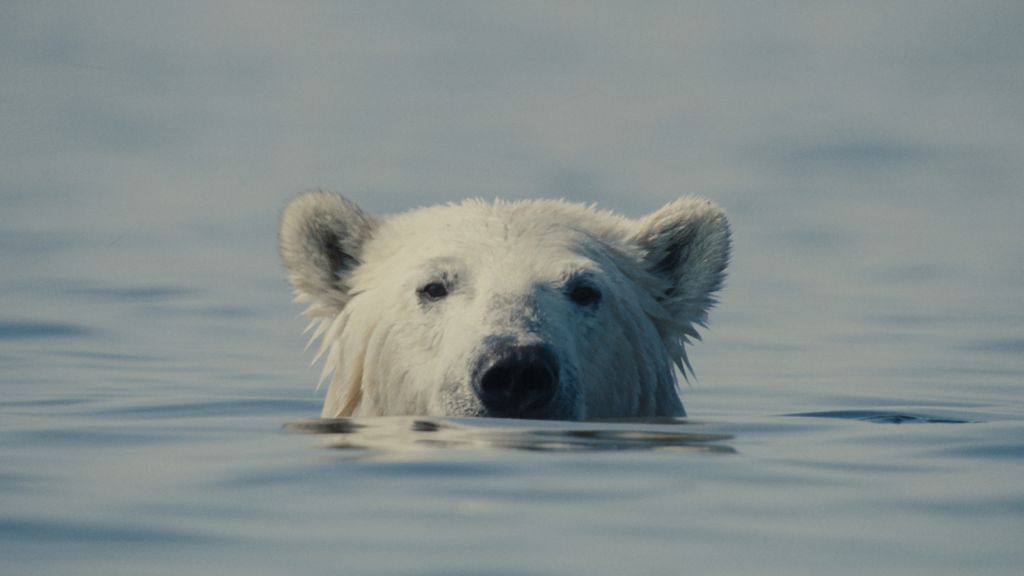
Nuisance Bear spends much of its runtime following a single bear who wanders near Churchill, Manitoba, colloquially termed the “Polar Bear Capital of the World.” He is eventually deemed a threat to the community, tranquilized, tagged and moved to a new location further north, only to find that he is then a “nuisance” to the Inuit community there. Many films have followed this general formula, but it’s the way in which Nuisance Bear presents its subject that is so ingenious. I’ve never seen a documentary like this that actually tries to explore the psychological workings of its animal subjects.
Using brilliant sound design (including Cristobal Tapia de Veer’s deeply affecting score) Nuisance Bear often puts us in the proverbial shoes of its polar bear subject. In a moment when he is under the effects of tranquilizers, the audio is muted and distant, placing us squarely in the bear’s point of view.
But most striking of all are the film’s sporadic “dream sequences,” often a hazy montage of seals swimming under ice, specters of a past when food was naturally easier for a polar bear to find. These moments, though brief, are emotionally crushing. Of course animals dream, anyone who owns a dog has seen that before. But do most people extend that same understanding towards “wild” animals? Who’s to say that polar bears don’t have dreams? Who’s to say that they aren’t just as capable of feeling as we are, just incapable of communicating it to us?
With all that comes a deep degree of empathy. Any sign of danger immediately tugs at the heartstrings. There’s a particular moment where police officers have trapped a group of polar bears against a fence and are trying to scare them off by shooting them with paintballs. I could hardly watch them roar in pain and panic without bursting into tears. It is the great irony of man’s relationship with nature: In trying to help them, we are also harming them.
Nuisance Bear is a film that strives for pathos above all else, and it is brilliantly successful in that venture. I’m not sure I’ve ever seen a nature documentary that successfully places you so intimately into the mind and heart of its animal subjects. It’s undeniably moving. As our planet slowly circles the drain, I can’t help but wonder if it’s even possible for humankind in its current form to ever live harmoniously with nature again. —Seth Turek
Read more of SLUG’s coverage of the 2026 Sundance Film Festival.
