Kogonada Films in Fragments in Zi
Arts
Sundance Film Review: zi
Director: Kogonada
Premiere: 01.24.2026
I can always tell when a movie is going to be polarizing — half of the audience squirming in awkward silence and contemplating walking out, the other half rapt with attention and a breath caught in their throat. zi, filmed in Hong Kong over three weeks with a team of just seven people and no real script, is not for everyone (as seen in its Letterboxd review distribution, with roughly equal amounts of one and five star ratings). But when I exited the screening, tears flowing freely, I was firmly in the five-star camp.
The Sundance 2026 premiere of zi comes shortly after the commercial failure of A Big Bold Beautiful Journey, Kogonada’s first (and most likely last) studio movie. zi marks the director’s return to micro-budget experimental filmmaking and a reunion with his favorite muse Haley Lu Richardson, who starred in his 2017 feature debut Columbus. It’s clearly a deeply personal project and, as he told his Sundance audience, the one that he’s most proud of.
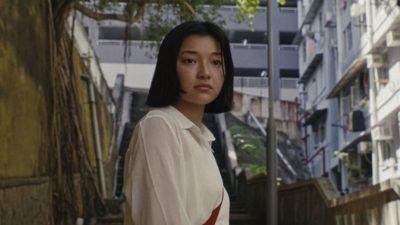
“I was lost that day. Stuck somewhere in the past,” says Zi (Michael Mao) to herself in the film’s opening scene. She sees visions of her future self, following its shadow through every corner of Hong Kong, her sense of time collapsing until she can’t tell what’s now and what’s later. The existential themes and rejection of traditional filmmaking evoke French new wave cinema, and much like Cléo Victoire in Agnes Varda’s 1962 film, Zi seeks comfort and escape while awaiting test results from a neurological center.
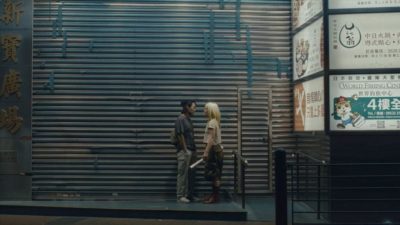
In a seemingly fated chance encounter, Zi meets Elle (Richardson), a foreigner with a cheap yellow-blonde wig and a penchant for observational quips, who resolves to help her while simultaneously managing her own baggage. Later, they meet Elle’s ex-fiancé Min (Jin Ma), and the three embark on a late-night jaunt through the city, determined to keep Zi living in the present for at least one more day. Elle is so quirky and effortlessly charismatic that she sometimes veers into manic pixie territory, but Richardson portrays her as a genuine and grounding force. Ma’s performance is quiet and understated, as Min slowly comes into focus and begins to pull his own emotional weight.
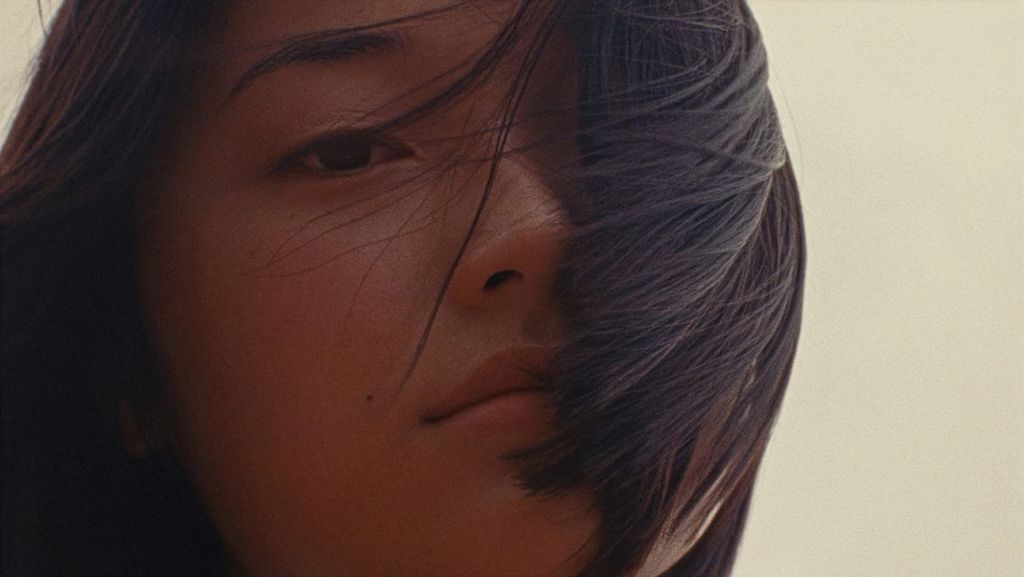
zi’s filmmaking style is more like a documentary than a narrative film, and Kogonada is far more interested in cultivating a feeling than advancing a plot. Cinematographer Benjamin Loeb uses a shaky handheld camera, alternating between uncomfortably close shots that feel like intruding on the trio’s strange dynamic, and extreme wide shots that emphasize their insignificance in the enormous, beautiful city that envelops them. The camera always serves as an observer in any film, but in zi, you really feel its presence, breathing and watching alongside the audience.
The sounds of Hong Kong hum and pound, accompanied by ambient piano compositions from the late Ryuichi Sakamoto, to whom the film is dedicated. Each character gets to sing their own song, too: Zi’s earnest rendition of the ancient poem “Prelude to Water Melody” set to a traditional Chinese melody, Elle’s tipsy, off-key karaoke performance of “Hand in My Pocket” and Min’s melancholic a cappella strain of “Leaving on a Jet Plane.”
Grief is at the center of the film, but so is serendipity and kindness. All Zi remembers about her deceased parents is the backs of their heads; similarly, that’s all she can see of her own future self. Zi and Elle have both given up on their passions of violin and dance, respectively, and are now reckoning with how to move on. Yet in spite of their struggles, or perhaps because of them, the two women share something special — beyond friendship or romance — that ties them together across the floating fragments of time. The final gut punch comes from Richardson’s own mother Valerie, whose brief appearance creates a perspective shift that feels like an enormous release.
While the film is symbolic of Kogonada rediscovering his voice and love for his craft, the characters still stand on their own as real, fleshed-out humans rather than wisps of philosophical musings. Critics will call it incoherent and meandering, but zi is utterly organic and ethereal; you can tell that everyone involved was absolutely invigorated by the experience of making it. —Asha Pruitt
Read more of SLUG’s coverage of the 2026 Sundance Film Festival.
