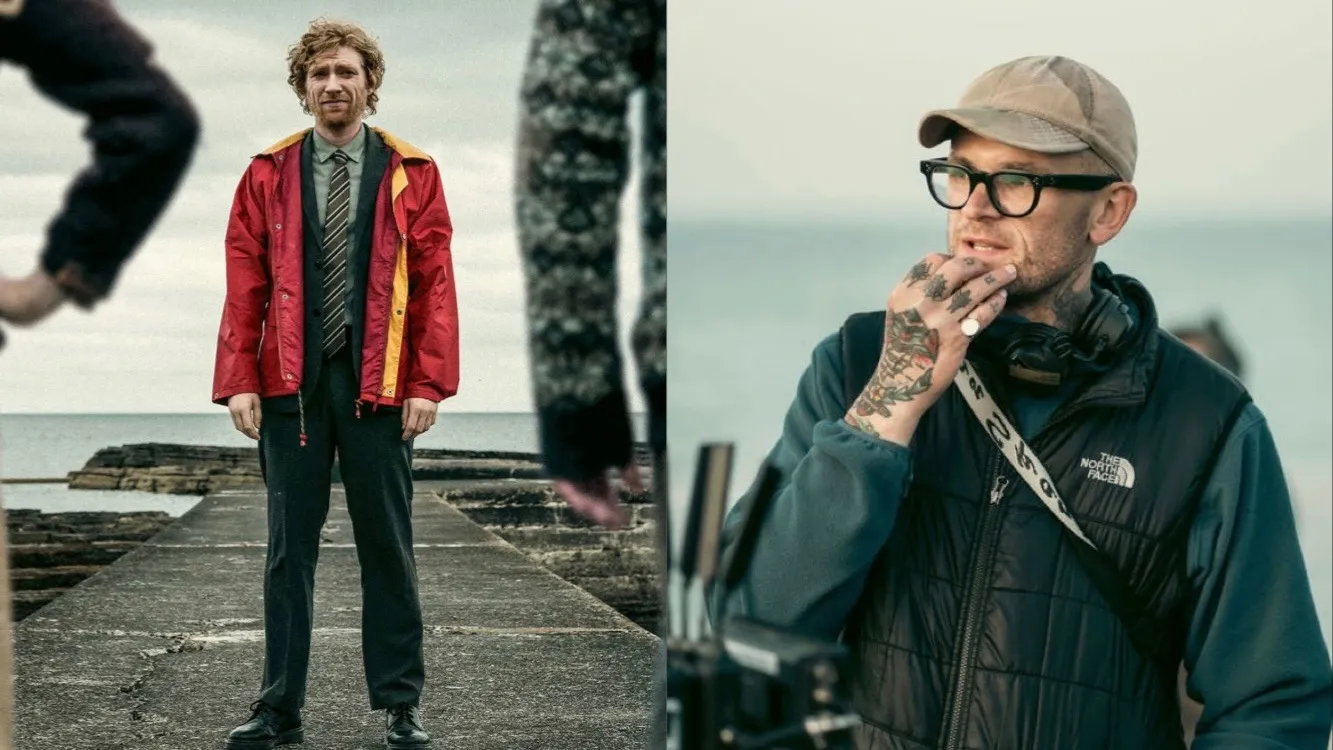
How Louis Paxton Came Into His Own with The Incomer
Film
Louis Paxton’s path to the 2026 Sundance Film Festival feels as carefully layered as his film, The Incomer. Paxton has been shaped by years of formal training, genre-hopping shorts and a deep personal connection to Scotland’s most remote landscapes. After studying at the Royal Conservatoire of Scotland and completing an MA in Directing at the National Film and Television School in London, Paxton built a reputation through short films that moved freely between comedy, drama, horror, and even musical storytelling. Now, he’s the award-winning director of a feature film, after The Incomer walked away with the NEXT Innovator award, as the unique and quirky comedy made quite an impression.
“I’m from Edinburgh, Scotland,” Paxton explains, before tracing the film’s roots to the far north. “In the far north, we have these islands, the Orkney Isles, which are wild and kind of barren and stunning. And I’ve been going there since I was very wee.” Summers spent exploring Neolithic dig sites, shipwrecks and listening to folk tales about fin men and selkies shaped his imagination early on. Paxton recalls learning about people who once survived by eating seabirds, burning peat and enduring a brutally simple existence on wind-swept isles. “I just found all of that fascinating,” Paxton says. Those ideas lingered for years before crystallizing into a film. Set on a remote Scottish island, The Incomer follows siblings Isla (Gayle Rankin, House of the Dragon) and Sandy (Grant O’Rourke, Outlander), who have lived in isolation for decades, surviving on seabirds, folklore and a fierce distrust of outsiders. Their insular world is disrupted when Daniel (Domhnall Gleeson, About Time, The Paper), an awkward land recovery coordinator, arrives with orders to force them back to the mainland.
When Paxton finally began writing The Incomer, practicality was part of the appeal. “I wanted to make a film that was achievable and small,” Paxton says. “If I set something on an island and I have a cast of like two or three, then I could do that.” But his instincts as a storyteller quickly pushed against those limitations. “Through writing it, it ended up becoming much more ambitious,” Paxton admits. Despite its intimate scale, the film involved water work, cliffside shooting, and visual effects, including the Fin Man, a mythological figure realized through a mix of practical effects and VFX. “It seems like a small film,” Paxton says, “but it’s not necessarily the easiest small film to shoot.”
One of the film’s most memorable sequences — the climactic attack involving gulls — captures Paxton’s playful, hands-on approach. “No, it wasn’t real,” Paxton says of the more heightened moments. “We did that with a mixture of VFX and puppets.” Those “puppets” were often stuffed birds manipulated just out of frame, an experience Paxton compares to indulging childhood fantasies inspired by the rabbit in Monty Python and the Holy Grail. Real birds were also used, though with mixed success. “They were actually famous birds,” Paxton says. “They were in The Lighthouse with Robert Pattinson. One was called Lady, and one was called Scampy.” Highly trained but stubborn, they often refused to perform on cue, leaving handlers to improvise. “It was complicated,” Paxton says, “but it was really, really fun to shoot.”
Paxton wrote the script with O’Rourke in mind from the beginning “I’ve known Grant since my first short film,” Paxton says. “We’ve made a lot of shorts together, and he’s fed into every draft of the script going back ten years.” Sandy’s mix of innocence, comedy and underlying threat grew directly out of O’Rourke’s strengths. Everyone else, Paxton explains, had to fit the world rather than define it. “Gayle was our first choice, and Domhnall was the best choice by far,” Paxton says, crediting all three leads with bringing something essential to the finished film. That casting also fed into one of The Incomer’s running jokes: Daniel’s enthusiasm for fantasy epics. The legal gymnastics required to repeatedly reference Lord of the Rings became part of the creative process. “We kept coming back to the same joke,” Paxton says, noting that alternatives choices — mainly, Star Wars or Harry Potter — were complicated by Domhnall Gleeson being a recognizable part of both of those franchises. In the end, Paxton found a workaround by reframing the story through Daniel’s bureaucratic imagination.
Perhaps the most demanding performance came from John Hannah (The Mummy) as the Fin Man. Determined to keep the role practical, Paxton resisted digital shortcuts. “I didn’t want to replace his head on someone else’s body,” Paxton says. The shoot required Hannah, in his late sixties, to enter the freezing North Sea encumbered by makeup and costume. “We kind of asked him expecting him to say no,” Paxton recalls. “And he was like, ‘No, I’m up for that.’” Watching Hannah endure hours of makeup, blazing sun and icy water left a lasting impression. “He would just turn on the character and start acting,” Paxton says. “I was astounded by how easy he was to work with. He just smashed it.”
The Incomer represents both a culmination and a beginning for Louis Paxton: it’s a film rooted in childhood memory, shaped by years of craft, and confident enough to embrace its own oddness. The wistful and whimsical tale of the Scottish Isles took its creator to the mountains of Park City, where they were greeted with great enthusiasm, and Paxton eagerly looks forward to distribution and sharing his film with the world.
Read more of SLUG’s coverage of the 2026 Sundance Film Festival.
