Ira Sachs on Art and Risk in Peter Hujar’s Day
Arts
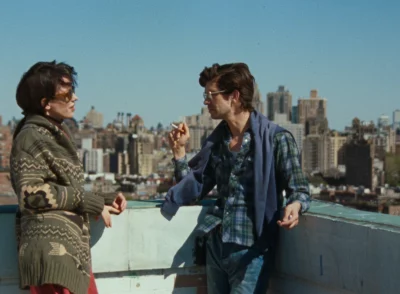
When Ira Sachs talks about his new film Peter Hujar’s Day, he speaks with the certainty of someone who has spent decades contemplating art, artists and the ways they shape a city. The film, adapted from Linda Rosenkrantz’s 2021 book documenting 24 hours in the life of photographer Peter Hujar, premiered at Sundance before its November U.S. theatrical release, and stars both Ben Whishaw (Skyfall, Mary Poppins Returns) and Rebecca Hall (The Town, Godzilla vs. Kong). For Sachs, the project is both a continuation of themes that run through his work and an intimate return to the city that defined him as an artist.
“Soon after I moved to New York, I went to a gallery show of Peter’s work,” Sachs explains. Hujar was widely known for his stark, intimate black-and-white portraits that captured the vulnerability and complexity of his subjects, working largely in downtown New York’s bohemian and queer art circles of the 1970s and ’80s. His most famous work, Portraits in Life and Death (1976), juxtaposed portraits of living New Yorkers with images from the Palermo catacombs. “I felt that the photographs — a kind of demimonde, an underground artist community in the East Village of New York — were like an invitation to a world I wanted to be a part of,” Sachs recalls. The director felt captivated not only by the portraits’ stark intimacy, but the discipline behind them. It wasn’t until reading Rosenkrantz’s book that Sachs felt the emotional key to making the film. “It was really reading this conversation, which to me gave me everything that I love in movies actually, which is intimacy and detail and authenticity and emotion,” Sach says. “I found the book very emotional, and I tried to create a film that could mirror that impact for the audience.”
While it would be only logical to mimic Hujar’s style, Sachs actively resisted allowing the photographs to dictate the film’s aesthetic. “I really tried not to look at Hujar’s work as I made this, but in some ways I know it so well that I’m sure it had influence,” Sach says. Instead, he thought of the film as a wider dialogue with portraiture. “I think that the filmmaker is the eye of the audience and that is going to be affected by light and by space. In a way, in every image, light in space tells a story,” Sachs explains.
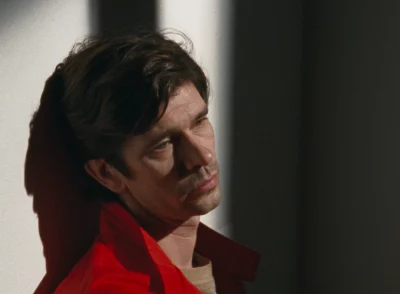
His solution was to structure the film as “a series of cinematic portraits, one after the other, which add up to be a collage, but also a story.” To achieve the handmade, tactile feeling he wanted, Sachs shot the film on 16mm. “I was always interested in making a film which felt very handmade, that you could feel the kind of process in the result,” Sachs says. The clapper left in the opening shot, the presence of the tape recorder, and the visible textures of the film stock are all intentional. “All these things made the film into a handmade object,” Sachs says. “That was the kind of work that I feel it has a kind of tenderness built in.” That tenderness includes embracing the imperfections of celluloid. “It also creates boundaries because it means a shot can only go on for so long,” Sachs says. “There’s always the possibility of some kind of technical accidents… a grain but there can also be scratches, and there’s something really human in this human element.”
For Sachs, the risks of analogue filmmaking echo the risks that defined the artists of 1970s New York. “I get strength from thinking about this period of time in which art making was connected to risk taking,” Sach says. “You couldn’t make something without putting yourself on the line in a very personal way.” Hujar’s refusal to avoid the sexual, the forbidden, or “the ever-exposed” resonates deeply with him. “This history is part of my history,” Sachs says. “ I do have a mission to try to tell the stories that are most important to me, whether people want them or not.”
Working with Ben Whishaw again — after Passages — helped cement the film’s direction. “When I read the book, I was working with Ben, and it gave me the opportunity to continue a collaboration which felt very thrilling to me,” Sachs says. “There was a kind of trust and exploration that we were undertaking together that I felt like was only beginning.” Rebecca Hall’s contribution, too, emerges from a carefully built environment. Sachs notes that the script’s verbatim use of Rosenkrantz’s text grounded the actors profoundly. “The text defined a lot, “Sachs says. “So I think it gave shape to the two characters. And I think the apartment that we built… put everyone in a place at a time.” What unfolded was a chemistry that felt lived-in, despite the actors barely knowing each other before filming. “Actors have a tendency and instinct to create intimacy without history. And I think both these actors did that very beautifully,” Sachs says. “There was this kind of triangulated collaboration between the three of us that was intimate in and of itself. So it was an environment of trust.”
For Sachs, Peter Hujar’s Day is not simply a portrait of an artist. It is a meditation on the communities — past and present — that teach artists how to see.
Read more film interviews:
Aaron Eckhart Has Gone To The Dogs in Muzzle: City of Wolves
Ross Syner and David Bradley on the Bond of Brothers
