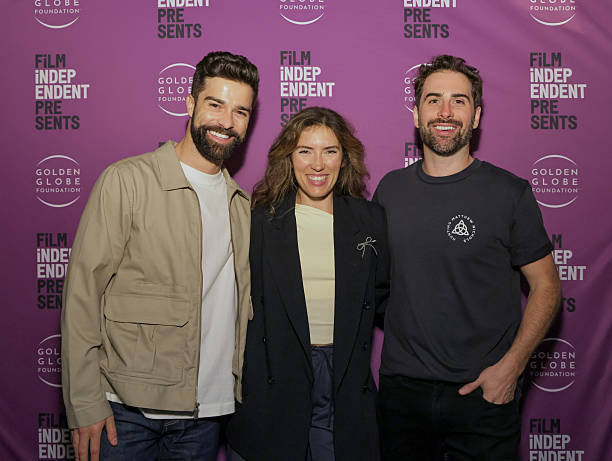
Miranda MacDougall and Sean Harris Oliver on Hunting Matthew Nichols
Arts
There’s something fitting about the film Hunting Matthew Nichols coming from artists whose roots are so deeply embedded in the theater. The 2024 Canadian supernatural horror film — written and directed by Markian Tarasiuk, co-written by Sean Harris Oliver and starring Miranda MacDougall — feels as much like a performance piece as it does a genre experiment. Built around the fictional disappearance of two teenagers on Vancouver Island in 2001, the film tracks the return of a grieving sister decades later, armed with a camera and a need for answers. The tale that unfolds is less of a straight horror story than a gradual, destabilizing descent into something stranger, more fragmented and far more unsettling.
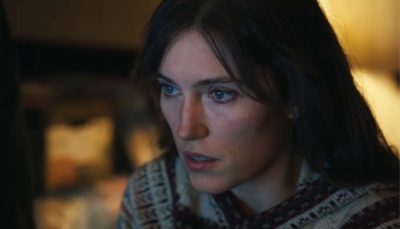
“I think of it from a writer’s perspective, with this story as being almost three separate films,” Oliver says, describing the film’s unusual structure. “To me, there’s the first part of the film, which is very much mockumentary, like talking head documentary filmmaking. The second act is process-based documentary filmmaking, and then the third and final portion of the film is very much found footage.” It’s a deliberate dismantling of genre expectations, one that mirrors the emotional and psychological unraveling at the heart of the story. What begins as a true-crime-style investigation — complete with interviews and archival clues — mutates into something far more primal, where the camera itself becomes a witness to horror rather than a tool to explain it.
Oliver’s path to filmmaking was shaped by years in the Canadian theater scene, where he built a reputation as a playwright. “I was working as an actor when I very first got out of theater school in Vancouver, and I quickly sort of transitioned into becoming a writer,” Oliver explains. “I just enjoyed writing the scripts more than I did performing in them.” After a decade immersed in stage work, the pandemic forced a pivot. “Theater all of a sudden disappeared, and I made the decision that I wanted to transition and focus my efforts on film,” Harris says. “The rest is history.”
Hunting Matthew Nichols was shot in just twelve days and leans heavily into its mockumentary aesthetic. For MacDougall, who plays Tara — the sister at the center of the mystery — the format wasn’t just stylistic, it was transformative. “It felt very theatrical in the way that you step into a play, and you don’t get to stop the play halfway through,” MacDougall says. “You start the scene, and we’re getting the whole thing in one take.” MacDougall’s background makes her uniquely suited for that kind of immersion. “I’ve been working in musical theater from the time I was five to now,” MacDougall says. A lifelong cinephile who grew up watching classic films with her father, she’s built a career that straddles stage and screen. “I’m just gratefully immersed in all things filmmaking and acting,” MacDougall says.
The role of Tara instantly appealed to her. “I was so attracted to the fact that these folks had written such a real person,” MacDougall says. “I love true crime, I love a mystery and I felt like the tone of the film really jumped off the page to me… I felt like it was genre-bending, and I really like when you can’t quite put something in a box.” That refusal to be boxed in is perhaps the film’s defining trait. It shifts from procedural to psychological horror, from grounded realism to something bordering on the occult. The discovery of a missing MiniDV tape — one that appears to show a ritualistic killing — marks a turning point not just in the narrative but in the film’s entire language. From there, the story plunges into increasingly surreal territory, culminating in a nightmarish encounter in the woods that blurs the line between reality and something far more sinister.
For MacDougall, staying in that headspace was both a challenge and a necessity. “It felt incredibly immersive, and it felt really natural to kind of stay in the headspace of terror the whole time,” MacDougall says. “Markian, the director, called me Tara anytime he needed anything. He never called me Miranda. And that alone really added to the psychology… of really feeling like this character the whole time.” The result is a performance that feels raw and immediate, as though the camera has simply captured something happening rather than something being acted.
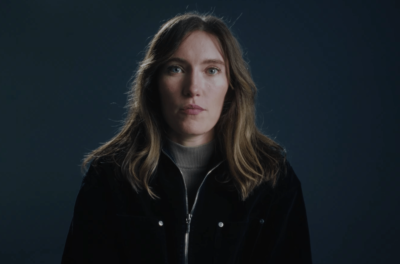
That immediacy is reinforced by the film’s production constraints. “We were shooting long days because we had to get it all in twelve days,” MacDougall notes. “So… it felt like a twelve-day-long play in a way.” There’s little room for second-guessing in that kind of environment, which lends the film a sense of urgency that’s difficult to fake. For Oliver, the film’s success lies in how those elements — structure, performance and production — come together to create something cohesive yet unpredictable. “It’s interesting when people say, ‘Oh, it’s a found footage film.’ It is kind of a found footage film for an aspect of it, but it’s also a mockumentary for another big aspect of it… I don’t think it’s just one thing, I think it’s multiple things.”
That multiplicity is what makes Hunting Matthew Nichols linger. It’s not just a story about what happened in the woods on Halloween night in 2001, but it is about how stories fracture under the weight of obsession and grief. By the time the film arrives at its final, deeply unsettling images, it’s clear Tara may not have succeeded in her quest for answers and closure, but Tarasiuk and Oliver are well on their way toward their quest for a sequel.
Read more film interviews by Patrick Gibbs:
Tony Benna and Lee Einhorn on André Is an Idiot
The Pitt Cast on ICE
