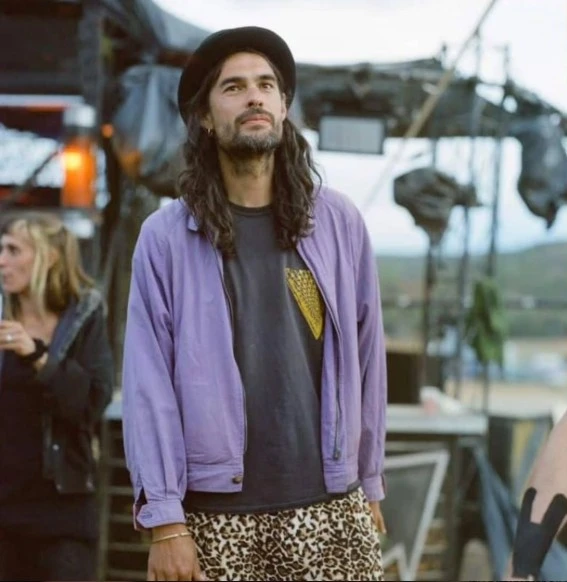
Óliver Laxe and the Journey of Sirāt
Arts
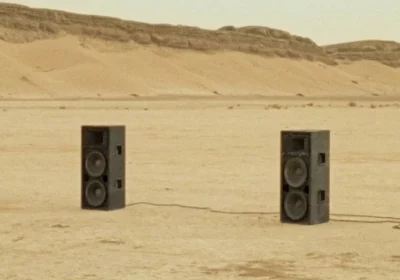
In Islam, the Sirāt is a razor-thin bridge stretched over Hell that every soul must cross on the Day of Judgment to reach Paradise. The righteous pass safely; others slip and fall into the fire below. In Óliver Laxe‘s acclaimed film Sirāt, grief, spirituality, despair and hope all converge in one hypnotic desert odyssey.
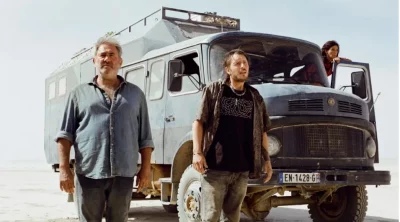
“I was living on a palm grove at that moment, and they were coming to organize a rave on New Year’s in Morocco,” Laxe says. The French-born Spanish filmmaker saw the trucks full of ravers driving across the desert, and his own wheels started turning. “Raving is not only going to parties; it’s also travelling,” Laxe explains. “And they live in these trucks.” This would become a key moment of inspiration for Laxe and the genesis of his most acclaimed film to date. Sirāt follows Luis (Sergi López, Pan’s Labyrinth), a father who plunges into Morocco’s desert rave scene searching for his missing daughter, dragging his young son Esteban (Bruno Núñez Arjona) with him. When war erupts, and the party scatters, Luis and Esteban join a convoy of ravers chasing rumors of another gathering deeper in the desert. What begins as a road trip transforms into a desperate journey through a mine-strewn wilderness where survival becomes a matter of blind faith. For Laxe, the imagery of nomadic ravers traveling through the Moroccan desert connected with something more personal. Having lived in Morocco since 2004, he had begun confronting his own relationship with mortality.
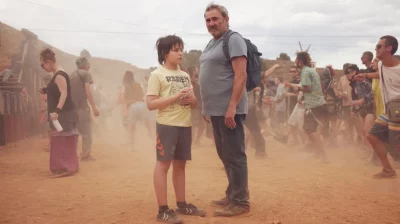
“In Western countries, we are escaping from death, and I knew that I needed to have death as an ally,” Laxe says. “So that film is an invitation for the spectators to die, to make a catharsis in the film… It’s shock therapy in a way. But it is therapy.” The journey at the center of Sirāt serves as both a literal quest and a philosophical metaphor. As the story unfolds, the father is pushed into a landscape that tests his endurance and sense of identity. “Sometimes we’re asking for something from life, but life knows what we really need,” Laxe says. “That’s why we are frustrated most of the time, because we really identify with the things we are looking for. So in this film, you have this father who is looking for his daughter. And he will be shaken by life. He will be broken by life. But it’s a mercy. It can be a mercy.” Laxe connects this idea to spiritual traditions that view suffering as transformative. “I think in life, we have to cross our mine field at some point,” Laxe says. “Life asks you who you are, and this father will have to answer. I think, as human beings, when we are pushed to our limits, we show the best of us.” Along the way, the father and son become part of an unlikely surrogate family made up of the ravers they encounter. Their communal care is something Laxe had experienced in rave culture and wanted to reflect in the film.
One of the film’s most devastating moments involves a sudden and unimaginable loss that leaves Luis changed forever, and Laxe admits that writing and filming the sequence was emotionally taxing. “It was really hard to write that sequence, to make rehearsals, everything, to shoot it, to edit it,” Laxe says. “It was really painful for me, and I’ll say I was scared, because it’s really risky what we are proposing.” The director understood the emotional intensity could easily backfire. “We were closer to failure with this film than to getting nominated for two Oscars,” Laxe says. “But we knew that it was important to propose that the spectators die watching the film. We want you to die because we think it’s a healthy thing.” For Laxe, the goal is not shock for its own sake, but a revival of cinema’s ancient role as catharsis. “This is cinema,” Laxe says. “It’s like the old theater. The Greeks were using tragedy and theaters to make a catharsis. So, in a way, yes, we’re pushing the spectator to an abyss, but it’s good medicine.”
That philosophy also shaped the film’s script, which became increasingly minimal during nearly a decade of development. “When we were starting to write that script, that was 2015,” Laxe says. The fifty-page screenplay provided the bare bones, but much of what appears onscreen isn’t on the page, as Laxe sought a more visceral experience. “Less script, more cinema,” Laxe says. “People need to go to theaters to feel things that we are not feeling in life. That’s the essence of cinema.” That belief extends to the theatrical experience itself. In an era when many films are consumed at home, Laxe sees the cinema as a place where images and sound should physically affect the audience. “If there is no difference between watching a film in a theater and at home, then stay at home,” Laxe says. “The essence of cinema is that images and sounds penetrate the audience. And I think that’s the case with Sirāt.” Despite the film’s technical challenges and shooting in punishing heat, Laxe says the greatest obstacle he faced was internal. “When you make a film, you see how crazy you are,” Laxe says. “Being there in the desert, exploding trucks, asking for love. Making a film, you ask for love. Look what I do. Love me. The greatest challenge is yourself.”
If Sirāt pushes viewers toward an abyss, it does so deliberately. In Laxe’s view, cinema should challenge audiences emotionally and spiritually — an experience that can be painful, but ultimately transformative.
Read more film interviews by Patrick Gibbs:
Patience is a Virtue for Ernest Harden Jr, and There’s Virtue in Patients
Director Geeta Gandbhir on The Perfect Neighbor
