Why Cinematographer David McFarland Took a Shot on Bedford Park
Arts
For cinematographer David McFarland, Bedford Park arrived at exactly the right moment — not just as a project, but as a kind of distillation of how he thinks about visual storytelling. The 2026 drama premiered at Sundance Film Festival 2026 and was written and directed by Stephanie Ahn in her feature debut. Bedford Park is an intimate film about emotional damage, cultural inheritance and the fragile, unexpected connections that form between wounded people.
“I could tell Stephanie knew what she was doing as a director.”
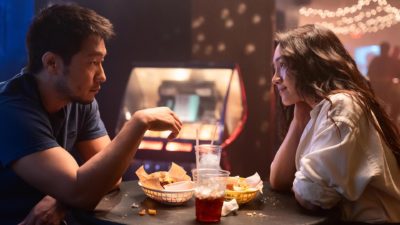
“I read the script, and she had done a sort of proof of concept short a few years before we made our film,” McFarland says. The veteran cinematographer, known for his work on The Ballad of Lefty Brown and 12 Mighty Orphans, was impressed by Ahn’s vision. “She had taken a couple scenes from the film and just done them in their entirety. And it was really strong. I could tell Stephanie knew what she was doing as a director. And so I was thrilled. I was really, really happy to be involved.” Bedford Park stars Moon Choi as Audrey, a Korean-American woman who returns to her childhood home after her mother’s car accident and Son Suk-ku as Eli, the man responsible for the crash. What begins in guilt and resentment slowly turns into recognition, as both characters carry their own histories of trauma and the shared weight of han — that deep, unresolved sorrow that lingers across generations.
“What we chose was not to go with some extreme color theory.”
The mutual trust between Ahn and McFarland led to an immediate connection — not only to the script, but to each other. That trust became the foundation for a collaboration that emphasized tone over technique. McFarland and Ahn spent significant time discussing how the film should feel — not just visually, but emotionally. “Stephanie and I certainly talked a lot about the look of this film, and the feel, and we approached it from every angle,” McFarland says. “Meaning, what’s the shot composition going to be? How’s the camera going to move? What kind of coverage are we gonna get? All of those things. And, of course, we spoke a lot about color and color theory.” What they decided not to do was just as important as what they embraced. Rather than leaning into an overt visual concept, they chose to stay grounded in reality. “What we chose was not to go with some extreme color theory,” McFarland explains. “I mean, it’s pretty much based in reality. And the way we photographed it… the attempt was to feel pretty natural.” But within that naturalism, he found space for subtle visual storytelling — particularly in how class divides the film’s emotional geography.
Eli’s world, shaped by poverty and instability, carries a cooler, harsher tone. “The character Eli, and the world he inhabits, he’s really flat, broke, and he’s kind of living on the edge of poverty,” McFarland says. “And so, his world inherently has more of a blue tint to it.” Much of this came from letting daylight dominate, allowing window light to fall uncorrected into interiors, or pushing soft bounces through glass. “Color temperature-wise, I let it go blue,” McFarland says, noting that Eli’s environment is filled with industrial fluorescents from the auto shop next door, reinforcing that coldness. Audrey’s world, by contrast, leans warmer — not in a dramatic way, but just enough to create a subconscious shift for the audience. “We had this kind of warm versus cold conversation going on,” McFarland explains. “The idea is to have them really help, kind of nudge the viewer a little bit.” Throughout the film, shadows retain a slight blue cast, creating a visual throughline that mirrors the emotional undercurrent of grief and unresolved pain both characters carry.
“I sort of take a simplistic approach to the way I work.”
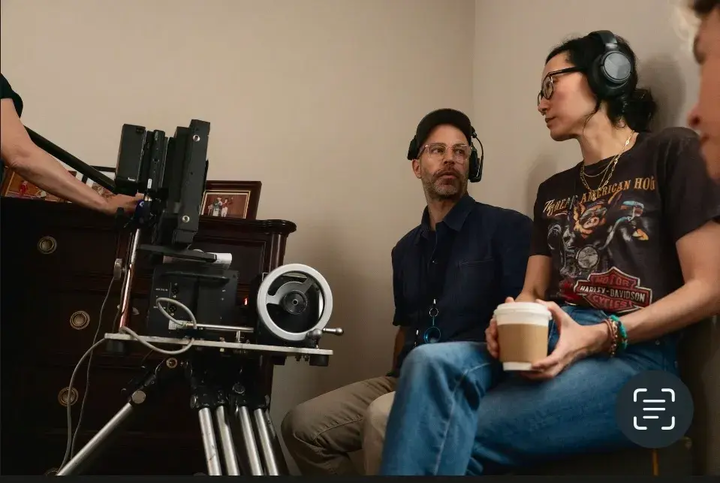
Technically, Bedford Park was built on simplicity. The team briefly considered shooting on film, but budget realities made that impossible. Instead, McFarland turned to a camera system he knows intimately. “We ended up going with the Alexa 35,” McFarland says. Operating the camera himself, he leaned on a workflow that felt instinctive, rooted in years of shooting film. “I sort of take a simplistic approach to the way I work,” McFarland says. “I can use my light meter, and it’s pretty accurate.” The biggest challenge, McFarland admits, wasn’t technical at all. “To be honest, there weren’t any big challenges lighting this film,” McFarland says. “The challenge was figuring out what the approach was going to be.” With only 23 shooting days and a limited budget, the solution was to strip everything back. “I embraced trying to rise to the challenge of lighting this one as minimally as possible and to light it in such a way that it gave the most room for the actors to perform,” McFarland says.
That philosophy runs through every frame of Bedford Park. The lighting never calls attention to itself; instead, it creates a broad, forgiving space where performances can breathe. “This film is a real performance film,” McFarland says. “And this is about connection between two people, and I really kind of took the stance that my job was to be able to create the broadest environment for them to connect in.”
In a film defined by emotional proximity — two damaged people slowly allowing themselves to be seen — McFarland’s cinematography becomes an act of listening. The camera doesn’t impose. It observes. The light doesn’t dramatize. It reveals. Bedford Park ultimately feels less like something carefully constructed than something gently uncovered, frame by frame, in the quiet spaces where grief, guilt and love begin to overlap.
Read more of SLUG’s coverage of the 2026 Sundance Film Festival.
