Keeping Public Lands in Public Hands with the SUWA Stewardship Program
Community
I bottomed out, again. My Subaru Impreza is a lot of things, but high clearance ain’t one of them.
The Sego Lily Wilderness Study Area (WSA) is red, rocky and remote. North of Bluff, south of Monticello and west of Blanding, it’s closer to Colorado than any part of populated Utah. The WSA is an example of the wilderness-quality land in Utah that the Southern Utah Wilderness Alliance (SUWA) seeks to protect as part of America’s Red Rock Wilderness Act, a visionary bill first introduced in 1989 that has not yet passed. Between the pinyon pines and junipers, I was one of a string of six cars heading to the canyon rim. Pending safe arrival, we would set up camp, crack open a beer and stargaze until tomorrow, when our work begins.
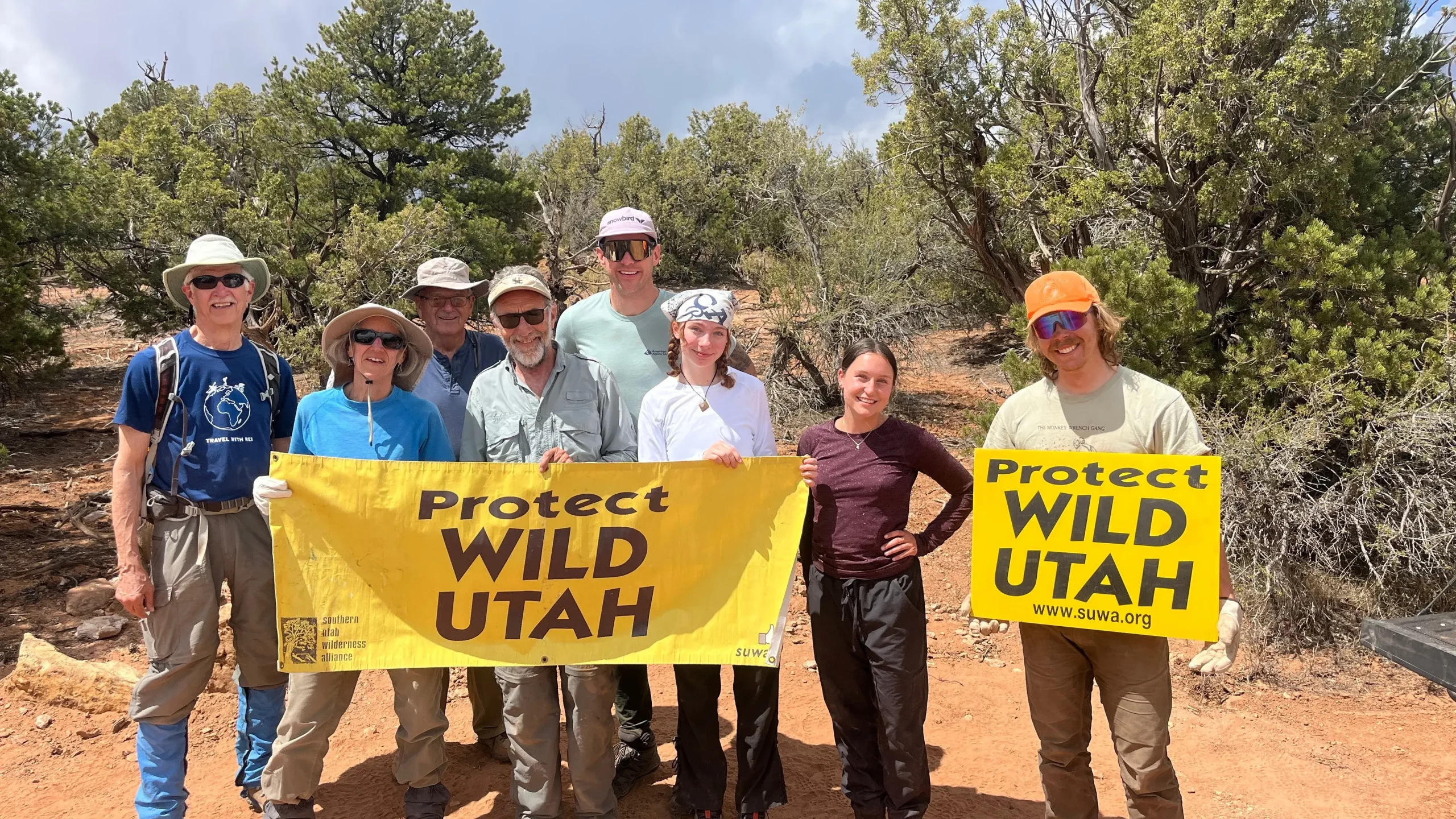
If you’re reading SLUG, you’ve seen a yellow sticker emblazoned with the words “Protect Wild Utah” before. These stickers are the calling card of SUWA, Utah’s premier wilderness defense organization. Citizen activists started the group in 1983 after the Utah Bureau of Land Management (BLM) office undercounted the state’s wilderness-quality federal land by approximately five million acres. Thanks to the tireless work of SUWA volunteers and staff, that number has risen to just shy of nine million acres worthy of protection. Today, SUWA’s legal teams, activist leaders and more work to protect the land and its wild qualities.
For much of SUWA’s history, that work was in streets and courtrooms. Ten years ago, though, it was time for a new frontier: the land itself. “It was an opportunity for us to build community around [wilderness] out on the landscape,” says Jeremy Lynch, SUWA’s Stewardship Director. With a few other members of SUWA’s Wildlands office, Lynch began working with local federal land management to identify wild parcels of land the agency needed help with. “[The BLM in the West] is widely underfunded,” continues Lynch. “They often don’t have the staffing to even send a ranger out on the ground. We’re there to support that.”
“The ecosystem services and then the social impact of knowing [that] there’s a place for you out there — somewhere to get away. It might do more for our mental health than we know.”
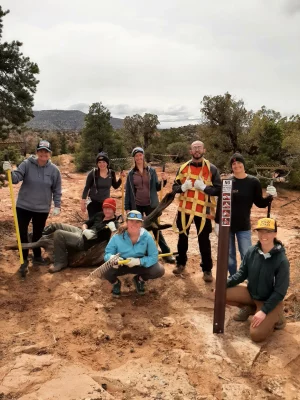
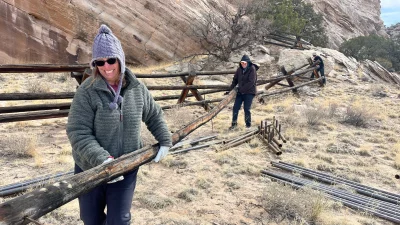
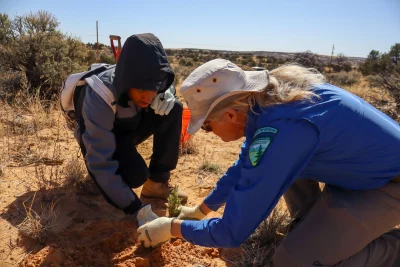
On the ground in the WSA, there was no ranger to join us. Instead, Seasonal Stewardship Coordinator Ellie Swanson gestured at the implements in the back of the white SUWA pick-up. I grabbed a pick and idly hefted it while Swanson explained what the Monticello BLM Field Station determined our group could do to best restore the land. These next few days would see hard work under the desert sun. We’d disperse illegal fire rings, clean up after a defunct wilderness therapy group and erase the tracks of illegal loggers to maintain the wilderness quality of the area. The older man in a visor next to me nodded, a pair of students at the University of Utah looked at each other and smiled. There were eight of us volunteers here in the Lands Between, ranging from out-of-state naturalists to fresh Utah transplants. Each of us brought a different perspective to the work, but we all shared one thing: a fascination with the idea of “wilderness.”
The Wilderness Act of 1964 defines wilderness as “an area where the earth and its community of life are untrammeled by man, where man himself is a visitor who does not remain.” Poetic, for an act of Congress. Since then, wilderness has been contentious in American politics. Once land is designated wilderness, it can no longer be drilled, logged, mined or built on (read: extractive industry can’t make money). Instead, the land stays natural, free for people, animals and plants. “You can get anthropocentric about [the value of wilderness], if you like,” says Swanson, a native Salt Laker. “The ecosystem services and then the social impact of knowing [that] there’s a place for you out there — somewhere to get away. It might do more for our mental health than we know.”
“It’s something you can actually do to balance the equation of what we’re all doing, which is burning fossil fuels to go to wild places and discover ourselves.”
So, why the picks and shovels? If land is excessively disturbed — by tire tracks, chopped trees, litter and illegal campsites — it is no longer eligible for protection. Recently, Utah Senator Mike Lee attempted to sell millions of acres of public land as part of President Donald Trump’s “Big, Beautiful Bill.” The only types of lands excluded were National Parks, National Monuments and Wilderness Areas. By ensuring lands are designated wilderness, they become that much harder to remove public access to. “[This work] is like a more tangible version of carbon credits. It’s something you can actually do to balance the equation of what we’re all doing, which is burning fossil fuels to go to wild places and discover ourselves,” notes Lynch.
Back in the WSA, I was dripping sweat and chugging Gatorade. I was also in awe. Walking to a site at the end of a gnarled road, one of my companions found something: a piece of chert, painted with black and white triangles. Then came an arrowhead, and the realization that washing down from the bank was a midden, where ancient peoples had thrown their trash. On the hill above, we saw a pile of yellow stone. “I think this was a watchtower,” said the naturalist. “Look!”
“Public lands are what we have in common. Things are contentious, but they’re going to be what ultimately brings us together.”
Looking out over the valley floor, beneath Sleeping Ute Mountain ahead of us and the Bears Ears behind us, we were reminded of the continual, millenia-long presence of Indigenous people on this land: We were not the first to steward this land. Hopefully, we won’t be the last.
Since its inception in 2016, SUWA’s Stewardship program has worked with 1,503 volunteers, remediated 1,058,312 square feet of landscape and removed 10,965 pounds of trash from public lands. Follow SUWA on Instagram at @protectwildutah and get involved by visiting suwa.org/join-service-project. Projects are free, exciting, and a great way to give back. “Public lands are what we have in common.” Swanson asserts. “Things are contentious, but they’re going to be what ultimately brings us together.”
Read more environmental features from SLUG here:
The Educated Tree Hugger: Content Creation with Justin Davies
Spirit Farm: Reconnecting and Reclaiming Roots
