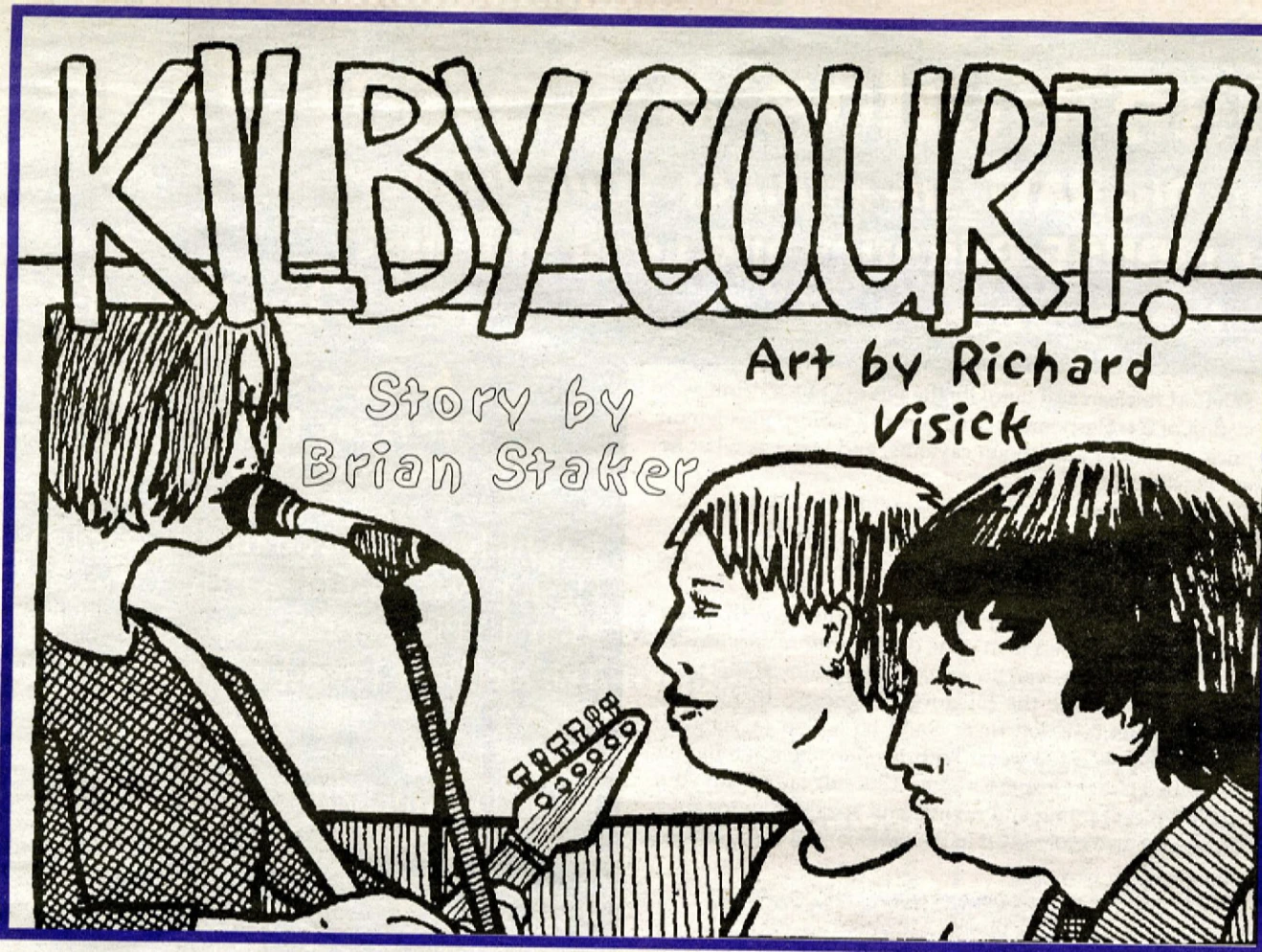
Kilby Court!
Archived
As I walk up to the unassuming building known as Kilby Court Gallery, Phil Sherburne, resident, furniture builder and operator of this most unlikely local music venue, greets me from up on the roof. He’s been attempting to install a swamp cooler to cope with the hot weather that, for audiences packed inside to hear the music of some of the most interesting bands in the indie music cosmos, could become positively sweltering. He’s trying to open the place back up again after being shut down by local police. “Hopefully it’ll happen in a week or so,” he says, a winsome grin on his face. “But I’ve been saying ‘hopefully this week’ for weeks and weeks.”
June 3, the night of the shutdown, was a bad evening for all concerned. At least locals Jenny Jensens got a chance to play. Gerald Music was in the middle of their set when the cops showed up. Touring bands Urban Legends and J. Majesty were still set to perform, and never did get a chance to hit the stage: The police came, they said, in response to a noise complaint. “It was more of a personal matter with the tenant living in a house at the end of the drive,” Sherburne claims. “The police who were first to respond saw Mike Snider taking donations,” Sherburne says. Sherburne told the police the noise wasn’t that bad and tried to demonstrate by walking the cops down to the end of the street, where the sound coming from the band, filtered through his relatively small sound system, became inaudible. “The police thought we had tricked them and had somebody turn down the sound,” Sherburne says. “Although it’s impossible to turn down a band, with all their instruments, all at once.”
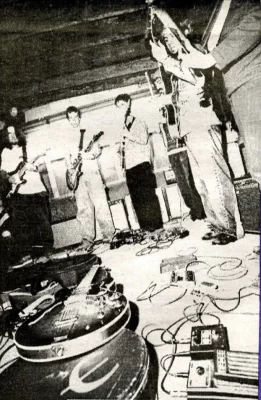
Officer Brian Bailey of the vice squad showed up and confiscated the contents of the donation jar, which was counted out to be $225. The money has been logged as evidence. “I’ve talked to him since, and can understand where he was coming from, but he seemed a bit harsh that evening,” Sherburne says. Bailey said if the music wasn’t stopped and everyone didn’t leave in five minutes that Sherburne would be jailed. “I tried to let Gerald Music finish the song they were playing, but the police insisted that we had to stop right away,” Sherburne explains. He announced that everyone had to leave, and all in attendance stood there stunned for a moment, but then Gentry Densley announced it for Sherburne again, and people got the message. “Everyone was really cooperative,” Sherburne notes appreciatively, “and this really helped diffuse a tense situation.” Bailey seemed to note the conformity, and this helped calm him down and behave more even-handedly as well, Sherburne believes. But not before Bailey threatened to confiscate the camera of SLUG Magazine Managing Editor Angela H. Brown, who protected her rights by flashing her press credentials. Then Sherburne had to walk down the street with the officers to write out the citations they were going to give him. All this because, Sherburne says, a neighbor was pissed off that somebody parked too close to his car.
It hadn’t been the first instance of trouble with the disgruntled neighbor who had called the law enforcement. On a Mardi Gras performance of Street Legal Theater, someone attending the show was revving their car engine outside the neighbor’s window and wouldn’t stop. At least that’s the neighbor’s story. The police forced the festivities to cease. And then on May 7, on a night featuring local one-man band The Vexations and San Francisco group Vue, which was only made known to Sherburne 18 hours prior to door opening (due to a snafu on the part of Vue’s booking people), there was more trouble. On this night, when there were only about a dozen people in attendance, the cops left them with a warning once again, and the combo and audience sang songs together a capella for a while in a hushed tone that wouldn’t disturb anyone. Sherburne notes that, on most occasions, nearby Club Fusion (now Vesuvius) was much louder than anything emanating from Kilby Court.
June 3 was the first and only instance of a citation. The two offenses, says Sherburne, were running a dance club and consumption of alcohol without a license. He’s been to court several times on the charges. At the arraignment he pled not guilty, even though the prosecutor tried to offer a plea bargain. The deal was something titled “Plea in Abeyance,” Sherburne explains, which would have been a terrible deal for him. Although the plea bargain would have reduced his fines, which could amount to several thousand dollars, if he was charged with any new infractions other than a speeding ticket, the old charges would come back double. The guilty plea would leave him with a criminal record. “I don’t want to plead guilty because I don’t think I was doing anything wrong,” Sherburne says. He wasn’t trying to operate a business at all, he says, just provide a place for people to go to see some of the most highly-touted indie rock groups, and he asked for donations to meet the bands’ expenses and pay his own landlord for renting the space. If he opens Kilby back up again and someone brings in alcohol (something that will not be allowed), Sherburne would then face two charges — the new infraction plus the original one from back in June.
Sherburne’s attorney, Lewis Francis, filed a “motion for discovery” to list the exact numbers of the ordinances broken, since they didn’t list those on the citations issued. Aug. 7 will be another pretrial hearing, at which Sherburne and Francis will again meet with the prosecuting attorney and see whether they can make some kind of arrangement or if the case will go to trial.
“I don’t know; I thought the case was pretty good because we were only taking donations, and not strictly charging admittance like a business,” Sherburne says. But the way the court sees it, Sherburne says, if you do anything and take donations, even if you happen to be having a party and one of the guests offers to help with your expenses, it’s still a violation of running a business without a license. “So I’m a little nervous about it again,” he explains. “I didn’t know there was anything incorrect about taking donations and running it the way I did. But they say that I have to run it as a business, so that’s what I’m trying to do — to reopen in conformity with all the laws.”
It’s been difficult because, in addition to all the state regulations governing businesses, including listing a maximum capacity (49) and installing an extra door in case of fire, he has to make the place compliant with the federally-mandated Americans with Disabilities Act, which means making everything handicap-accessible. That includes ramps, rails, doors and bathrooms that are big enough to fit a wheelchair through (36” wide, to be exact). “It’s costly,” he says. “and difficult for someone trying to operate an all-ages music venue. You have to have a building you can afford, since we aren’t making much money, but an inexpensive building is expensive to bring up to code.” He’s been able to do this, though, thanks to funding from Salt City CDs, who has been in the forefront of supporting local music and musicians, selling local CDs and even allowing local bands to perform in the store.
“All the structural work is done,” he says. “The fire department okayed it, and we just have to wait for the building inspector.” Even though Sherburne is hoping to open the place up again, the whole experience has left him less than optimistic about the local environment for music and business in general. “The laws seem to be set up so that there are enough ordinances that, more than likely, you will violate one,” he says. “If someone wants to shut you down, they probably can. It will be a tightrope act to make sure nothing happens.” For instance, if anyone in the nearby area is caught drinking in their car when there for a Kilby show, Sherburne can be held responsible. “How can I enforce that?” he asked the vice officer who had told him this. “Hire more security that can patrol the alley” was the response. His remedy is to schedule shows differently, groups will go on early and stop early, and then “maybe everybody will go out to a bar afterward,” he laughs. “It’s all about the music anyway.”
With money raised at the first few shows after reopening, Sherburne hopes to raise enough money to get a beer garden permit, to use an adjacent building to sell beer to those of age. BROWN BAGGING IS ILLEGAL! These words require emphasis because, unless you want to see Sherburne in jail, discard the practice common to habitues of the place. It’ll be as hard for me as anyone not to walk down the lane with a sixer of Natty Light under my arm. But it’s the law. Sherburne will need to meet license expenses of $70 for a basic business license plus $10 for each employee. But the voice on the phone at the City Hall neglected to tell him about the additional $70 for a live music venue and another $70 for live entertainment that’s not musical, like poetry, theater or Street Legal. The city also wanted to charge him $70 for a dance club but, he explains, “It’s not a dance club.” Everyone, he winks, will have to hold stock still while the music plays — which is about typical for indie rock crowds anyway, who aren’t known for dancing to the music.
“It should be easy to remain compliant with the laws,” he says, “because the crowd that usually comes here is really respectful. If I tell them what is expected of us by the police, they won’t have a problem working within those rules. They care about the music. It’s more difficult to do some shows than others,” he notes. “Certain bands can bring crowds that are still hanging onto the 1980s punk mentality that all authority is bad, period. It’s impossible to work with that kind of attitude, so we have to be somewhat selective. It sucks but there’s nothing we can do about some people’s lousy attitudes.”
With all the stress he’s been through, why is it so important to start Kilby up again? “In a community like this, it’s especially important,” he says. “Without naming names, culturally there is one side and the other. A lot of kids don’t fit into the norm. You’ve gotta have somewhere to go, and Kilby’s a great place for people who didn’t find a home with the Young Republicans. Not to mention the great bands that come here.” He continues, “It’s not a clique or anything, but it’s somewhere else to go besides a dance club. These kids think differently. And it’s not just for kids, but for the whole community I hope.” Kilby Court Gallery has been the place in Salt Lake to see an entire array of bands you’d never find anywhere else in this state and one of the few remaining all-ages venues for live music. Visiting bands “appreciate being able to play for a crowd that is actually listening to you, unlike in a bar,” says Rex Shelverton of Vue.
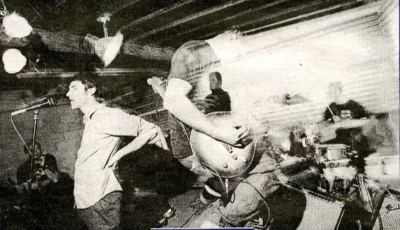
Over 100 shows have happened at Kilby since opening almost exactly a year ago on August 9, 1999 with the Pinehurst Kids visiting from Portland. The lineups have read like a who’s who of up-and-coming indie and smaller label rock bands: The Wicked Farleys, Bindlestiff Family Cirkus, Juno, IQU and Jason Traeger from K Records, Mid Carson July, The Black Heart Procession, Bardo Pond, the Microphones, …And You Will Know Them By the Trail of the Dead, the Dismemberment Plan, Pedro the Lion, Boston’s Papas Fritas, Love as Laughter and Wesley Willis all rocked the house there. For those in attendance, the place has been the site of some very magical moments, like when the guitarist from Trail of Dead, in between strums, flicked his pick up in the air and caught it mid-air. Or the happy-go-lucky pure pop sound of Papas Fritas that had the notedly stolid indie rock kids moving back and forth to the music (legal side note: The kids were NOT dancing. Just an ever-so-slight sway). Or Jason Traeger talking about his Taco Bell job and going into a rousing version of Lenny Kravitz’s “Fly Away.” Or maybe best of all, just sitting around the fire outside talking to friends.
So, once Sherburne meets with vice to make sure they have no problem with the place legally, gets the building inspector’s OK and files the license paperwork, Kilby can continue. Not exactly as before, though. Gone is the familiar portapotty in the courtyard, but perhaps not missed much. Of course, for now at least, there’s no beer. There are some shows already lined up that may, as several gigs scheduled immediately preceding the shutdown, be moved to other venues like Getty’s or Todd’s. On Aug. 3, Trail of The Dead will be playing… somewhere. Aug. 11 is the Causey Way, and Aug. 15 hosts 764-HERO and Love as Laughter.
Sherburne has some hopes to be open for the latter two shows. But his attitude about local culture, and law enforcement in general, has taken a turn by the events of the past several months. “I’d like to see a representative of the police come down and talk to people who hang out here, to try to explain the police point of view,” Sherburne says. “I think they’ve taken ‘To Protect and Serve’ off their squad cars and replaced it with just ‘To Enforce.’ It would be good for cops to have some dialogue with kids, so kids don’t hate and fear cops.” Bailey had made it clear to him that, unlike the rumored behavior of some vice cops, he didn’t enforce the laws selectively. Still, Sherburne feels the completely strict enforcement of the laws makes it difficult for people to live. “I wish cops in general would explain why they have to act so tough,” says Sherburne.
Still, he did find some assistance in the Mayor’s office. Scot Barraclough of the Office of Community Affairs and Roger Evans in Zoning, Sherburne says, were both really helpful, and even Officer Bailey has been helpful in deciphering a myriad of ordinances and laws that Kilby will now have to enforce. Sherburne says he told them that he’d like to have SLPD officers come down and explain to people why they have to “draw the line” on enforcing laws so strictly. “Maybe the mayor would come down,” Sherburne says hopefully. He notes that Barraclough told him that Rocky Anderson wanted to be the first one through the doors when they open again — which, to get back to the beginning, he hopes will be soon. Sherburne glances up at the hazy summer sky, gazes off and says, “I can’t wait to start doing shows again.”
Call 320-9887 for updated information on shows moved to other locations and opening information.
