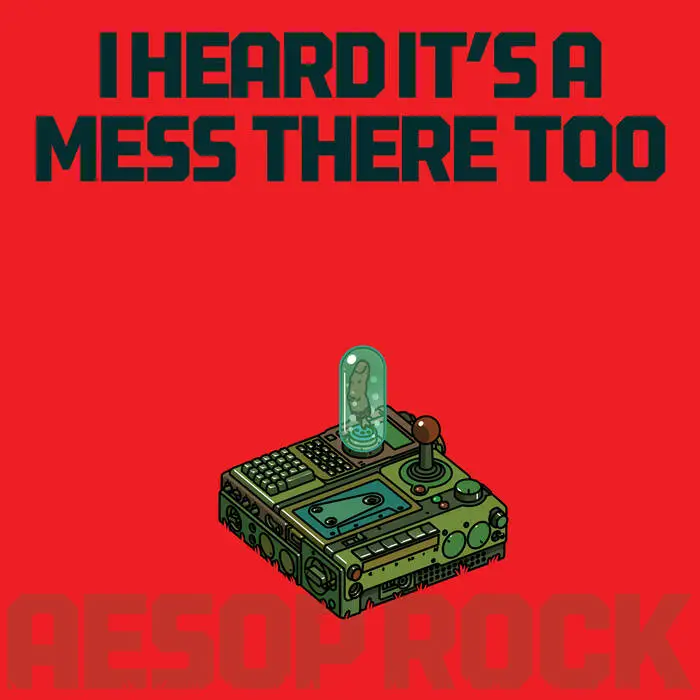
Review: Aesop Rock – I Heard It’s A Mess There Too
Music
Aesop Rock
I Heard It’s A Mess There Too
Street: 10.29.2025
Rhymesayers Entertainment LLC
Aesop Rock = Del The Funky Homosapien + El-P + MF DOOM
Time is a construct. Nearly 30 years have passed since Ian Matthias Bavitz, better known as Aesop Rock, released his 1997 debut album, Music for Earthworms. I was only eight years old at the time and wouldn’t discover Aesop Rock’s music until five years later, when I heard the song “Labor” from his 2001 LP Labor Days on Tony Hawk’s Pro Skater 4 (released in 2002).
Like many in the “Tony Hawk generation” who developed an eclectic taste in music, I could tell early on that Aesop approached his craft differently. Sure, I was a teenager then, just starting to really hear music, but fast forward to 2025, and he’s still doing things in his own distinctive way. I Heard It’s A Mess There Too arrived at the end of October, only five months after May’s Black Hole Superette, proving that time — however artificial — marches on, and prompts the inevitable question of what we are doing with ours if Aesop can craft a 12-track album so quickly.
Mr. Rock said in a press release, “The phrase ‘I Heard It’s A Mess There Too’ started as a lyric, but it got its hooks in me soon after. It felt familiar, like something I’d said a thousand times while checking in with friends across different cities. The more I sat with it, the more it started to feel like the center of this project… It’s about observation and communication. Sonically, I wanted a reset — cleaner beats, more space, fewer layers. Just enough to get a wave rolling and not much more.” Whether you’re a first time listener or long time enjoyer, you’ll hear that message conveyed from song to song.
Not to wade into politics, but the phrase “I Heard It’s A Mess There Too” could probably appeal to people on all sides of the political spectrum. So as I listened to the opening track “Crystals and Herbs,” I wondered which direction we (the listeners) were going to go in. The instrumental riff that starts the song is weird — it almost sounds like there’s something wrong with it, but when the bass drops and the lyrics begin, it all makes sense: “Blood in my hair, shit on my shoes, spit on my shirt / Ash in the air, ick on the nose, system alert / It might just be the dish we deserve.” Okay, we’re neck-deep in politics and the state of the world, but with Aesop on the mic, it’s going to be entertaining.
The next cut, “The Cut,” keeps the eerie and entertaining vibe going musically with his aforementioned wave that is rolling. It’s simple and inviting, which isn’t always the case when he makes beats. The wordplay and imagery he’s known for is in full effect with bars such as “It’s like throwing a book at a ghost / You could damage the book, plus they just poof into smoke.” While the ghost might be transparent, his lyrics a lot of the time won’t be. Upon more listens, I found myself drawn to what could be described as a night with friends where inside jokes were birthed: “We read off Trivial Pursuit cards from the Goodwill / Porting bagels from Long Island to a mountain over Whoville.”
“Full House Pinball” is definitely one of the standouts on the album. There’s a little more energy, bouncy percussion and grooves. This all mixes well as Aesop raps about fresh air, long walks and a reminder of how small rituals can keep us from not losing our goddamn mind when shit starts to hit the proverbial fan.
The piano riff on “Potato Leek Soup” melted my entire being to the point that I listened to the song three times in a row. The chorus of “I been playing in the streets all day / Meeting with the B-team, being in the way / Ease in, show a couple teeth to the prey / Ease out, peace out, see you in the fray” makes me think of something different almost every time I listen to it. My first listen had me reminiscing about cherished memories with adolescent neighborhood friends, at a time when playing tackle football with them in a backyard was the most important thing you could, and would, ever do. The second listen made me think of trying to prove myself when people doubt me. The third listen made me think of how nobody’s got it figured out, so fuck the haters and do your thing. Don’t stop.
“Poly Cotton Blend” is another track where you can sonically see the scaled back sound executed skillfully with precision. Tight drums, tight vocals, tight ass song. “Call Home” is similar musically, but with some of the most relatable lyrics Aesop has ever written: “Friends, I hope you / Find what you need to find, so you can be the people you’re / supposed to / And friieennddss… I hope that / You talk that shit you talk if it helps you deprogram.”
The album comes to a close with the song “Sherbert.” It’s definitely the most ethereal of the tracks, but in true (more mature) Aesop fashion, it’s executed cleanly. I think it’s somewhat of a quietly satisfying closer to this unexpected release. For a first-time listener, this song may feel like it’s moody without a map to guide you to what you’re supposed to feel or come away with, but by your second or third listen, you’ll start to find your way to what the song means to you.
After three decades, Aesop Rock continues to evolve without losing what makes him him. Time is fake, the world’s on fire and he’s still out here trying to make sense of it one rhyme at a time. I Heard It’s A Mess There Too might not have the ability to fix all the chaos, but it proves art can still turn the noise into something worth replaying. —Christian Ledek
Read more National Reviews here:
Review: Ashes and Diamonds — Are Forever
Review: King Gizzard and the Lizard Wizard – Phantom Island
