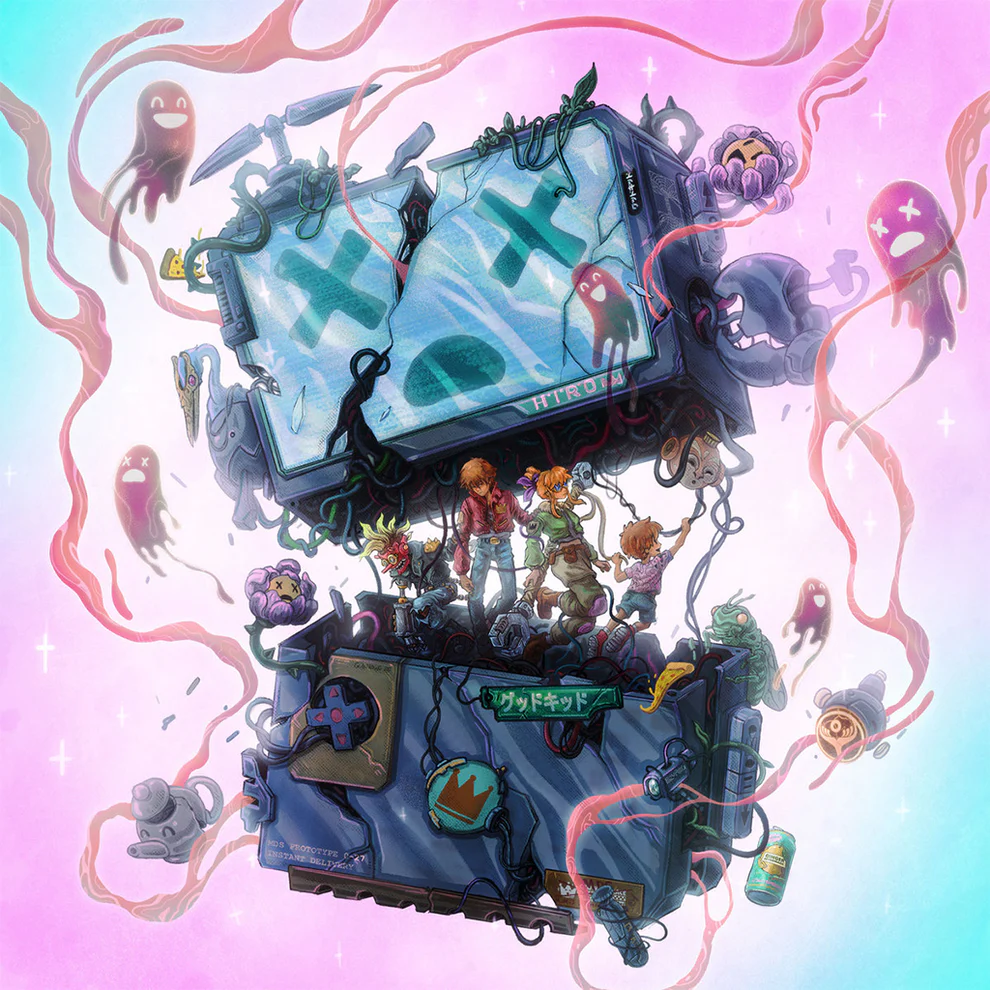
Review: Good Kid — Can We Hang Out Sometime?
Music
Good Kid
Can We Hang Out Sometime?
Good People Record Co.
Street: 04.03.2026
Good Kid = Two Door Cinema Club + Young the Giant + Fall Out Boy
The debut album from Canadian indie rock outfit Good Kid is both the five-piece group’s first all-encompassing hard-launch toward more widespread notoriety and a cumulative result of the years they spent amassing a dedicated online audience who by this time already know them well. The band’s literally hundreds of thousands of followers and listeners have been steadily graced with Good Kid music for over 10 years — their discography includes numerous singles spread across five EPs and one bit-crushed video game soundtrack, all released independently. Supplementing this prolific effort, Good Kid also tends to spawn new fans wherever they play, with their live performances being reputedly full of contagious energy that emanates from the epicenter of the stage whenever and wherever they take it.
Formed in Toronto in 2015, Good Kid is what happens when five e-kids of the 2000s, each of them also being apt computer programmers, decide to make music together. The group’s focus on the connection between their music and their deep stake in nerd and online creator culture is integral to their identity and success so far. Take the first-ever Good Kid single, 2015’s “Nomu.” The song introduces the Nomu Kid, an animated protagonist who goes on to appear regularly in the digital spaces Good Kid occupies and fills with their art, from their Discord channel and social media pages to their music videos. They even made a browser-compatible 8-bit video game called Ghost King’s Revenge, where the damsel in distress isn’t Princess Peach but the Nomu Kid himself.
Two Good Kid songs, the 2017 single “Witches” and spacey 2021 single “Orbit,” were featured on Fortnite’s in-game radio in 2021, a breakthrough that quickly saw the band’s name populating every pocket of the web from Reddit threads to video chats between friends while slogging through another round of League of Legends. By that time, their music was starting to regularly appear on Twitch and YouTube streams, but the executive top-hats of the music industry were then, as ever, more concerned with the rules surrounding the sharing and reuse of music in digital spaces — in the name of “protecting the artist,” not their wallet, of course! To help their listeners, many of whom are Twitch streamers and monetize their streams, Good Kid reportedly made a unanimous, cooperative decision to allow their music to be free to hear and reuse anywhere online. Their audience thus continued to bloom organically, aided in no small part by the band’s decision to lean into community and the true principles of the internet at its founding, all while maintaining strict independence from the mainstream, industry-approved channels to fame.
Good Kid has released this first official, full-length album through a small label, relying on the talents of Grammy award-winning producer John Congleton at an L.A. studio in its recording, but their music fits the mold by and for which it was made. This band is not a marketing exercise. The quality of their music speaks for itself and breathes new life into a genre that’s descended from the kin of bands like Young the Giant, WALK THE MOON and Cage The Elephant. It’s the style of indie rock that was so quickly and shamelessly beaten dumb through the butt-end of the Top 50 radio era and replayed ad nauseam over barely functioning loudspeakers in T.J. Maxx stores nationwide for almost a decade, having been polished commercially to the point of meaningless sap. Good Kid is an example of how catchy, pop-like music can shed the genre parameters hammered in by what music executives think people will like and be able to digest without ruffling feathers, becoming something deeper and more genuine underneath, despite the up-tempo, sometimes over-earnest, bleeding-heart style they assume.
The album’s themes come face-to-face with difficult and all-too-adult lamentations on missed or failed human relationships. Whether due to Good Kid’s characteristically quick and light sound or because of the internal fortitude afforded by their decades-long friendship, it still somehow avoids dabbling in the type of audible despair that usually accompanies such complicated emotions and highly personal situations. There is a degree of radical acceptance and effort despite failure in the lyrics of songs like “Rift” and “Tea Leaves,” the latter of which tells the story of someone reading discarded tea leaves in desperation, hoping that anything at all may make clear the future of their dying relationship. “Wall” is about encountering your ex in a vintage store: “And then, I see a smile / Between repetitive aisles of flannel shirts / And I, I thought you would show / Like a beautiful ghost caught in a saving throw.”
The vocal maturity of lead singer Nick Frosst shows growth and a seriousness that suits the half-somber, half-accepting lyrics. It’s actually surprising the entire album doesn’t sound like the first two tracks, “Rift” and “Eastside,” as both occupy what you’d call the hard-edged extremity of Good Kid’s ambidextrous spectrum. The solemn tone you pick up while listening to parts of the album is perhaps a result of the circumstances of their three-week recording stint in L.A. in January 2025. As wildfires ravaged the city outside the studio door, the band remained completely studio- and Airbnb-bound for the duration of the trip, which incidentally gave them time to dabble and rap off each other while developing their songs and ideas. Each member brought their own occasionally difficult life experiences to the table, and they credit Congleton with nailing down a fully cohesive project while simultaneously supplying the recording expertise needed for Good Kid to explore their own dynamic nature in their approach on each track.
Whether because of their time as friends and bandmates and growth therein, or due to working with an award-winning producer in an environment that left them with only their thoughts, instruments and each other for three weeks straight, Good Kid’s synchronized instrumentation carries this album, along with Frosst’s vocals. Rhythm guitarist David Wood plays alongside lead guitarist Jacob Tsafatinos so naturally that you don’t notice it most of the time, an indicator of a truly complementary guitar player. When Wood does take the lead, like on “Ghost Keeper,” where he strums out fast-paced melancholy notes literally akin to and eliciting the same reaction as “Open Your Eyes” by Snow Patrol, his skill at making a mood happen is dutiful. Layered on top or below, Tsafatinos’ scale-climbing, flitty and smooth picking and overall wailing jubilance with the guitar match the characteristics of the genre, but he leaves room for inventive soloing and includes, perhaps with Congleton’s assistance, the use of modular effects throughout that diversify the listening experience.
Together, Wood and Tsafatinos are a powerful force serving the fluctuating moods of the album, from the heavily-distorted punk rock on “Eastside” and “Tornado” to the California indie-pop heard on “Coffee” and “Cicada.” Bassist Michael Kozakov is an especially deep and prevalent force as well, which is necessary considering the higher register the rest of the band resides at most of the time. Drummer Jon Kereliuk, who’s also one of the band’s primary composers, nails the off-kilter ska rhythms and breakdowns, following the ebbs and flows of each song’s structure with ease and keeping the listener grounded.
Good Kid remains optimistic in their sound and acceptance of other ebbs and flows as well, such as those that life allows. They are inherently anti-commercial in their rise and approach, so why should they worry about falling victim to the pitfalls once-promising bands like Young the Giant often have encountered after a massive debut? These “good kids” are catering to a new generation of fans — those who spend much, if not most, of their time online. Either because of this or despite it, Good Kid voices a yearning for meaningful relationships, in a manner that is not wholly melancholy. Instead, their music acts as a Baja Blast infusion of unadulterated caffeine in the middle of the night, giving their listeners the energy to see that boss fight through to the end or to keep on with that long-distance call until the dawn finally falls upon the windowsill and the sun shines upon their loneliness. —Kyle Forbush
Read more music reviews by Kyle Forbush:
Review: War Child Records — HELP(2)
Review: Johnny Blue Skies & the Dark Clouds — Mutiny After Midnight
Enjoying reviews of national music by local voices? Consider joining our community of donors!
