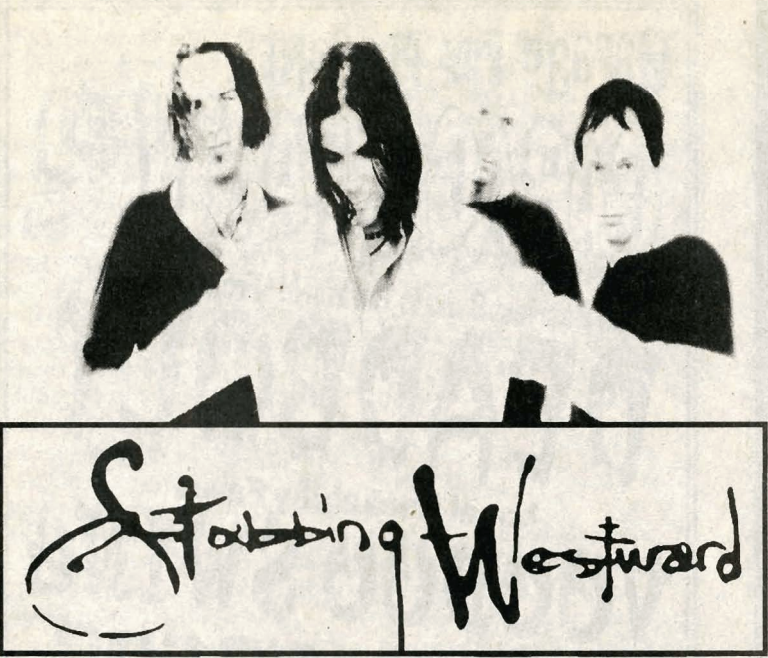
Stabbing Westward
Archived
Stabbing Westward are of a Nine Inch Nails, Depeche Mode breed if you can imagine such. But wait, it goes further than that. They can slap on heavy guitars, almost of an industrial / metal nature and beckon your attention with brutal rhythm or just a faint, comparative to those of Trent Reznor (NIN) or Martin Gore (Depeche Mode) – venting the debilitating circumstances and emotional chaos that can occur in relationships. Vocalist and guitarist, Christopher Hall’s words express the self-actualization, dependency, frustration and bewilderment that we all suffer in our lives when feeling run deep for another.
“This is just one of the few things I care about,” Hall says about Stabbing Westward’s material. I really am not too into politics. The first record was really about a personal relationship gone horribly wrong and this one is similar, but it’s more about where I’m at. “After reading the lyrics for “Wither Blister Burn+Peel”, all of which were written by Hall or co-written with drummer Andy Kubiszewski (who did studio work with NIN and Prick in the past), you can’t help but wonder if organized religion is a “theme” in the band. Statements such as “I don’t believe that I am real” among the album’s lyrics might push the listener making him / her wonder: Do we exist? What are we here to accomplish? How are we supposed to treat each other? When I asked Hall about religion he responded that it isn’t part of his agenda and that it did not play a role in the band’s music.
“I was raised Catholic. I went through Catechism and almost got confirmed and then after learning everything about it I decided I didn’t buy it. There are songs like “Why” where it says, “I can’t believe in anything sacred.” This response seemed awkward given that he sports tattoos of crosses on his body and wears a chain with a cross on it around his neck! “I have like four cross tattoos, various Celtic crosses—I don’t know why. I think I’m fixated on my Catholicism youth.” He seemed sarcastic when he peddled off this excuse for the tattoos. The band does propose a gothic image to an extent, so the crosses fit right in!
All of the band members except for one graduated college— Hall was a trumpet major! You’d figure that Hall’s parents would be proud; he has an education and a band that is becoming successful. “What do I Have To Do,” is the radio single and MTV video—his parents must hear and see him all the time, no? Chris laughs when I ask him if his parents (who live in central Illinois) heard his song; “they don’t get it— Mom I’m on MTV— do you know what MTV is?— do you have cable?— [mom] doesn’t get it, she still wants me to get a job.”
I continue to extract the vision of Stabbing Westward—why all the pessimism, the eeriness and the chilling music?
“We definitely try to make the music and lyrics match emotionally— that the lyrics would reach an angry frenzy, if the music would match, and if they became more melancholy and introspective, the music would come down with it. The first record is angry and bitter and very much placing the blame for everything that’s gone wrong in our life on a few select people. Two years later, we kind of are using this record to sort of do a retrospective look back on our life and realize maybe we’re the ones who fucked up a lot of things or I’m the one who fucked up—maybe a lot of my own personal fear and hang-ups are what cause relationships to crumble. The ending of the last couple of relationships I’ve been involved in were very intense. It was far more intense for me than the person who left me because each time that someone leaves you as you get older, you start questioning more and more– what’s wrong with me that no one can love me? As you start to ask questions, that you’ve avoided asking through puberty and the early twenties, you start to realize stuff you may not want to know and haven’t acknowledged that you better face up to and solve or else you’re going to be 60 years old, 70 years old, living on your front porch yelling at the neighborhood kids by yourself.
As a rule, every member of the band played guitar on the record reiterating a statement by Hall that Stabbing Westward is a pure democracy. He noted that no one in the band had any technical guitar training but that this was a positive thing!
“We know how to make music and we know how to use and instrument but we haven’t learned or mastered the guitar– therefore, we were able to step out of the pre-conceived rules of the instrument. It’s cool to know things but you have to be able to go beyond the knowledge given to you and be more intuitive as well, otherwise, we’d all be writing silly love songs / pop music.”
When he’s not recording or performing, you’ll find Hall gearing up for a good rock climb. This is his idea of recreation, a sport most people cringe at! Touring gives him a chance to find some nice climbing spots.
Speaking of touring, Stabbing Westward has a chance to play England’s renowned Reading Festival—a half hour set for 140,000 people. How did Chris feel when he looked out?
“I felt really hungover because we’d gone to Martin Gore’s wedding the night before and I just went straight from the wedding to Reading. I have this very vivid memory of it now but at the time that I was doing it I couldn’t even think straight because it was so weird— it was like a sea of bodies—a mosh pit going off like 20,000 people. We were so high just being there— the set was over in no time at all.”
The last leg of this interview was spent talking to keyboardist and “utilities man” (guitarist as well!), Walter Flakus. He indeed identifies with Hall’s motives and the vibe of Stabbing Westward. “I’m not the most lyrically oriented, however, I totally agree one-hundred percent with the lyrics of this band, as I think most people, can because I think everybody has gone through these kind of situations and has felt these things at one time or another. To me, interesting sounds, rhythms and beats tend to grab my attention first– if there’s great lyric, as I think we have in a lot of our songs, then that’s just added bonus-plus. I think it just brings the whole experience home.”
One way to look at the group and their music is that the songs are of therapeutic value—a release of energy. As for writing happy love songs in the future, Flakus says, “If at some point we’re overflowing with flowers, the patchouli is stinking up the room, maybe then that happy love song will be right there.”
Read more from the SLUG Archives:
7″ Records
Record Reviews
