Going at it Hammer and Tongs: The Journey of Wasatch Forge
Community

Not so long ago we used our hands to build tools and houses, to craft and create. Though we slowly traded ability and skill for comfort and convenience, there are still places where you can learn to swing a hammer, use raw materials and make something with your bare hands.
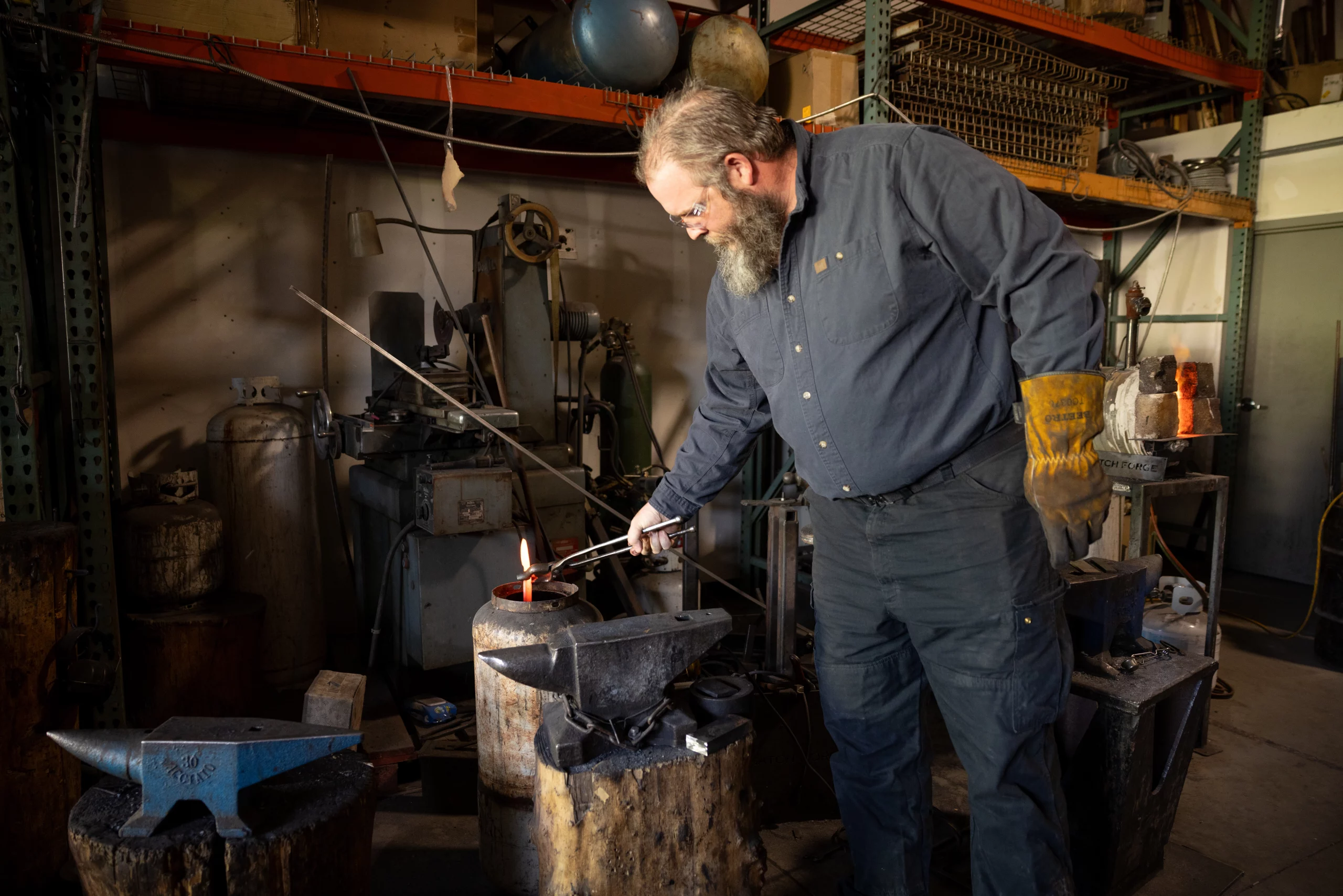
Started by Matt Danielson, Wasatch Forge is such a place, where an instructor will hand you a piece of steel and teach you how to turn it into something useful. Meeting the rising demand of students, Danielson and company offer the knowledge and expertise to turn anyone willing to learn into a blacksmith.
“One day I was waiting around at Wasatch Steel, and I looked at their King Metals architectural catalog while they were cutting my steel. I saw that they had hand-forged garage lamps, and I [was] like, ‘Cool there’s a demand for what I’m doing.’”
Danielson’s own smithing journey began early, but with no real resources he struggled to find his footing. “I’ve been geeky my whole life,” he says, “But at 14 I wanted to make swords and knives, so I started forging. … I was working on a two-inch solid steel hitch from my dad’s garage as my anvil and an old firewood stove as my forge. For a couple years I screwed up heavily, learned stuff, was doing everything out of books — there were no instructors back then, there were no opportunities that I could find to learn.”
Danielson continues, “Eventually one of my friends said, ‘Hey, I know a blacksmith up at This is the Place Monument,’ and so I did two seasons of apprentice work up there learning how to engage with the crowd, how to do ‘show-blacksmithing.’ When the crowds would die down, he would actually teach me the fundamentals and that gave me my start.”
“I brought on an apprentice, trained him up, and gave him basically free lessons. He offered to build me a webpage, wasatchforge.com.”
An entrepreneur at heart, Danielson tried blacksmithing professionally, starting his own business forging garden art for local garden shops. “I failed for a number of years doing that stuff,” he says. “One day I was waiting around at Wasatch Steel, and I looked at their King Metals architectural catalog while they were cutting my steel. I saw that they had hand-forged garage lamps, and I [was] like, ‘Cool there’s a demand for what I’m doing.’ Then I looked at the price, and it was $56 bucks for this imported garage lamp. I borrowed a calculator and did some rough math on how long it would take me to make that in my little shop. I found out I would make about $4.16 an hour, so I just folded the book up, handed it back, and asked for a job application. I washed my hands of all of my blacksmithing dreams and said, ‘You know what? I’ve got a wife now. I want to get a house. I want to start being successful.’ So I became a steel warehouse worker.”
“I’ve been geeky my whole life … But at 14 I wanted to make swords and knives, so I started forging. … I was working on a two-inch solid steel hitch from my dad’s garage as my anvil and an old firewood stove as my forge.”

Even though he did hang up his hammer for a time and worked instead for a steel supplier, Danielson continued to meet other blacksmiths. Through talking to them, he found that he still had a passion for the craft. “There was a resurgence going on that started a bit of a fire [in me] to get back into blacksmithing as a hobbyist,” Danielson says. “I did that for a couple of years and one of my customers for a campfire cookware company said, ‘Hey, I need these products. Do you know anybody?’ And I said, ‘Yeah, absolutely. Go talk to these people that I’m selling steel to.’ At that point, I was a steel salesman, and I wasn’t going to crap in my own nest. So he comes back in and says, ‘Okay, so they’re getting work done for me, but I’m not a priority, because they’re doing other things.’ He says, ‘Matt, I really need some help. I’ve got a container going to Australia, and I’ve got all my fire pits in there, and I don’t have my hand forge items that need to go. Can you help me out?’ So over the next couple of days, I finish his order. He comes in and hands me a check. So I look at it and I’m like, ‘Oh shit, I guess that’s my price.’ That started some more income coming into the forge side of things.”
Eventually, with three other smiths, Danielson rented a space to work out of and started really investigating whether there was any chance of making the endeavor profitable. But after one year, it was down to just one other blacksmith.
“Humans are designed by our hands to have to wield tools … If I don’t wield tools on a regular basis, there is a part of me that is itching in the back of my head that can only be scratched by wielding a tool. I can’t have my hands not doing something.
“It was me and a guy named Mike Imperiale, and he said to me, ‘Matt, it’s just you and me, so I guess we’re going to shut down.’ I’m like, ‘No, I’ll cover the other two shares. I’m not shutting down. If you want to leave, fine, I’ll cover yours too,’” Danielson says. “He [was] like, ‘Well, hang on — fine, we’ll do it another year.’ Then he and I built Wasatch Forge, at least to some degree, together. But at that point, I kind of realized that my buy-in was significantly higher than his buy-in. I kind of knew what was going to happen, and just started trying to run Wasatch Forge more professionally. I brought on an apprentice, trained him up, and gave him basically free lessons. He offered to build me a webpage, wasatchforge.com.”
Being one of the few blacksmiths in the area, and most likely one of even fewer that had a digital footprint at the time, Danielson was an obvious choice when the University of Utah Continuing Education Program was looking for a blacksmith teacher. “I don’t want to downplay Mike’s involvement in creating Wasatch Forge, because when I was contemplating teaching these courses, I had a lot of doubts about being able to do it. So I went to him and he was like, ‘I’ve actually got a degree in some type of adventure education, and we can do that. No problem.’ So we built a rough curriculum, and that’s where Wasatch Forge took a turn. This is 11 years ago now, and we’ve become a trade school. Now production and stuff like that is something that we do very little of, and about 80% of Wasatch Forge is teaching people how to do this particular craft.”
“I washed my hands of all of my blacksmithing dreams and said, ‘You know what? I’ve got a wife now. I want to get a house. I want to start being successful.’ So I became a steel warehouse worker.”
Right around the time they started offering classes, Forged in Fire, a TV show where contestants forge knives in timed competition, began airing on The History Channel. It was a huge shot in the arm for growing interest in the blacksmithing and bladesmithing communities. “l’m very thankful for Forged in Fire to get people to know that this stuff exists and that you can actually shape metal as if it’s clay and pottery, except it’s permanent. It’s really cool; I love anything that helps the craft community. I had Jason Knight, who was a judge on Forged in Fire, come to my shop — he had a layover, came in, and I was teaching one of the U of U courses … He comes in and he says, ‘That’s freaking awesome. I didn’t know that anybody taught blacksmithing. Everybody’s a bladesmith.’”
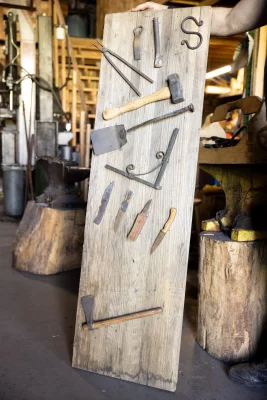
Danielson says watching his passion for the craft spread to his students has become a huge motivation to keep Wasatch Forge going in spite of financial adversity. “Humans are designed by our hands to have to wield tools,” Danielson says. “If I don’t wield tools on a regular basis, there is a part of me that is itching in the back of my head that can only be scratched by wielding a tool. I can’t have my hands not doing something. In my classes, I love to have my students build hammers — you see them realize that if they can do that, they can do anything. If they build a hammer, then there’s no way they take home and leave it in a drawer. They’re going to have to build something with it and that’s what keeps me going.”
“There was a resurgence going on that started a bit of a fire [in me] to get back into blacksmithing as a hobbyist.”
Having personally taken classes at Wasatch Forge, I can tell you that yes, you will get dirty, and yes, it will be hot and sweaty, but you will definitely have a smile on your face when you leave. There’s nothing like the feeling of creating something by hand that you will have forever. A handcrafted bottle opener or a knife will mean so much more than anything you buy, because it’s wrapped up in the experience of crafting and learning. Check out the trade school’s full class offerings at wasatchforge.com.
Read more Community stories from SLUG:
Ramblin’ Rods Race Towards Tomorrow
The Educated Tree Hugger: Content Creation with Justin Davies
