Charles Baker on Finding a Home on The Pitt
Arts
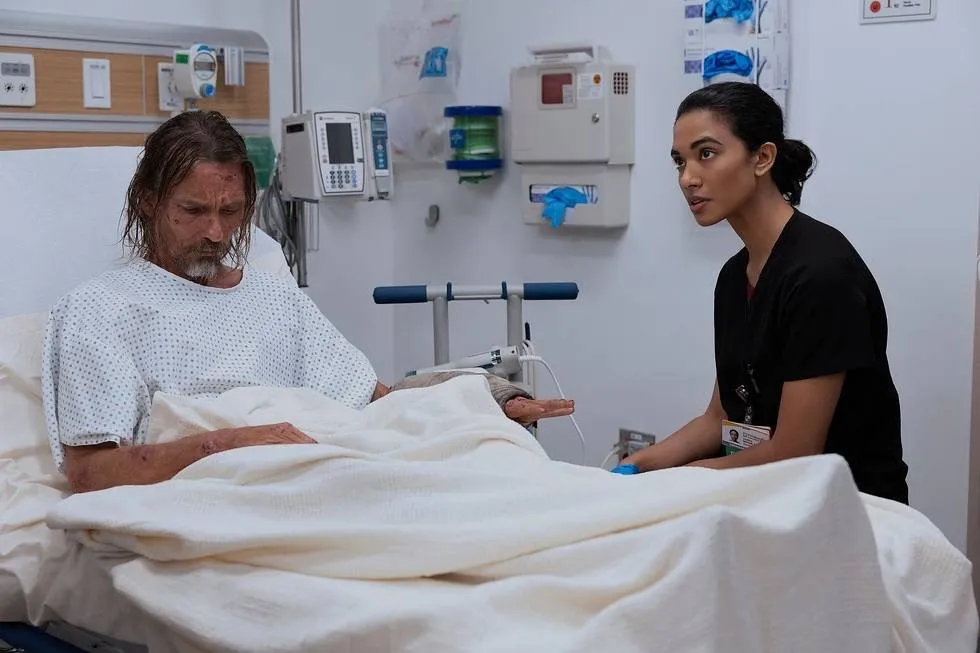
Charles Baker has built a career on inhabiting men who exist on the margins, such as the meth dealer known as Skinny Pete on Breaking Bad. As Troy Digby in The Pitt, Baker has found what may stand as his most personal and profound work yet. Digby, an unhoused man grappling with mental illness, enters the hospital carrying not just his condition but a lifetime of assumptions placed upon him. What Baker brings to the role is something deeper than performance — it’s lived experience, refracted through craft.
“Playing Digby was kind of like the closest to just being myself in a character that I’ve ever really been,” Baker says. That statement lands with weight once you understand what Baker carried into the role. Given minimal information before his audition, beyond that Digby was bipolar and schizophrenic, Baker turned inward by drawing from a childhood marked by psychiatric abuse. As a teenager, Baker was institutionalized for months against his will as part of an insurance scam, manipulated by a system that falsely diagnosed him and convinced him he might never live a normal life. That long shadow of misdiagnosis shaped Baker’s understanding of Digby, a man the world has similarly mislabeled and dismissed.
Baker’s performance hinges on contradiction. Digby is introduced in a way that invites snap judgment — another unstable presence in a chaotic emergency room — but the show gradually reveals layers that challenge both the characters onscreen and the audience watching. In the season finale, Digby is last seen walking through a park at night on the Fourth of July, pushing a shopping cart with a mannequin in it, wearing an ID badge which he stole from a doctor in the hospital and giving a detailed lecture on the history of fireworks to his anthropomorphized companion. “You see this guy, and you just assume stuff about him,” Baker says, comparing the sequence to the moment in Breaking Bad where Skinny Pete suddenly reveals himself to be a masterful piano player. “Then you see what he knows in his life and what kind of knowledge he’s holding on to. And you wonder, where did he get this?” It’s in that tension — between perception and reality — that Baker finds the humanity of Digby.
“The show never judges him,” Baker says. “It’s such a beautiful, human portrait of a person.” In a genre that often reduces patients to cases, Digby becomes something rarer: a fully realized person with a rich personal history, whose struggles are neither sensationalized nor simplified.
Before committing to acting, Baker was a musician, fronting an alternative rock band in Texas. A moment of overheard criticism — bandmates questioning his lack of stage presence — became a turning point. “He’s a really good singer, but he doesn’t have any stage personality at all,” Baker recalls hearing. Determined to change that, he enrolled in an acting class, initially as a means to improve his performance as a singer. Instead, he found something more transformative. Asked to perform in a straight play, he resisted at first — “no music?” — but the experience altered his trajectory. “I became completely immersed in the character. I got hooked,” Baker says.
That sense of immersion is evident in his work on The Pitt, including a standout sequence in which Nurse Dana Evans (Emmy winner Katherine LaNasa) and Emma Nolan (Laëtitia Hollard), a young nurse on her first day at the hospital, give Digby a haircut and a shave. When he sees himself in a mirror, Digby is tearful, fearing that if his family comes looking for him, they won’t recognize him, and the nurses comfort and reassure him. Baker describes the set as a collaborative space driven by empathy and mutual respect, where even seasoned actors remain open to learning. “Every job I have is a learning experience,” he says. “It’s just an amazing experience.” For Baker, those connections are essential, especially in emotionally demanding scenes that require vulnerability not just from him, but from everyone involved. Baker’s preparation for Digby drew from personal history, including growing up with a bipolar mother and witnessing firsthand the effects of untreated mental illness. That dual perspective — both as someone misdiagnosed and as someone who has observed the realities of mental health struggles — adds nuance to his portrayal. Digby becomes a reminder of the stories we fail to see, and Baker doesn’t play him as a symbol or a cautionary tale but as a person shaped by circumstance, intelligence, pain and resilience. The result is a character who lingers, not because of dramatic excess but because of the honesty behind every moment.
Baker’s work on The Pitt underscores a simple but powerful idea: that empathy begins with seeing people as they are, not as we assume them to be. Through Digby, he invites viewers to reconsider those assumptions — and, in doing so, to recognize the humanity that exists in even the most overlooked corners of society.
Read more coverage and interviews on The Pitt:
The Pitt Cast on ICE
Patience is A Virtue For Ernest Harden Jr, and There’s Virtue in Patients
To help SLUG continue bringing you behind-the-scenes insights from the best in the film industry, consider becoming one of our donors!
