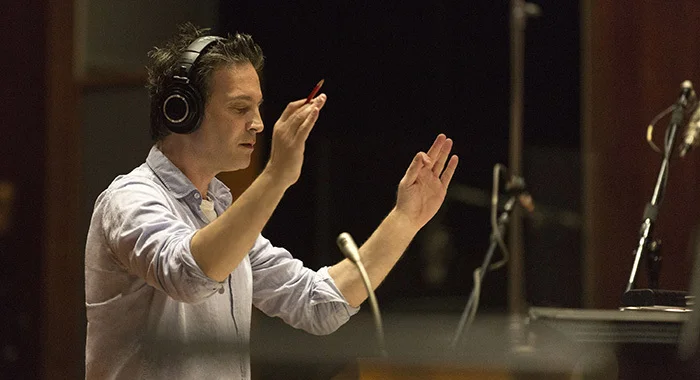
Jeff Russo Boldly Brings New Life To Television Through Music
Film
Jeff Russo has built one of the most versatile careers in modern film and television music, moving effortlessly between science fiction, horror and psychological suspense. From expanding the musical universe of Star Trek to bringing palpable tension to Alien: Earth and Cape Fear, Russo says every score begins with the same goal: communication.
“Music is how I communicate,” Russo says, tracing that philosophy back to his teenage years. Although his father introduced him to classical music as a child, it wasn’t until he was 13 that he became determined to make music his life. Russo started on drums before switching to guitar. Fueled by inspiration from the albums of giants such as Led Zeppelin and The Police, he formed bands, wrote songs and dreamed of becoming a rock star. Russo says that David Gilmour‘s lyrical guitar work particularly shaped his musical voice. As a composer, he also draws deeply from classical giants including Beethoven, Stravinsky and Mahler, blending orchestral traditions with contemporary sounds. That blend has become central to Russo’s work on the Star Trek franchise, where he has composed for multiple series while giving each its own identity. A long-time fan who became an ardent Trekker with The Next Generation, Russo recalls first being struck by the astral symphonies of Jerry Goldsmith and James Horner upon seeing Star Trek: The Motion Picture (1979) and Star Trek II: The Wrath of Khan (1982) in theaters with his father. While it was John Williams‘ deeply emotional score for E.T. the Extra-Terrestrial that first made Russo truly feel film music in a life-changing way, he still often revisits Horner’s rousing Wrath of Khan score. “I listen to it, and I’m always surprised,” Russo says.
After winning an Emmy for his work on Fargo in 2017, Russo made first contact with the Star Trek universe with Star Trek: Discovery and went on to create beloved themes for Star Trek: Picard and Star Trek: Strange New Worlds. Boldly going where giants have gone before means honoring decades of musical history without simply repeating it. For 2026’s Star Trek: Starfleet Academy, Russo collaborated with producer and DJ Dan Nakamura to introduce electronic beats and a more youthful energy while preserving familiar musical touchstones. “You’ll still hear the Alexander Courage theme,” Russo says. “You’ll still hear the Voyager theme in some places… We have a fantastic group of composers that have worked in the world of Star Trek, so mining some of that material for our scores is very useful and very effective.”
That balancing act — respecting iconic music while forging something new — also defined Russo’s work on Cape Fear. Rather than simply recycling Bernard Herrmann and Elmer Bernstein’s legendary themes from the original 1962 film and the 1991 Martin Scorsese adaptation, Russo sought to capture Herrmann’s harmonic language while composing an original score. “The thing that we didn’t want to have happen is we didn’t want to use Herrmann’s music that would make our score sound old-fashioned,” he explains. “My job was to write an original score… while still evoking the past and pointing toward the future.” The project carried added pressure, as both Scorsese and Steven Spielberg served as executive producers, and both offered creative feedback on the music. “At the beginning, it was surreal,” Russo admits. “Two of the greatest filmmakers in history are making notes on my score.” Fortunately, Russo says their comments focused on broad creative direction rather than technical details, while showrunner Nick Antosca worked closely with him on the finer points of individual scenes.
Russo found himself another film music legacy of galactic proportions with Alien: Earth, where he found himself once again following in the footsteps of both Goldsmith and Horner, who not only created the cinematic sounds of the seminal Star Trek films but also the groundbreaking scores for Alien (1979) and Aliens (1986). Rather than choosing one approach over the other, he tried to merge the emotional DNA of both classics. “The approach was to take the greatest horror movie of all time and the greatest action movie of all time… and sort of take those feelings and merge them together,” Russo says. Russo acknowledges that Goldsmith’s influence is strongest throughout the first season, though Horner’s sweeping melodic style also appears at key moments. Russo’s goal was creating a distinctly modern sound while paying proper respect to two of cinema’s most beloved science-fiction films. “It was really a question of trying to find a unique voice that was decidedly modern, while also paying a correct amount of homage to what this IP is,” Russo says.
Whether exploring strange new worlds, revisiting one of cinema’s greatest thrillers, or making you feel like something from another world is about to burst forth from your chest, Russo’s approach remains remarkably consistent. Every project begins by studying the composers who came before him, understanding what made their music resonate and then finding a fresh way to communicate those emotions to a new audience.
Read more film interviews by Patrick Gibbs:
Siobhan McCarthy and the Cast Talk She’s the He
Rod Davis Lurie Lights Up Lucky Strike
Enjoying SLUG’s inside coverage of the film industry? Consider becoming one of our donors!
