Film Review: The Weight
Film
The Weight
Director: Padraic McKinley
Fields Entertainment, Under The Influence Productions, Augenschein Filmproduktion
In Theaters: 09.18.2026
The Great Depression has long provided authors and filmmakers with a rich setting for stories about poverty, desperation and survival. The Weight aims high in bringing us a new story that draws inescapable parallels between this bleak era and the America we live in today — and sometimes it succeeds.
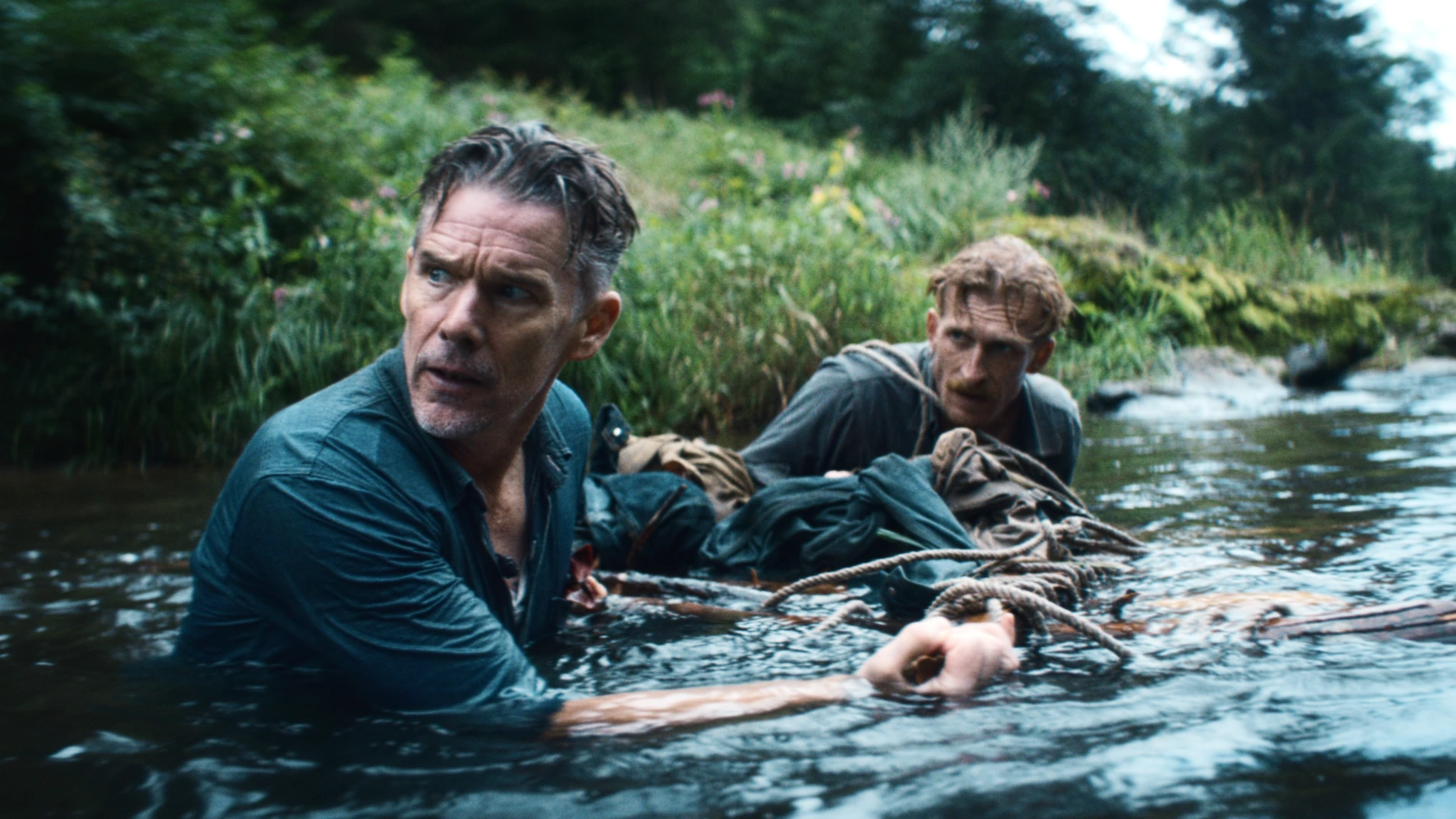
It’s 1933 in Eugene, Oregon, and a widowed veteran named Murphy (Ethan Hawke, Dead Poets Society, Training Day) struggles to support his beloved young daughter, Penny (Avy Berry, A Quiet Place: Day One, Breathe Deep). When a misunderstanding leads to a back-alley fight with undercover police officers, father and daughter are separated, and Murphy is sent to a brutal prison–work camp, run by the hard-nosed Warden Clancy (Russell Crowe, Gladiator, A Beautiful Mind). When Murphy’s ingenuity catches Clancy’s attention, the corrupt warden offers him a deal: an early release in exchange for leading a group of fellow prisoners on a dangerous gold-smuggling expedition through 100 miles of wilderness. Carrying bars from a mine shut down amid Roosevelt’s restrictions on private gold, Murphy and his team face treacherous terrain, dwindling supplies and growing distrust.
The Weight is an often gripping drama that sets out to be a throwback to the rugged survival pictures of the late 60s and 70s, films such as Cool Hand Luke (1967), Deliverance (1972) and Sorcerer (1977). Director Padraic McKinley has a strong feel for the time period, effectively transporting the audience to a different time and place. The atmospheric touches and the harsh trials faced by the lead bring a lot of gravity to the story, and I was all in on my desire to see Murphy succeed in getting back to his adorable daughter.
While the tense action sequences — particularly one nail-biting scene on a collapsing suspension bridge — demonstrate McKinley’s skill behind the camera, the film struggles to maintain this level of tension and momentum throughout. The middle section drags as the narrative becomes more episodic and flat, and supporting characters begin to take too much of the focus.
I really wanted to be interested in the dynamic between Singh (Avi Nash, Silo), an Indian man passing for white, and Rankin (Austin Amelio, Hit Man, Hokum), who endlessly harasses Singh about his socialist beliefs. This repartee grows stale quickly, and the screenplay by Matthew Booi and Shelby Gaines never manages to take it anywhere, especially in that it feels a bit too on the nose in its efforts to draw parallels to today.
In an interesting sequence in the third act, Murphy steals an automobile equipped with a velocity governor that prevents the car from reaching top speeds. The irony is that, at this point, watching Hawke desperately try to drive a solidly built vehicle forward despite its inability to keep a sufficient pace felt like another obvious parallel, this time to the film itself. McKinley lets several scenes go on and on in this way and move surprisingly slowly. It keeps a very good movie from building the momentum needed to be a great one.
However, Hawke is terrific and carries the film with his committed performance. The character is hard not to root for, though it’s also hard to escape the feeling that he’s a bit old to be playing the single father of such a young girl. Crowe is given a pretty simple character, but even when he’s chewing the scenery, he brings considerable presence to the role; even with rather limited screen time, it’s one of his better roles in recent memory. Berry is a nice discovery, delivering a surprisingly mature portrayal of a child forced to grow up too soon, and Julia Jones (Rez Ball) adds some heft as Anna, an Indigenous woman who becomes mixed up in the mission.
The Weight is a very worthy effort that has an appealingly unvarnished quality to it, and at its best, it’s quite captivating. If it didn’t have such a tendency to saunter without purpose at times, and the supporting characters were more richly drawn, we could have had something really special here. While I found the trek to be decidedly worth the effort, it never quite managed to set a new gold standard for the genre. —Patrick Gibbs.
Read more of Patrick Gibbs’ film reviews below:
Film Review: The Fix
Film Review: MayDay
Enjoying SLUG’s coverage of films? Consider joining our community of donors!
