Alex Caldiero’s Final Recitation of Allen Ginsberg’s “Howl”
Art
Alex Caldiero is one of Utah’s most prolific, mystical and unorthodox living poets. In addition to authoring a wealth of poetry collections, including Some Love (2015), sonosuono (2013) and per-sonal effects (2021), Caldiero is an acclaimed sculptor, musician and sonosopher — a term he coined for a performer who blurs the lines between sound, poetry and philosophy. In Caldiero’s own words, “What philosophy is to ideas, sonosophy is to sound. Everything is basically different forces of sound, and everything is constantly in transformation. Sonosophy tries to articulate that, not only theoretically, but in practice.”
Caldiero is also a scholar and revivalist of beat literature, the body of work written by midcentury iconoclasts and seekers like Jack Kerouac, William S. Burroughs, Diane di Prima and Allen Ginsberg. In this spirit, he has performed live recitations of Ginsberg’s seminal long poem, “Howl for Carl Solomon,” (“Howl”) every five years since 1995. This 30-year tradition will culminate — and unfortunately terminate — on Oct. 7 with a recitation to celebrate the 75th anniversary of Ginsberg’s first live reading of the poem at Six Gallery in San Francisco. This free performance will be held at the Utah Museum of Contemporary Art (UMOCA) at 7 p.m., and Caldiero will be accompanied by improvisational music from local bands Iceburn Collective and Theta Naught.
Caldiero is a long-time humanities professor and artist in residence at Utah Valley University, and I was fortunate enough to take one of his literature classes in the fall of 2015. Each of his lessons was an erratic journey through the netherworld of literature, during which he would frequently meander into lectures on obscure folklore, break into nonsensical singing, produce a mouth harp from his tweed jacket for impromptu performances and even scream at the top of his ample lungs midsentence, startling us awake to the ineffable possibilities of artistic experience that traditional academia often numbs young people to.
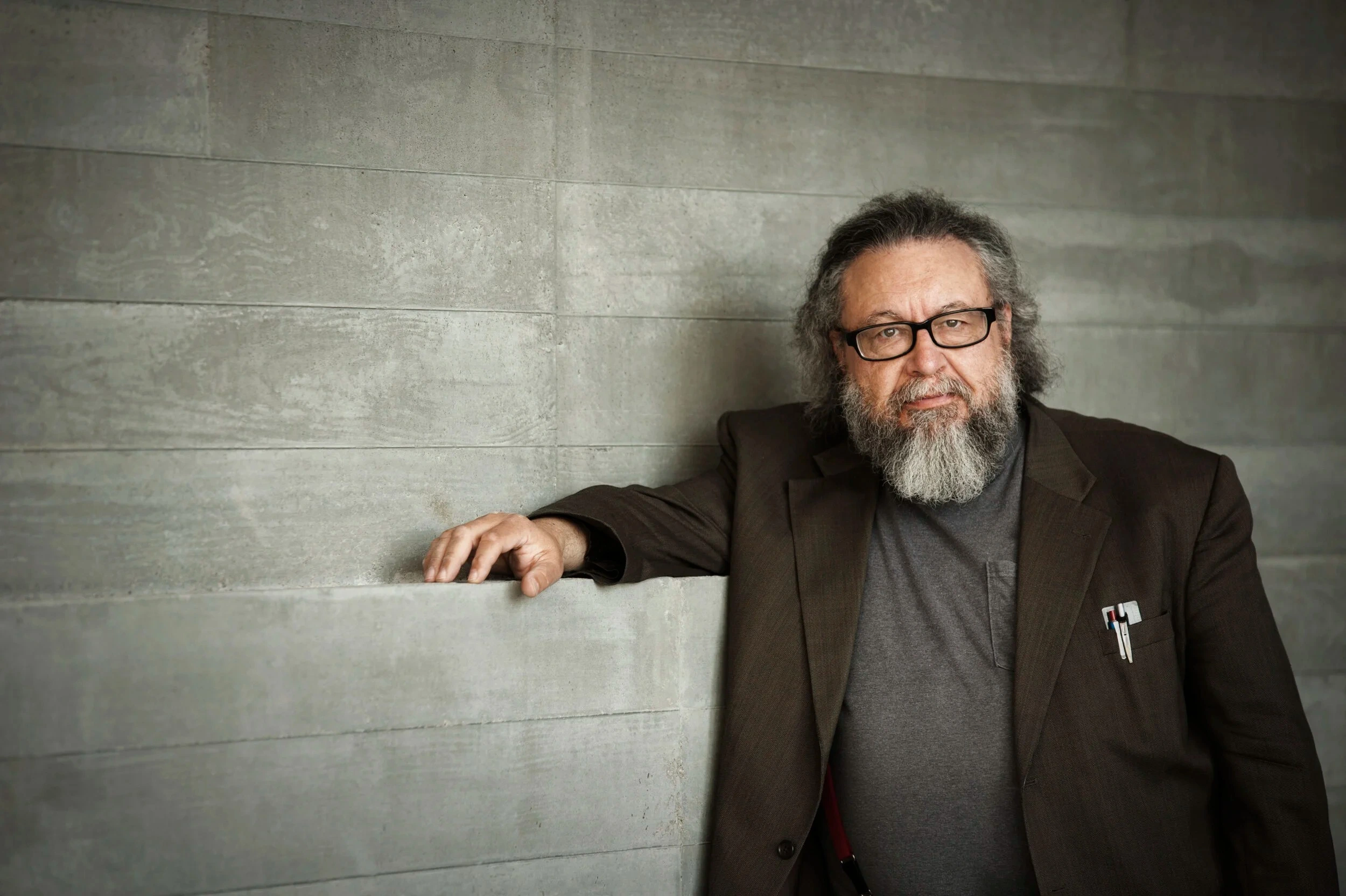
Last Saturday, I reunited with this orphic madman at his home to discuss his upcoming recitation of “Howl,” pick his brain about the poem’s significance and learn why he’s retiring these performances. When Caldiero answers the door to let me in, he’s slightly shrunken and a little more wizened than I remember, but he is otherwise exactly the same as a decade ago: Abrahamic beard, brown eyes impishly shining through his spectacles and bushy eyebrows gesticulating with every emotion and epiphany that crosses his mind. He sits me down in a living room lined with overfilled bookshelves spilling hefty tomes on language, religion and poetry out onto the floor. A large piece of art by William Blake hangs on the wall overhead.
After we caught up, I kicked things off by asking Caldiero why “Howl” is still such an important and widely read poem after all these years. “It sort of encapsulates our entire culture,” he replies in his dulcet but gravelly Brooklyn accent, a holdover from his upbringing in New York City. “And it continues to address problems in a very direct, raw manner. Part one is about the outsiders, those that have been abused, the down-and-outers. You know? The gays, the criminals, the poor, the drug addicts. People that are not really considered part of society, but are society. Not the fucking oligarchs.”
“And then the second part,” he continues in fragmented spurts, “which just keeps getting more and more powerful, especially the Moloch. Oil. Banks. Nothing’s changing. I must tell you that in the ‘60s and early ‘70s, things were this bad. You know, it can be read as an apocalyptic book.”
“And then in the last section, everything is holy. And that’s what I want to affirm for myself, you know? The holiness of everything,” Caldiero says. “And a personal salvation that’s not part of a political or religious organization. That last section is so uplifting. He takes you down into darkness, and then brings you back up into the light, which is what shamans do. And it’s American. That’s the other thing. This process that’s in every ancient culture entered mainstream America through this poem and through his ability to synchronize Jewish, Kabbalistic, Christian and Buddhist traditions. This is how the poem becomes almost like a scripture. It becomes holy writ.”
He then tells me about his plans for his final performance. “Every one of them, I’ve tried to reshape and make unique,” he says. “And for this one, I think the musical link is going to be the strongest. We’ll have six musicians. And the musicians will shape the thing with the poem. I’ve worked with the musicians that will be there before. Gentry Densley [of Iceburn Collective] is one of the most incredible musicians anywhere around, seriously. He was at the first ‘Howl’ and about two other ‘Howls’ for the prelude music. This time, they’ll all be performing during and between the poem to give every section more of a movement, coloring each section so that there’s more distinction between the sections. So that’s very exciting to me.”
In fact, Caldiero tells me he has just returned home from a recital with the musicians. “That’s why I’m a little hoarse,” he explains. “And we really got jamming for the Moloch section. It’s such an indictment of how fucked up we are as a culture. Not to mince words.”
Both Densley and Ryan Stanfield of Theta Naught had a lot to say when I reached out with questions about working with the sonosopher. “It’s always been a transcendental delight to make a joyful noise with Alex,” says Densley. “Playing alongside him, I learned to be present, fully in the moment and just let it be what it was becoming. I first met Alex at a benefit show for Food Not Bombs at Centro Civico Mexicano here in SLC. I was totally taken by his performance, and I guess he dug Iceburn. Not too long after, he called and said he was going to read ‘Howl’ on the 40th anniversary, and he wanted Iceburn to play as well.”
Stanfield’s initiation into the “Howl” performances was slightly different. “I first met Alex in 2004 when he attended a Theta Naught performance,” he tells me. “Alex came up to us after the set and said, ‘WOW! You guys can count! I haven’t felt like that since I saw Iceburn.’ He came to another performance a few weeks later and asked if we’d perform together with him. In 2005, we recorded an album called Sound Weave together, toured to promote the album and played a lot in 2005-2006.”
The thoughts of both musicians regarding the cultural importance of “Howl” largely echo Caldiero’s, though each has a more personal interpretation of the poem as well. “It contains multitudes,” Densley says. “Like a song of oneself. It’s probably one of the earliest examples of a punk rock song that was way more punk than punk ever got. It’s an anthem to the underground, the disenfranchised and marginalized. It’s also a love letter and holy hymn.”
“‘Howl’ is an amazing, complex piece,” says Stanfield. “The first and longest part covers the alienation and struggles that most artists go through. The second part on Moloch is the most identifiable for me as a metaphor for the dehumanization from corporations, greed or war. And the footnote is utter beauty transforming the despair into holiness. I think it’s what every artist hopes for and occasionally achieves through their chosen medium. Music is one of my mediums, and it has brought me more flow and joy than I could’ve imagined.”
Interestingly, Caldiero says that his inaugural performance of “Howl” in 1995 was actually sanctioned by Ginsberg. “I called up Ginsberg,” he says, smiling. “I was introduced to him by an incredible poet, Cid Corman, who said to call him up. And I told him, ‘Listen. I want to do “Howl” and I want your blessing.’ And I remember he chuckled then said, “Okay, I give you my blessing.’ It was kind of a joke, but we both believe in blessings in an internal way. Not just in terms of permission, if you know what I mean.”
I then ask Caldiero why he has continued performing “Howl” for so long. “Well,” he replies, “the first time I thought it was a one-shot deal in commemoration of the 40th anniversary. But the first thing that struck me when I saw the people gathered there was that it was this motley crew. This beautiful menagerie. People were coming out of the woodwork. I mean, there were people in the streets, and we had to get mics. There must have been five, six hundred people, easy. And there was this moment of brother-sisterhood, of shared humanity, amongst all the people there. We were all on the same wavelength. And I said, ‘Damn, I think I’ve got to do this again.’”
He falls quiet for a moment, his eyes on the floor while he gathers his thoughts. Then he tells me what these recitations have meant to him personally. “You know, I keep fighting my own cynicism because otherwise I get very dark. And I think reiteration helps me to keep a certain part of myself inviolate so that it cannot be tampered with. Every performance, I’ve seen that play out again — that feeling, you know. It’s like a very private moment of recognizing your own humanity like that. That’s the thing that keeps me doing it.”
Despite how edifying and life-affirming these performances have been for Caldiero, failing health is forcing him to retire from the taxing recitations. When I ask if he’d like to see others continue the tradition in his absence, he candidly replies, “I don’t know. Traditions are very, very interesting. They require more than simply doing something over and over. I grew up in an environment of traditions, some of them dating back to the Middle Ages, and they require more than action. They require that, at one point or other, there was an establishment of a ground upon which the action rests and is carried. I don’t know if you can plan that. I’m hoping that it could inspire, like I was inspired, but that’s just a hope.”
I wrap up by asking what Caldiero hopes his audience will take away from this final performance, and his answer is both ominous and moving. “Well, funny you should use the word ‘final’ because it might well be,” he says, eyebrows bristling forebodingly. “But what I hope is that everybody takes away hope. And I don’t mean to be funny, but yeah, that’s what I hope. Hope may be one of the things that Pandora’s box still has in there. We all would have been goners without that little thing that was left.”
As our political climate slides back toward the censorship that plagued “Howl” upon publication, and the greedy hawkishness that Ginsberg’s poem condemned, once again rears its ugly head, I’ll take all the hope I can get. If you’re also in desperate need of what was at the bottom of Pandora’s box, don’t miss Alex Caldiero’s final recitation of “Howl” with support from Theta Naught and Iceburn Collective at UMOCA on October 7 at 7 p.m. You can RSVP for this free event on UMOCA’s website.
Read more art features on talented creatives in Utah:
Beto Conejo’s Road to Creating Utah Day of the Dead
The Best Gifts Come in Small Packages: The Helper Mini Museum
