
Venus Unbalanced: A behind-the-scenes conversation with the crew of Voodoo Theatre Company’s Venus in Fur
Art
The seesaw of power is at the heart of David Ives‘ Venus in Fur. What begins as an audition becomes a battle of control and perception. Adapted from Leopold von Sacher-Masoch‘s Venus in Furs and set in contemporary New York City, the play continually asks audiences to reconsider who controls the scene — and who is being manipulated.
As Voodoo Theatre Company prepares its production, director Patrick Kibbie, actor Deena Marie Manzanares, actor Jaden D. Richards and assistant director Sophia Van Nederveen sat down with SLUG to discuss trust, vulnerability, artistic collaboration and why this provocative work continues to titillate and resonate.
SLUG: Why this play? Obviously, it’s a little edgier than what we normally see in this market. Is there a place for edgier theater here?
Kibbie: Yeah. That’s kind of what Voodoo [Theatre Company] likes to do. We like to produce work that’s outside the norm — shows that normally wouldn’t be done in Utah.
I think the edginess of this play is something Utah audiences will really enjoy, because it isn’t the average musical. It’s not Joseph and the Amazing Technicolor Dreamcoat or the kinds of shows people are used to seeing.
As for why this play now — I fell in love with it back when I was an undergraduate. One of my theater professors introduced me to it, and ever since then, it’s been sitting in the back of my mind as something I wanted to direct. I just knew I needed the right people and that the right opportunity would come along someday.
Then I got a call from Deena. She said, “I’m really interested in this show. Let’s have lunch and talk about it.” So we did, and that’s where the idea really took shape. It turned into the perfect time, the perfect place and the perfect people to produce it. Honestly, we’re doing this because of Deena.
Manzanares: It’s funny because I didn’t grow up in a conservative household or family. I wasn’t sheltered the way some people in Utah might have been. Sometimes I honestly forget that things are considered “edgy” here.
It really wasn’t until these last couple of weeks of rehearsal, when people started saying, “Oh, you’re in a play — I want tickets,” that I realized I needed to explain what this show actually is.
At first I’d tell people, “It’s a little spicy.” Then I realized that doesn’t really mean anything. So now I just tell people, “This would absolutely be rated-R if it were a movie.”
There are six F-bombs within the first ten seconds after I come onstage. It’s not that anything is crude for the sake of being crude. This play is so smart, so beautifully written—
Kibbie: It’s incredibly intelligent.
Manzanares: Exactly. The language and subject matter may be difficult for some people, and I want audiences to know that going in so they can decide whether it’s something they’re comfortable seeing.
When I lived in New York, I saw this show on Broadway, and I thought it was absolutely brilliant. I remember sitting there thinking, “I have to play Vonda Jordan someday. I cannot leave this earth without playing this role.”
What drew me wasn’t simply that it was edgy or sexy. It was an acting challenge. Watching the actress playing Vonda, she was able to access so many different facets of the character. One moment she’s completely disheveled, dropping F-bombs, and the next she’s a polished, classically trained actress. The speed with which she made those transitions was astonishing, and the audience applauded those moments.
I’ve been doing theater for a long time. I’ve played a lot of different roles, but this felt like a completely different kind of challenge. I like roles that scare me a little. I like feeling challenged. I like taking on work that feels daunting or difficult because that’s what keeps me growing as an actor.
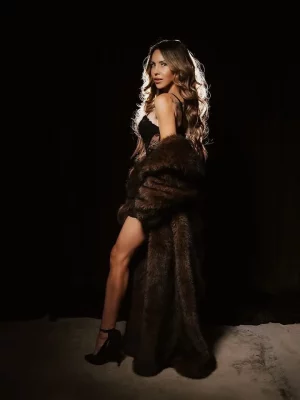
SLUG: Was taking on that challenge something you were excited about? Has it tested you as an actor in the way you hoped it would?
Manzanares: Absolutely. Everything is different now that I’m a mom. You see everything through a different lens, and your time is much more limited. I had to ask myself whether I could take on something this demanding — memorize it, commit to the rehearsal process, and really give it everything it deserves. A few years ago, I don’t think it would have been possible. My kids were too little, and I couldn’t have stepped away the way this role requires. Now, though, it felt like the right time. That’s why I finally reached out and thought, “Let’s see if we can make this happen,” because I felt like I could create the space for it.
Is it challenging? Absolutely. My schedule is crazy, so fitting this into my life is a sacrifice. I’m missing family events this summer and saying no to a lot of things. But I also have my family’s support, which lets me come here, breathe and give the role what it needs.
One thing I’ve realized is that the play unfolds entirely in real time. It’s one continuous scene. It never stops. We never leave the stage, no new characters come on, we don’t have costume changes backstage—
Kibbie: There aren’t even set changes. The show starts, and it’s a sprint all the way to the finish.
Manzanares: Exactly. There isn’t a break. The mental stamina required is on another level.
SLUG: How are you building that stamina? The rehearsal process for something like this has to be very different because you never have the chance to step offstage, take a breath, or even think, “What was my next line?” You’re always in the spotlight.
Richards: Deena and I realized pretty early on that repetition was going to be the key. Not only did it help us memorize the script, but it also helped us pace ourselves through the entire show.
Manzanares: I think back to other large roles I’ve played, like Hedda Gabler or Blanche DuBois. Those are emotionally exhausting, but there are still scene breaks. With this play, Patrick wisely divided the script into three sections — the first 20 pages, then the next 20 then the final 20. We spent about a week on each section, which gave us the chance to really dig into the material.
Then came the challenge of stitching those sections together into one continuous performance. At this point, we’re running the entire show every rehearsal, and I think that’s the only way to build the stamina it requires. We have to experience the flow of it and understand what it demands.
Richards: One thing that’s really helped me has been breaking the script down into beats. Even though it’s one continuous scene, approaching it through script analysis lets me create smaller sections in my mind.
That helps me track my character’s energy and intentions. Within the larger play, there are also the smaller scenes inside the play itself, each with its own objectives and rhythm. Understanding how those connect has made the whole thing much easier to navigate.
Manzanares: You do begin to recognize where each section begins and ends. The audience will never notice that, but we certainly do. By the end of a run, though, it’s exhausting. For me, it’s actually more mentally draining than emotionally draining.
Van Nederveen: It also requires an incredible amount of vulnerability and intensity between the two of you. You’re playing multiple characters without ever getting a break or a chance to reset. You simply have to stay in it while constantly shifting. It’s really beautiful to watch.
Richards: I love that challenge. You really have to understand every character’s intention in every moment, because you never have a second to stop and reorient yourself. That’s why we’ve spent so much time not only rehearsing together but also doing individual preparation. I’ve spent countless hours studying the script so that when we’re in rehearsal, I know exactly where my character is emotionally and what each moment requires.
Kibbie: I also have to say these two are consummate professionals. We spent a week on each section of the script and then finally ran the entire play straight through. I honestly couldn’t tell where one rehearsal section ended and another began. They had done so much work developing their characters that everything flowed naturally.
SLUG: Trust is something we talk about a lot in theater, but I think this play takes it to another level. What role has trust played in this process? Did that come naturally, or was it something you had to build together?
Manzanares: When we first talked about producing this show, one of the biggest questions was who was going to play Thomas. That was honestly a little scary, because we had no idea who that person would be. We had a list of possibilities, but none of them felt quite right. Then we held auditions, and I realized the actor cast opposite me would probably be someone I’d never worked with before. That was exciting, but also intimidating.
Trust is everything in a play like this. I say all the time that if Jaden hadn’t shown up, I honestly don’t know what we would have done. We probably would have had to keep looking. But when he came to callbacks, everything felt different. The chemistry was there immediately. From the very first script read, there was nothing but respect, care and positive energy from everyone involved. That part has actually been easy, thank goodness. I can’t imagine doing this any other way.
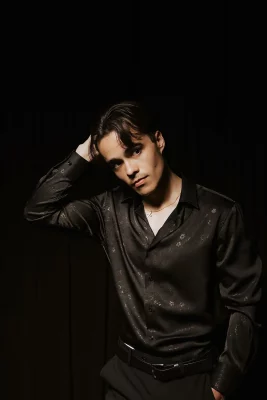
Richards: I felt that trust during callbacks, too. It was surprising because we’d never worked together before. One of the callback scenes is where Thomas really begins pushing Vonda to do the things he wants her to do. To be able to explore that with someone I’d just met — and still feel completely safe — was remarkable.
Manzanares: Everyone involved is incredibly thoughtful about their work. Patrick is a smart director, Jaden is a smart actor and our entire team contributes ideas. It really has felt like a collaborative process from day one. That supportive environment was always the goal, but everybody genuinely showed up ready to create that kind of space.
SLUG: I think the smaller the cast, the more important that trust becomes because everyone is working so closely together toward a shared vision. Did you all find yourselves on the same page early, or did you have to work toward a shared interpretation?
Kibbie: Honestly, once Jaden came into the audition, everything just clicked. The chemistry between the two of them was obvious. From the beginning, everyone approached rehearsal with open minds and a willingness to experiment. Those first couple of weeks were all about asking, ‘What happens if we try this?’ We created a space where nobody was afraid to fail. If something didn’t work, we’d simply move on. If it did work, we’d build on it. Everyone came in with open hearts, open minds and a willingness to be brave, and it’s been wonderful to watch.
Manzanares: It’s funny you ask that because I was actually thinking about it this afternoon. I’ve carried this play around in the back of my mind since 2011, so of course I had my own vision of what it might look like — how Vonda would be portrayed, what Thomas would be like, the costumes, the overall feel. I wondered what would happen if I walked into rehearsal and discovered we all had completely different ideas.
Thankfully, we got incredibly lucky. We all seemed to approach the material from the same place. Even little things reflected that. There’s a moment where Vonda changes into a very specific pair of boots. Patrick had already ordered a pair, and I happened to find some online that I loved. When we compared them, they were practically identical. We had envisioned exactly the same thing.
I’ve watched productions of this play from all over the world, and they’re all different. The costumes, the staging, the performances — everyone interprets it differently. But this production feels exactly like I’d hoped it would.
We’re not playing it safe. We’ve even added a couple of moments near the end that aren’t explicitly in the script because we wanted to fully commit to the story we’re telling. I love that.
Richards: I think that’s really what theater has always been about — pushing boundaries, challenging expectations and surprising audiences. Everyone entered this process with that goal in mind. Nobody came in weighed down by preconceived ideas or fear, and because of that, we’ve all been willing to experiment. I think that openness really shows in the work.
Van Nederveen: Especially here in Utah, the themes of this play can feel taboo, even though they’re also very much part of people’s lived experiences. Right now, we’re seeing films exploring power, domination, submission, manipulation and relationship dynamics. It feels like exactly the right moment for a play like this. That goes back to your first question about why now. The timing simply feels right.
Manzanares: We talked about that a lot during our first week of rehearsals — what this play meant in 2011 compared to what it means in 2026, and why it still feels so current.
There’s also been a lot of conversation recently about creating work for the female gaze. I think this play was doing that long before it became part of the larger cultural conversation. It may actually have been ahead of its time.
I think audiences today will appreciate that perspective even more.
SLUG: We’ve talked around the plot quite a bit without really explaining it, which is probably appropriate. But for someone who’s never heard of the play, how would each of you describe what it’s about without giving away too many spoilers?
Kibbie: I usually describe it as a story about power dynamics within a relationship. Who has the power? Who wants it? Who believes they deserve it? At its core, that’s really what the play explores. There are certainly other themes, but everything ultimately comes back to the balance of power between two people.
Manzanares: I love describing it as a love letter to the female gaze.
There are so many different ways to interpret the play. Theater people will recognize the audition dynamic immediately — the experience of walking into a room where someone else holds all the power. I think many women, or anyone who’s experienced misogyny or an abuse of authority, will recognize pieces of themselves in this story.
I usually tell people it’s a wild ride. It isn’t what it first appears to be. Just when you think you’ve figured it out, the story shifts again. By the end there are surprises that completely change the way you’ve been looking at everything.
Richards: For me, one of the central ideas is the erasure of identity — particularly the erasure of women. Society often expects people to fit into very specific roles, and when they step outside those expectations they’re judged for it.
From Thomas’s perspective, though, I also think the story is about embracing your authentic self.
Manzanares: And there’s a tremendous amount of fantasy woven throughout the entire piece.
Kibbie: That’s one of the things I love most about it.
SLUG: I appreciate all of you taking the time to talk with me today. I know you’re eager to get back to rehearsal.
One of the things that fascinates me, from a theater perspective, is that the person auditioning isn’t supposed to hold the power. They’re expected to ask, ‘What would you like me to do?’ and simply comply.
Seeing a play that pushes back against that dynamic is compelling to me, regardless of gender. Watching someone who’s expected to be submissive reclaim that power is something I’m really looking forward to seeing onstage.
Produced by Voodoo Theatre Company, Venus in Fur runs July 17–26, at the Mid-Valley Performing Arts Center. Tickets are available at SaltLakeCountyArts.org and VoodooTheatreCompany.com.
Read more exclusive coverage from Ryan Michael Painter:
The Human League, Alison Moyet, Soft Cell @ Red Butte Garden Amphitheatre 06.11.26
Electro Light Parade: Erasure’s Andy Bell Comes to Park City
Want to help SLUG keep highlighting the artists of the local art scene? Consider becoming one of our donors!
