Relics and Their Humans: Showing all of the sides of ALS and Caregiving
Art
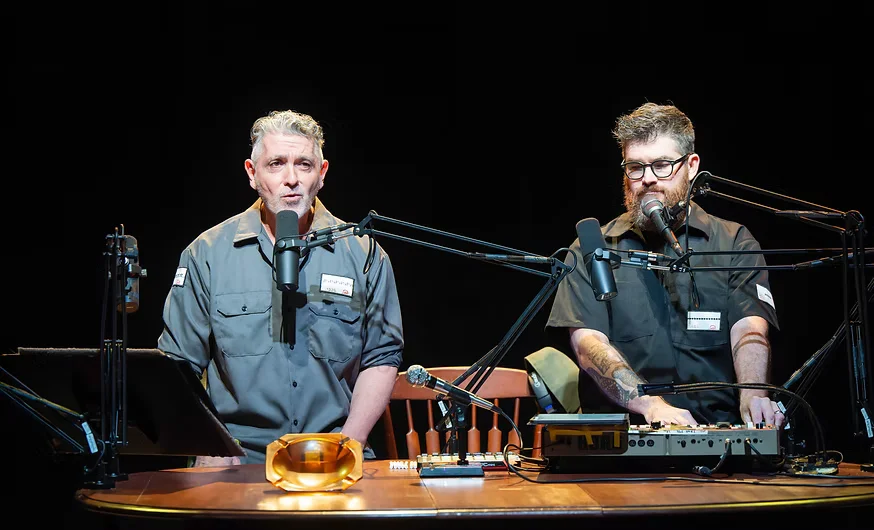
I’m handed a pamphlet on Amyotrophic Lateral Sclerosis (ALS) as I sit in a dim, intimate room at Kingsbury Hall on Wednesday, opening night of Relics and Their Humans. The pamphlet shares that ALS paralyzes the body. There’s no cure. There’s a dining table on the small stage in front of me, dressed in a podcast-style setup and surrounded by four chairs. The backdrop shows the faint outline of a door and subtle details of a decorated dining room. Two men walk out. They speak of a playlist, tiny wooden houses, a journal and a Reuben sandwich crafted meticulously with gluten-free bread, crisped to perfection with the homemaking skills of a purist mother named “Sue.” Despite all of my research into the event, I’m still not sure what I’m going to experience.
Like a delightful conversation between friends, Relics and Their Humans unfolds naturally through Josh Quillen and Ain Gordon performing the story of Josh’s father, Jerry Quillen, his ALS diagnosis and the challenges that came with it. Gordon performs as himself, a narrator and the role of Sue Quillen, Josh’s mother and Jerry’s spouse.
Delivered through ordinary personal items, poetic pacing and dynamic songs, they dive into their stories with immersive atmosphere and prose. This is best shown in the song “Jerry’s Always Had to Drive,” where they use short adjectives and simple sentences to build tension to convey Jerry giving 23 years of hard work to a company that would let him go. The song fades to body percussion, acapella humming and a sniffle at the end of each measure, accompanied by guest performers Nathan Moss and Ethan Ribble.
Rather than lingering on the background details, they engage the audience by exploring the timeline non-linearly and dropping hints as to what might come next. Gordon and Josh also do a great job of showing all of the family’s experience with the disease: Sue’s perspective as a wife and as a caregiver, Jerry’s experience going through ALS and losing his independence and the reactions of both of their sons.
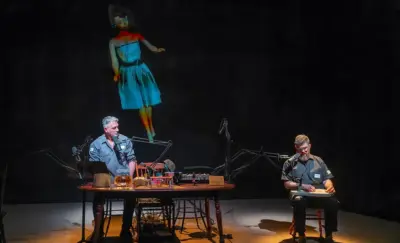
At the end of the performance, I find myself wishing that it was longer and wanting to get more involved in my community to help those affected.
“I don’t talk about it much, but it’s very true: Both of my parents died during the process of making this show, and I’m an only [child], so I was handling all of it. So, this show became a way … for me to process that on stage without anyone having to know that that’s what I was doing,” says Gordon.
While Relics and Their Humans originally explores the hardships of grief, caregiving and loss in the Quillen family, it is certainly influenced by Gordon’s as well. While discussing playing the role of Sue, Josh credits Gordon’s success in this role to Gordon’s caregiving past, as he tended both of his parents and his aunt until their passings. Gordon says, “I know exactly what this is. I don’t have to reach very far.”
The performance explores Jerry and Sue’s challenges together as they have tried every alternative remedy possible to cure his ALS and to adjust to this new “normal.” It starts with his right leg and works its way up. She balances taking care of him and being resourceful while also needing to keep her full-time job for health insurance reasons. They struggle to travel as ADA requirements aren’t met everywhere, especially in older cities and historical areas. Sue does most of this on her own with some occasional help from friends and family, that is, until she breaks her arm and must call in help from hospice.
I still find myself thinking about Sue’s wooden houses that lined the door’s header like sticks of selenite. I think about that Reuben sandwich she made Gordon from the beginning of the show, foreshadowing the kind of love, protection and attention to detail that being a caregiver takes from you — and gives to you.
I am touched by how much kindness and help the family received from the community during their difficult time: They received a lift from a neighbor who trained Sue on how to use it, friends helped in the middle of the night, the fire department knew them by name and hospice helped Sue with her cast. Josh says that this time brought his family closer together.
When asked about what the public could do better to help those with disabilities, Josh says that awareness is the first step. He gives examples like matching their pace, not talking over someone and, in general, making people feel included and that they belong. Ain says that there’s a lack of sensitivity around the elderly and mentions how everything being online is alienating, as there’s no human courtesy or contact.
“My cousin, Jess, … has cerebral palsy, and I think the thing that I’ve learned from her is that that’s the only difference between her and everyone else,” says Josh. —Brandi Trujillo
Read more about theater in SLC:
20 Years Later, Facing East Still Hits Home
Stage Musical Little Shop of Horrors to Play Remodeled Murray Theater
Want more articles about local theater? Consider joining our community of donors!
