Clair Popkin on Capturing the Human Story Behind Everest: The Other Side
Film
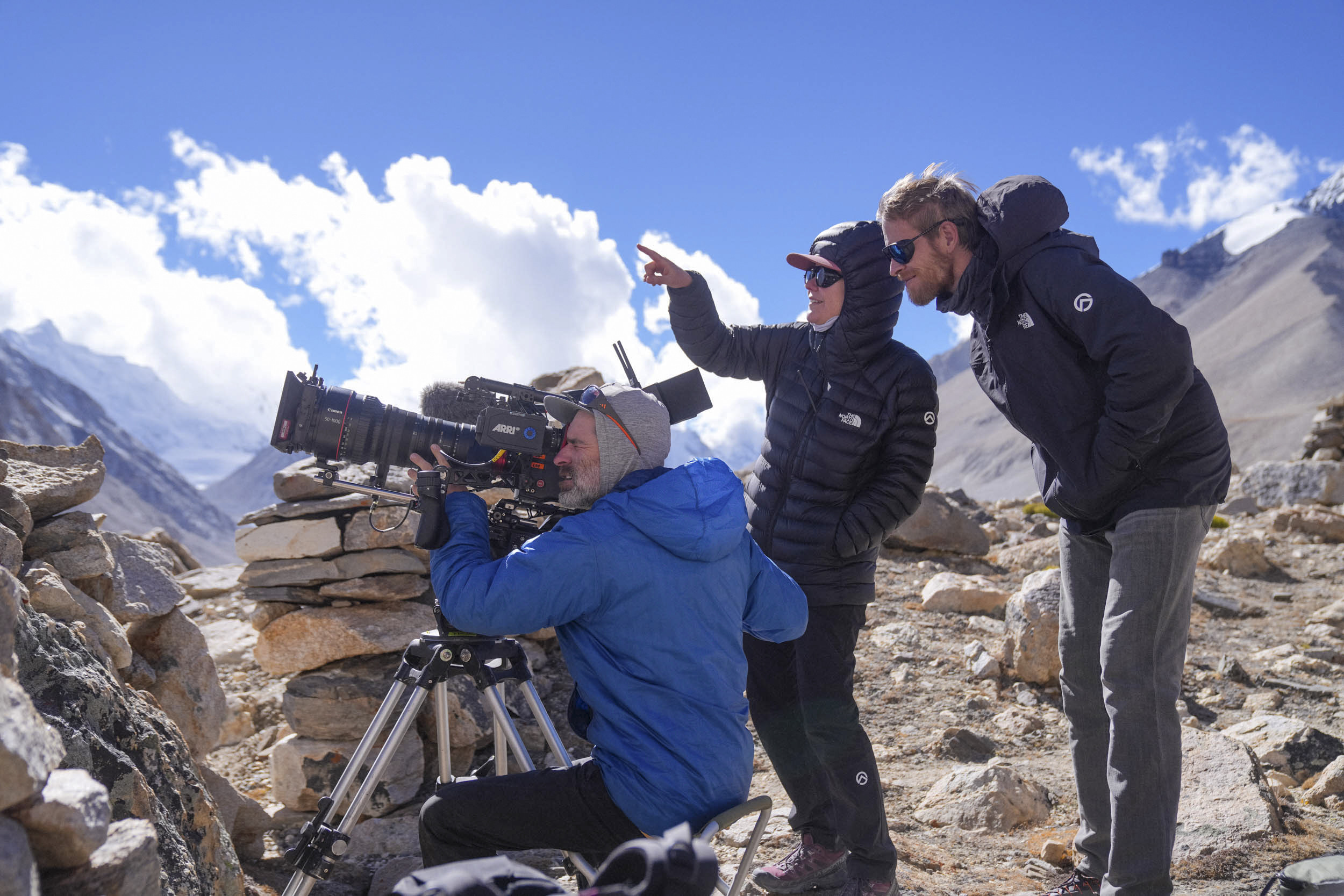
Shooting on the North Face of Mount Everest presents challenges that go well beyond the usual demands of documentary filmmaking. At altitudes where breathing becomes a physical undertaking, capturing an expedition requires preparation, adaptability and working under conditions where there are no second chances. For cinematographer Clair Popkin, Everest: The Other Side was an opportunity to document an extraordinary climbing achievement while telling an intimate story about perseverance. Working alongside directors Elizabeth Chai Vasarhelyi and Jimmy Chin, Popkin helped capture both Everest’s imposing beauty and Jim Morrison‘s deeply personal journey after the loss of his wife and climbing partner, Hilaree Nelson.
“I think the themes of grief, rebirth, recovery and keeping going are front and center in this film,” Popkin says. “Even after Hilaree was gone, she’s present in Jim’s whole journey,” Popkin says, and his goal was to keep the camera focused on the human story and “the universalities we all share rather than just the climb.” The filmmakers wanted to create something that would resonate with audiences who had never climbed a mountain. The environment itself presented a unique challenge, not only physically but also from a filmmaking perspective. “Shooting above 18,000 feet is difficult because your body is essentially breaking down from lack of oxygen, and one wrong step can be disastrous. You have to always be operating at 100%,” Popkin says.
Popkin previously worked with Vasarhelyi and Chin on the Academy Award-winning documentary feature Free Solo (2018), and had the advantage of going into Everest with a long-established creative dynamic built on trust. Though Chin and Popkin both received a director of photography credit, Chin was serving as both a co-director and a participant in the expedition, and the bulk of the cinematography was left to Popkin. The two discussed their approach, specific shots, and the overall tone and feel of the film, also working with drone operator Leo Hoorn to establish how they wanted the imagery to look. While Chin was with the summit team higher on the mountain, Popkin was stationed at Advanced Base Camp, approximately 18,000 feet up, documenting everything happening there. That included the team watching the weather, radio calls, responses to incidents higher up and the climbers’ eventual returns. The goal was to make sure every camera matched and that the footage was contributing to a cohesive story.
As Morrison continued his journey without Nelson, the visual approach naturally changed. “The story became much more internal, so the camera had to get quieter and closer,” Popkin explains. He concentrated on filming Morrison by himself during quiet moments when he was processing what had happened, journaling and reflecting. “I think the camerawork is emotionally informed. It’s about being there, close and intimate, and catching real moments in real time without a big footprint.”
Balancing the spectacle of Everest with the emotional story was another important consideration. Popkin drew inspiration from photographers Sebastião Salgado, Ansel Adams and Galen Rowell, looking at how they captured the majesty and scale of the natural world. He felt a responsibility to convey the mountain’s beauty and the almost inexplicable attraction it holds for climbers. “There’s a very real fascination with Everest, and the vast majority of people in the world will never go see it,” Popkin says. “I felt I had a duty to capture it in a real way, to impart the spirit of the mountain into the film in whatever way I could.” At the same time, he was careful not to let the scenery overwhelm the people at the center of the story. “You have to resist constantly showing how big and beautiful it is. The mountains mean something in relation to the people in them in a film like this.” That meant photographing conversations in close-ups and allowing the emotions of a scene to inform the coverage. “We never wanted the film to just be landscape photography, but the viewer needs to understand the draw of the place.”
The production also required more preparation than any documentary Popkin had previously worked on. Every camera was tested in snowy conditions in Telluride, with the footage graded at Company 3 and projected in IMAX to identify exactly where each camera might struggle. That allowed Popkin to give the high-altitude team specific instructions before they reached the mountain. “Because of that, there were very few surprises on the mountain,” Popkin says. The experience also reinforced just how much coordination and manpower an expedition of this scale requires. Even compared with Free Solo, the logistical undertaking was on another level.
For Popkin, the sequence that best captures what the film is ultimately about is reaching the summit, where Morrison and his climbing partner, Erich Roepke, along with the rest of the team, experience a moment of catharsis. But it’s also the quieter imagery that stays with him, particularly the moments when Morrison appears small within the enormous landscape. “The stuff at the end of the film, the resolution of the film and of Jim’s goal,” Popkin says, is what resonates most. It’s a fitting visual conclusion to a story in which the mountain may be the destination, but the human journey is what makes the climb worth watching.
Read more film interviews:
Punk rockers can make movies too: an interview with the star of Dark Arrows
How Shabana Azeez Stays Grounded in The Airport Chaplain
Want more inside stories of the creative people behind the latest films? Consider joining our community of donors!
